Springbok, Natal plums, Pinotage: three names on Aubergine's spring tasting menu give a compact introduction to the Cape Town restaurant. The loin arrives with beetroot noodles, a celeriac galette and chestnuts; the plums belong to the sauce. Beneath the dish sits its proposed companion, Spioenkop's 2021 ‘1900’ Pinotage. The plate already has a partner.[1]
Chef-owner Harald Bresselschmidt opened Aubergine in 1996.[2] Thirty years later, that conversation offers a useful way into a restaurant whose reputation includes a particularly serious cellar. The interest lies in what collecting wine lets a cook do with dinner: revisit a combination, accommodate a different vintage, or find a bottle that makes a familiar ingredient newly interesting.
This profile draws on the restaurant's published accounts, its menus checked on October 21, 2026, and independent reporting. The menu combinations are documented examples; the tasting judgments below belong to the named critic.
A cook settles into a house
Bresselschmidt grew up on a dairy farm in Germany's Eifel region. His training began in 1980 and took him through several European countries before he moved to South Africa in 1992 to lead the kitchen at Paarl's Grande Roche Hotel. Aubergine followed four years later.[2]
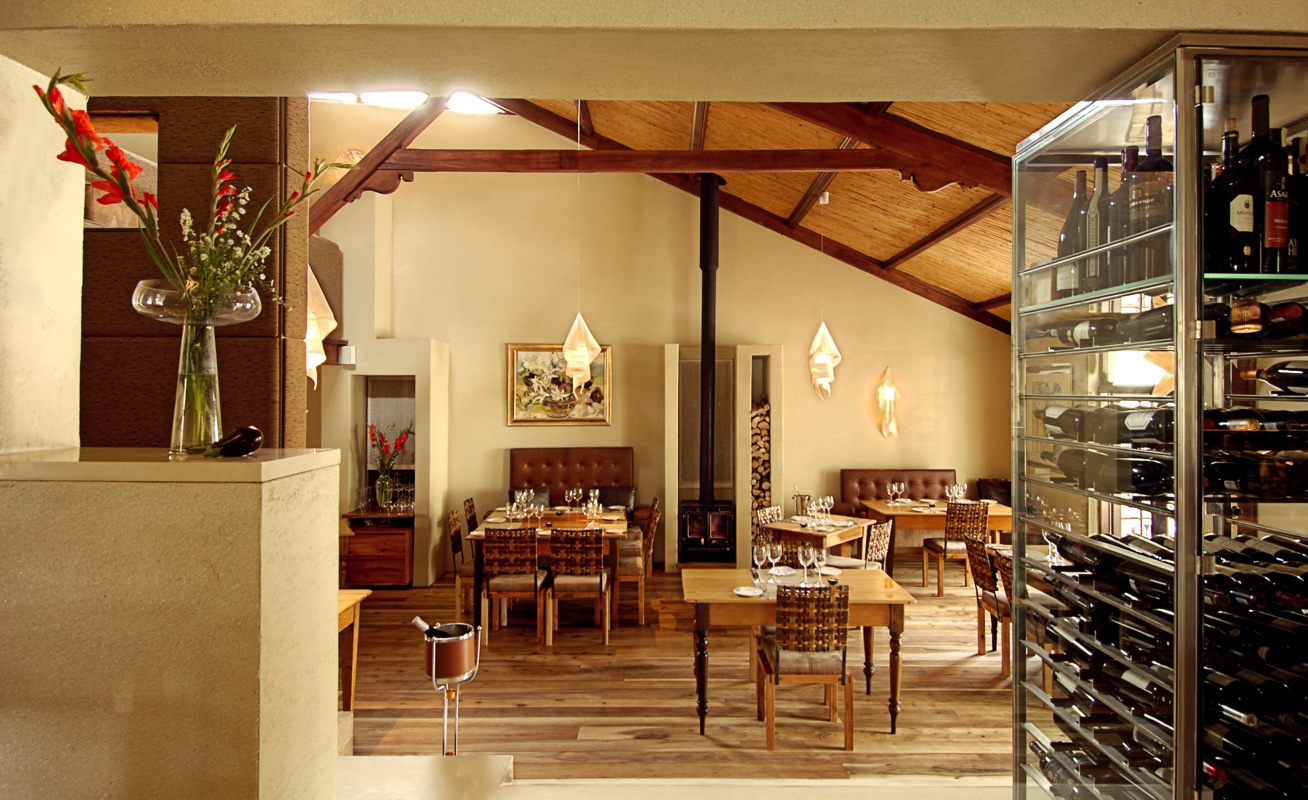
The restaurant describes its setting in Gardens through materials a guest encounters at close range: yellowwood tables, sash windows and Knysna blackwood floors. A terrace extends the room outdoors in summer; a fireplace supplies its winter center. Its account of the staff emphasizes ongoing training, including tastings and visits to winemakers for the sommeliers.[2]
What the sauce brings along
The current menu moves easily between repertoires. Ostrich comes with Spätzle and mushroom sauce. A tuna starter brings together kelp dashi gel, spiced papaya and radicchio. Those descriptions make the restaurant's stated combination of Eastern and Western influences tangible.[1]
The springbok course is especially suggestive. Reading its full description, the wine must encounter vegetables, chestnuts and a fruit sauce as well as meat. That is an interpretation of the menu's construction, rather than a tasting verdict on the pairing. It gives the sauce a consequential role: whatever it contributes reaches the next sip too.
A collection that reaches back before opening night
In her 2024 guide for Decanter, Pippa de Bruyn reported that Bresselschmidt had begun collecting wine before Aubergine opened. She also recorded its win in the inaugural South African Star Wine List Grand Prix in 2022.[3] The chronology matters. A restaurant that has held wine over time can offer a different kind of choice from one assembling its list entirely from recent releases.
That distinction is about opportunity, rather than an automatic hierarchy of quality. An older bottle still has to suit the food and the person drinking it. The useful luxury is having more possibilities available, then receiving help with the choice.
Aubergine's own wine account describes another connection to production: its special house cuvées were developed with winemakers to accompany the cooking. The list also reaches beyond South Africa, including German Rieslings and wines from several other European countries.[4] Here, a house wine carries a specific relationship between a kitchen and a producer. The chef's involvement begins before a sommelier brings the bottle to the table.
One successful pairing, one difficult meal
An older review gives that ambition a revealing test. Writing for Winemag in October 2014, Daisy Jones described an aubergine soufflé with a marinated goat's-cheese center. The recommended Colombar, La Complicité, had enough acidity to meet the cheese while leaving room for the soufflé's delicate flavor. Jones judged the pairing successful.[5]
Her verdict on the meal was much less favorable. She criticized several preparations, particularly the fish course, while praising the wines and aspects of other dishes. This was one meal twelve years ago, and it cannot establish the kitchen's performance today. It does show why a profile built around the cellar needs to keep the food in view.[5]
A successful pairing requires two things to arrive in good condition. Wine knowledge can make a mouthful more interesting; it cannot supply the missing care in a poorly executed course. Jones's account makes that distinction unusually clear because admiration and disappointment occupy the same table.
Thirty years, still something to pour
The cellar continues to attract recognition. In the 2026 World's Best Wine Lists regional results, Aubergine won the Middle East and Africa categories for long lists, Champagne and sparkling wine, and dessert and fortified wine.[6] These are awards for the wine program; their scope matters when considering the restaurant as a whole.
What makes Aubergine worth examining at thirty is the relationship beneath those distinctions. A cook collects, collaborates with producers and writes a menu; the dining room turns those accumulated choices into an evening. The springbok course brings that long history down to a manageable size: a little sauce on the fork, a sip of Pinotage, and the diner deciding how they meet.
Sources
- Aubergine, “Our Food Philosophy” — spring à-la-carte and degustation menus, checked October 21, 2026.
- Aubergine, “About” — chef biography, opening year, setting, staff training and official gallery credited to photographer Alain Proust; checked October 21, 2026.
- Pippa de Bruyn, “Cape Town: Best restaurants and bars for wine lovers,” Decanter, August 19, 2024 — Aubergine's collecting history and 2022 wine-list recognition.
- Aubergine, “Wine” — cellar philosophy, international range and special house cuvées developed with winemakers; checked October 21, 2026.
- Daisy Jones, “Aubergine – restaurant review,” Winemag, October 22, 2014 — soufflé and Colombar pairing, alongside criticism of the meal's execution.
- The World of Fine Wine, “2026 Regional Winners” — Aubergine's Middle East and Africa wins in three wine-list categories; checked October 21, 2026.