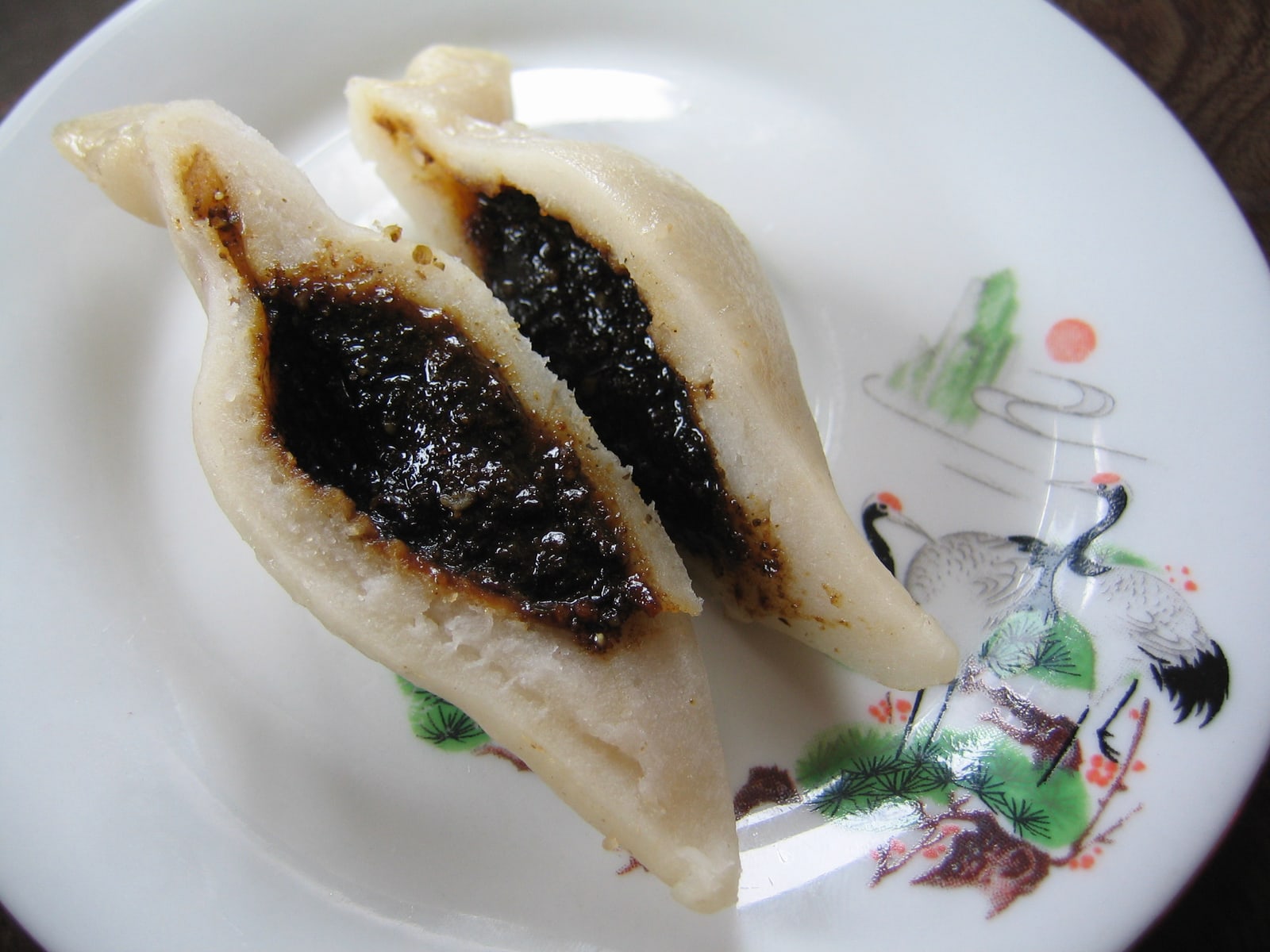
The most revealing view of a yomari is through a break in its white shell. In Ritesh Man Tamrakar's photograph, the pale dough frames a dark filling flecked with sesame: an everyday sweet with the drama hidden inside.[6] This Newar dumpling from Nepal's Kathmandu Valley gives the diner two very different materials in one mouthful. Rice flour makes the enclosure; chaku, a worked jaggery taffy, supplies the sweet center.[1]
That enclosure is worth looking at before opening it. The taper, the rounded body and the sealed end record a small piece of handwork. Once broken, the shape becomes a serving vessel for its own filling. Yomari asks the shell to be both something you eat and something that briefly holds the rest of the dish together.
The sugar has already been worked
“Molasses” appears frequently in English descriptions of yomari, but chaku has a more particular identity. Food writer Prashanta Khanal describes sugarcane jaggery being boiled, then pulled and stretched repeatedly while warm. The work makes the mass glossy and aerates it; he attributes a balancing bitter edge to caramelization. The filling therefore begins with a confection that has already demanded skill.[1]
Recipes do differ. The Nepal Tourism Board's Nepali Heritage Cook Book specifies blackstrap molasses, roasted sesame and grated coconut for its syrup mixture.[2] Read beside Khanal's account, it is a useful reminder to ask what a cook actually uses. A convenient English ingredient name can conceal a difference in preparation.
Sesame also deserves a place in the description. Against the dark sugar, the visible seeds give the filling a stippled surface. The contrast with the unadorned white shell makes a cut-open yomari look richer than its closed form lets on.
A shell shaped from the inside
The tourism board's recipe makes the sequence clear: rice flour is kneaded with boiled water and a little oil, briefly rested, then shaped into a hollow cone. Filling goes into that cavity before the dough is closed into a pointed form. The dumplings steam in a covered, perforated container; the book gives approximately 15–20 minutes, with doneness determining the finish.[2]
The cook is building an interior as well as an outline. Seen that way, a neat point is only the visible part of the task. The wall must leave room for filling and still close securely. The recipe's progression from hollow cone to sealed dumpling explains why the finished shape bears such a close relationship to how it is made.
It also changes what to notice at the table. An impressive silhouette is pleasant, but the revealing mouthful crosses the boundary between shell and center. Too much attention to the filling alone misses the rice dough that gives the sweetness its scale. The photograph makes that proportion unusually easy to see: the white edge remains a substantial part of the food.[6]
A sweet made to be shared
Yomari's best-known occasion is Yomari Punhi, a Newar rice-harvest celebration around the winter full moon. Khanal describes families making the sweets together and young people moving through their neighborhoods, singing and asking for yomari.[1] The dumpling belongs to a social exchange before it becomes an individual dessert.
A Nepali Times photo essay from December 2012 catches that generosity at an extravagant scale. Women in Kathmandu worked with 48 kilograms of rice flour to make one enormous yomari, while another group prepared ordinary portions. A procession carried the celebration through the city; after the moon appeared, the giant sweet was shared.[3]
The same report records a smaller, revealing detail: the ordinary dumplings were served hot with potatoes and pickles. Sweetness did not require a separate dessert course. On that festival plate, yomari sat beside savory food, with the whole bowl offering more than one direction for a bite.[3] It is a useful counterpoint to imagining the dish exclusively on a pastry menu, isolated under restaurant lighting.
When the center stops running
As yomari moved into regular café service, cooks began changing more than the flavor. In a 2019 report on Yomari Corner in Lazimpat, Sewa Bhattarai described traditional runny fillings being made thicker so they would stay inside when bitten. The café also offered savory versions and chocolate alongside familiar sweet fillings.[4]
That adjustment is a small but consequential design choice. A thicker center makes the dumpling tidier to eat. It also changes the moment when the shell opens: the eater encounters a filling that holds its place instead of flowing. Neither effect can be understood from an ingredient list alone. The question is what experience the cook wants the first bite to deliver.
Reporting later that year, The Kathmandu Post found a related negotiation at Village Café. Its makers had initially doubted chocolate yomari, then continued producing them because customers enjoyed them. The report also followed women earning income from yomari stalls and documented the dish's move onto year-round menus.[5] Innovation here involved working cooks, customers and livelihoods, alongside questions about inherited flavor.
Those accounts make the opened dumpling an especially good place to begin. The shell, sweetness and consistency each tell you something different. Try the rice dough with a little filling, then notice how the next mouthful changes their balance. Yomari's pleasure unfolds across that white edge and dark center, in a form made carefully enough to be handed to someone else.
Sources
- Prashanta Khanal, “The story, and history, behind yomari and chaku,” The Kathmandu Post (July 17, 2020) — chaku production, Newar identity and harvest customs.
- Nepal Tourism Board, Nepali Heritage Cook Book (May 2018), pp. 72–73 — yomari ingredients, shaping and steaming method.
- “Yummy Yomari,” Nepali Times, photographs by Min Ratna Bajracharya (December 28, 2012) — communal preparation, procession and festival serving.
- Sewa Bhattarai, “New, improved Yomari,” Nepali Times (July 18, 2019) — Yomari Corner's filling consistency and flavor experiments, as reported at that time.
- Shashwat Pant, “The growing appetite for yomaris,” The Kathmandu Post (December 12, 2019) — café adaptations, year-round menus and women's yomari businesses.
- Ritesh Man Tamrakar, “Yomari Inside,” Wikimedia Commons (December 2, 2009) — original photograph, CC BY 2.0.