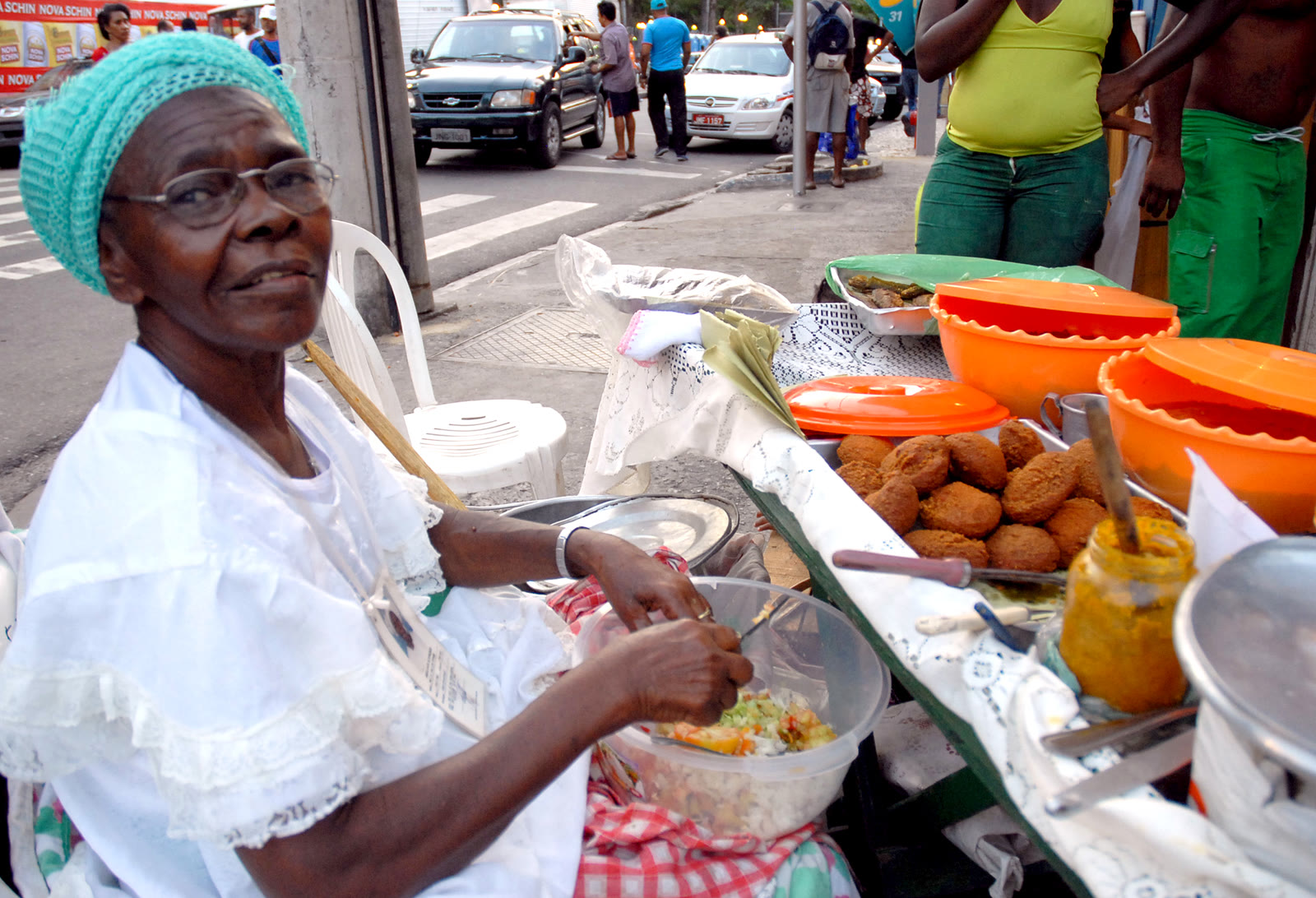
Anelita Conceição Viana sits at the curb with Salvador moving behind her. Traffic noses through a junction; passersby hover at the edge of the frame. In front of her, a tray holds a small hill of rust-gold fritters beside bright lidded tubs, bowls of fillings, folded paper and a jar stained yellow with seasoning. Her white blouse and turquoise headwrap are as legible as any chef's jacket. This is mise en place with exhaust fumes, conversation and weather in it.[9]
Look only at the acarajé and you see a remarkably engineered bite: a brittle, craggy shell; a hot, porous middle made from black-eyed peas; the deep perfume of dendê; then pepper, dried shrimp and soft, savory fillings pressing back against the crust. Look at the whole stall and the scale changes. The dish is one visible part of an institution made from religious knowledge, women's work, dress, public-space labor, memory, hospitality and split-second service.
The tabuleiro is the crucial unit of attention. It compresses pantry, fryer, pass, counter, signboard and social stage into one piece of street equipment. It also keeps the serving conditions inside the dish: heat, timing, choice and conversation all meet at the handoff.
The Atlantic lineage is a relationship, not a neat origin arrow
The family resemblance begins with akara, the black-eyed-pea fritter associated with Yoruba communities in what are now Nigeria, Benin and Togo. Akara remains plural even there. It can be breakfast, memorial food, festival food or an offering; batters and seasonings vary across cooks and occasions. National Geographic's account follows the fritter into Brazil and the Caribbean through the violence of the Atlantic slave trade, while a recent peer-reviewed study of the baianas treats acarajé as a transformed diasporic descendant rather than an unchanged export.[1][8]
Brazilian heritage research locates acarajé's roots around the Gulf of Benin and credits enslaved Africans with carrying the knowledge to Bahia.[2] But “carried” should not be mistaken for “copied unchanged.” A lineage is not a frozen recipe traveling in a sealed box. In Salvador, the fritter became entangled with local street commerce, Afro-Brazilian religious life, the dendê trade and a repertoire of accompaniments. Its history is a record of continuity made through adaptation, not evidence that one present-day version is the uncontested original.
That distinction protects both sides of the Atlantic from being flattened. Akara is not merely an early draft of acarajé, and acarajé is not simply akara with more garnish. They are relatives whose shared bean-and-air technique opens into different languages of ceremony and service.[1][2]
Beans and air make the fritter; a whole mise en place makes the service
The base sounds austere: soak black-eyed peas, remove their skins, grind them, season the paste and beat it before frying portions in oil. The cited akara recipe whips the paste, and its author notes that interiors can range from fluffy to dense. Frying fats vary across West African traditions; Bahia's heritage descriptions, by contrast, make dendê part of acarajé's stable core, staining and seasoning the crust with palm oil.[1][2][3]
At the tabuleiro, that fried core may be opened and filled with combinations of pepper, dried shrimp, vatapá, caruru and salad. Around it sit other “comidas de baiana”: abará, a related steamed bean preparation, as well as sweets and savory foods that vary by vendor.[3] The result is not a single composed plate. It is a modular service. Heat tolerance can be negotiated. A filling can be added or left out. The customer sees the fritter opened and the soft elements loaded against its crisp interior.
This is where the dish becomes especially interesting to a fine-dining cook. Texture is governed by time at every stage: soaking, peeling, grinding, aerating, frying, draining, cutting and filling. The last step begins to soften the first. There is no way to hold a fully assembled acarajé indefinitely and preserve the crackle. The vendor therefore does what a good counter restaurant does—moves final assembly close to the guest and lets service complete the cooking.
The tabuleiro turned culinary knowledge into livelihood
Bahia's heritage institute traces street selling to enslaved and freed Black women.[3] Those categories cannot be collapsed. Under slavery, gain labor could be coerced and part of a seller's earnings could be claimed by an enslaver; for freedwomen, the tabuleiro offered a route to family and terreiro livelihood and a measure of economic agency.[2][8] Across those unequal conditions, the baiana carried culinary knowledge into public exchange rather than acting as the anonymous last link in somebody else's supply chain.
The visual language matters too. Full skirts, lace, headwraps, beadwork and colors associated with personal orixás are not branding devised after the food became famous. They belong to a longer Afro-Bahian system of dress and religious meaning.[3] Nor should every baiana be forced into one static biography or degree of religious observance. A living occupation changes as practitioners, cities, markets and beliefs change.
That is precisely why Brazil's federal heritage record recognizes the Ofício das Baianas de Acarajé—the craft and occupation of the baianas—not a laminated master recipe. IPHAN's dossier records council approval at the end of 2004, and the agency describes the practice as entered in the Book of Knowledge by 2005.[2][4] Its scope ranges across sacred food, livelihood, preparation, clothing, markets, street festivals, contemporary change and safeguarding. A 2021 technical review then asked whether the practice remained recognizable under market pressure and across generations.[2][4] The recognized object is a network of verbs: sourcing, soaking, grinding, beating, frying, dressing, arranging, selling, teaching and worshipping.
Heritage should preserve agency, not trap the food in amber
There is an obvious tension in turning living food into heritage. Recognition can improve visibility and guide safeguarding; it can also tempt outsiders to police authenticity as though a vendor were a museum interpreter. A more useful boundary is that change should not erase the people whose knowledge makes the practice legible.[2][4]
That leaves room for migration and return. Carolina Alves de Brito learned Bahian foodways in Itapuã, built Acarajé da Carol in Lisbon, and opened a Salvador location in 2025. The city's account of her route describes restaurants, embassy cooking and collaborations with Portuguese chefs before the business came home.[5] This is not a fall from pure street food or a promotion into restaurant respectability. It is another circuit of work: knowledge leaving, earning, adapting and returning with its author still named.
Salvador's high-end dining makes the argument more contentious. In a 2024 report, chef Fabrício Lemos told Eater that an early Origem snack fused acarajé with abará, the steamed relative made from bean dough and banana leaf. He also recalled criticism for changing recipes rooted in the terreiros. In his account, the snack later spread across the restaurant group, but that is a history of the menu—not proof of what is being served in 2026.[6]
The criticism belongs in the lineage rather than outside it. Reinterpretation can make suppressed histories explicit; it can also turn sacred and working knowledge into somebody else's creative capital. Lemos's stated boundary was that modern cooking may move forward but cannot ignore where the food began.[6] TIME's separate profile of Origem describes the larger method: chefs Lemos and Lisiane Arouca researching Bahian ingredients and techniques shaped by African, Indigenous and European histories, collaborating with producers and engaging foods connected to Candomblé.[7] Respecting a lineage, then, need not mean miniaturizing every emblem. It can mean building research, purchasing and storytelling practices that keep the wider food culture—and the people who hold it—visible.
The service test is what the new room keeps
A chef can move acarajé indoors, adjust its scale or separate its fillings into a tasting-menu sequence. None of those moves is inherently disrespectful. The sharper test is what survives the translation. Does the batter still taste of beans and carry enough air? Does dendê remain an ingredient with its own force rather than a decorative orange drop? Is the fritter served before its crust collapses? Are the baianas and the Afro-Bahian religious history named? Does money or opportunity move back toward the knowledge network, or only toward the new dining room?
The comparison is operational, not hierarchical. A restaurant translating acarajé encounters a service that is already complete: the baiana joins technique to timing, clothing to ceremony, customization to hospitality and food to livelihood. The tabuleiro keeps heat and finishing close to the eater, lets choices happen at the handoff and makes the person with the culinary knowledge visible. A new dining room can change the scale. Its harder task is to understand how much was happening in the old one.
Sources
- Toyo Odetunde, “4 essential West African dishes and how to make them,” National Geographic Traveller, 19 October 2024 — akara's Yoruba context, Atlantic spread, technique and ceremonial uses.
- Instituto do Patrimônio Histórico e Artístico Nacional, Ofício das baianas de acarajé, Dossiê Iphan 6, 2007, cataloged by Rede Memória — ritual context, technique, dress, markets, change and safeguarding.
- Instituto do Patrimônio Artístico e Cultural da Bahia, “Ofício das Baianas do Acarajé” — street work, ingredients, dress, Candomblé ties and the tabuleiro repertoire.
- Instituto do Patrimônio Histórico e Artístico Nacional, “Ofício das Baianas de Acarajé,” 2021 technical revalidation materials — continuity, market pressure and intergenerational safeguarding.
- Salvador da Bahia, “Acarajé da Carol — de volta às origens,” updated 23 August 2025 — Carolina Alves de Brito's Salvador–Lisbon–Salvador restaurant route.
- Rafael Tonon, “In Salvador, Brazil, Chefs Rethink the Food of the Gods,” Eater, 16 February 2024 — Origem's acarajé–abará snack, the criticism around it and the restaurant's historical boundary for reinterpretation.
- TIME, “Origem,” 2024 — contemporary Bahian fine dining's research, producer and Candomblé-linked food context.
- Lébini Bossêdé Honorine Agani and Sílvia Sousa Almeida, “Acarajé como símbolo de resistência cultural: narrativas sobre o modo de saber fazer e servir,” RELACult, 2025 — peer-reviewed account of diasporic transformation, gain labor and the baianas' living craft.
- Fábio Rodrigues Pozzebom / Agência Brasil, “Baiana-acarajé-Salvador,” 2008, via Wikimedia Commons — CC BY 3.0 Brazil documentary photograph of vendor Anelita Conceição Viana.