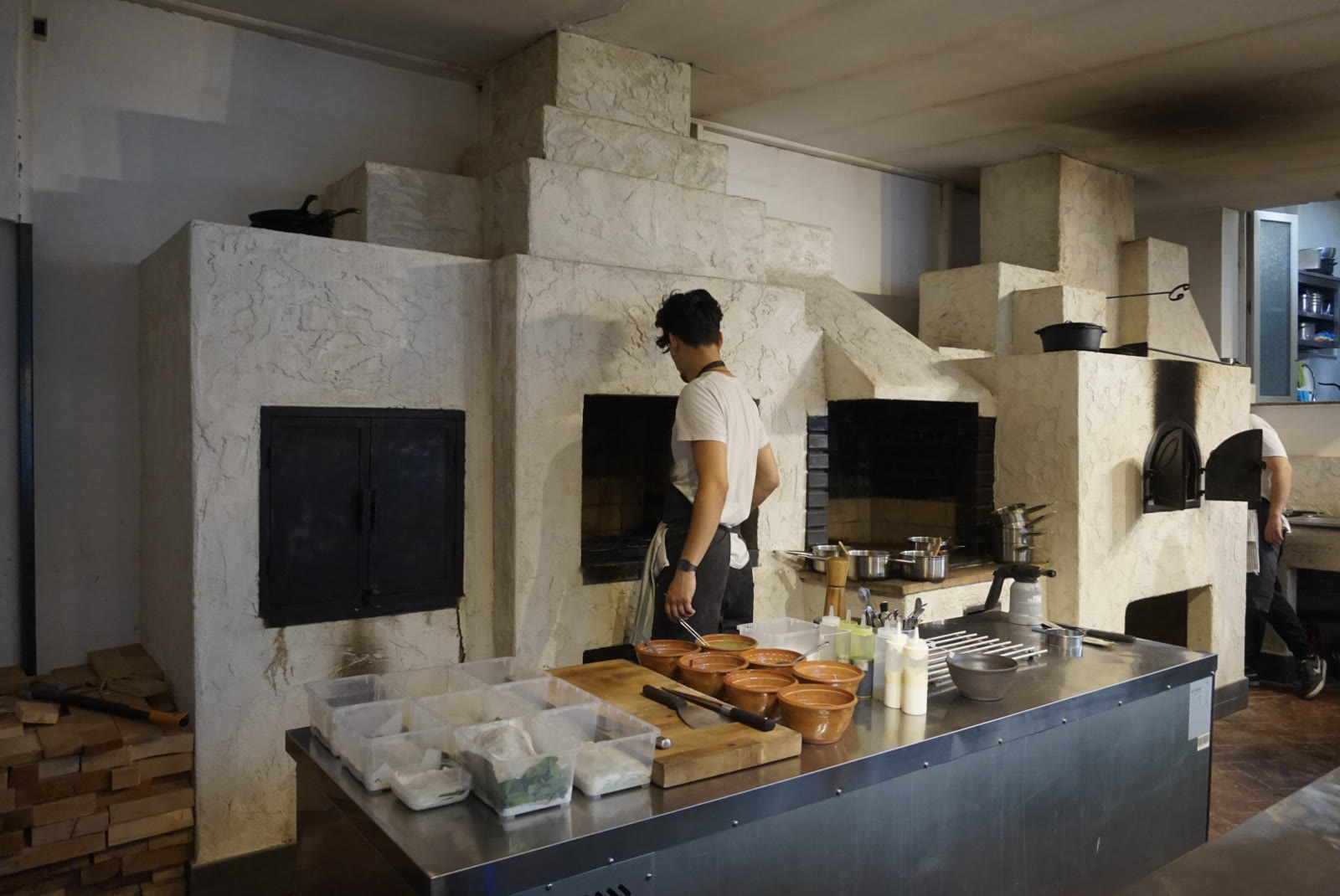
The first thing to notice in Soro Lume's kitchen is not a plated course. It is a small white landscape of masonry: squared hearths, deep black mouths, chimney stacks and iron doors, with split wood waiting at floor level and clay bowls lined across the steel pass. A cook standing between those structures looks less like the operator of one grand oven than the traffic controller for several kinds of heat.[6][7]
Across Bucharest at NOUA, the defining machinery is less visible. It lives in the route chef Alex Petricean took through ambitious kitchens abroad, then in the discipline he brought back to Romanian produce, seasonality and service. These restaurants are often grouped under the convenient heading of “new Romanian cuisine.” A better way to understand them is as two different journeys beyond the capital. Petricean went outward through international restaurant culture; Soro Lume's Mihai Toader went into villages and microregions. Both returned with methods, not souvenirs.[3][4][5]
That makes them a useful two-dinner itinerary. This is not a ranking, and it is not a report on dishes that may disappear with the next menu change. It is a way to read Bucharest as a city where fine dining is no longer obliged to choose between imported polish and a frozen picture of tradition.
The first road out runs through other kitchens
Petricean's biography can sound like a prestige roll call: the 2026 Bucharest city guide traces work through kitchens including Noma and Geranium in Copenhagen, Frantzén in Stockholm, Central in Lima, Boragó in Santiago and Quintonil in Mexico City. The important part is the repeated return. The article describes travel as a method of contrast—seeing how another restaurant treats an ingredient, a season or a service standard, then asking what the same seriousness would look like in Romania.[3]
At NOUA, that question becomes deliberately plain before it becomes elaborate. In a 2025 interview, Petricean named sour cream, dried thyme and Romanian tomato as a kind of foundational trio: inexpensive ingredients that locate a taste immediately. He also rejected preservation as stillness. Romanian cuisine, in his account, has to change with the people eating it, and global technique can help make it newly attractive without replacing its identity.[4]
That is a more interesting proposition than “traditional flavor, modern plating.” It suggests that refinement begins by deciding what must remain recognizable. A sauce can be smoother, a portion smaller and a sequence longer, but acidity, dairy richness, dried-herb perfume or the savor of a ripe tomato still has to arrive with enough force to trigger memory. Technique earns its place by sharpening that recognition, not by making the ingredient harder to name.
First dinner: let NOUA establish the grammar
NOUA's current site places the restaurant at 7 Popa Nan Street, with Wednesday-to-Saturday reservations between 18:00 and 21:00.[1] Treat those details as the fixed part and the food as the moving part. Book the formal room, but resist studying an old menu as if it were a contract. The restaurant's stated logic—Romanian cuisine, seasonal products and direct relationships with local farmers and small producers—is more durable than any one course.[1][4]
The right question during dinner is not “Would somebody's grandmother plate it this way?” Of course not. Ask instead what survived the translation. Is the sourness structural or merely a bright dot? Does a familiar herb organize the dish, or only garnish it? When a humble ingredient is processed into a fine-dining texture, does its flavor become clearer or more remote?
Petricean's more relaxed NOUA B.A.R. is a separate venue, but one documented dish there shows the wider vocabulary at work. In 2024, National Geographic Traveller described a version of storceag, the Danube Delta fish soup, made with farmed sturgeon, whey, lovage oil and green chilli. Whey supplies tang and body; lovage keeps the soup tied to a herb deeply familiar in southern Romanian cooking.[8] The example matters here not as a promise that the same bowl waits at NOUA, but as evidence that the project can move between restaurant formats without abandoning its flavor anchors.
This first dinner teaches compression. A household association, a local product and a technique learned elsewhere can occupy the same plate. Bucharest is not erased by the international grammar; it becomes the place where that grammar is edited.
The second road out leaves asphalt behind
Toader's research starts differently. He has described years spent traveling through Romanian villages and microregions with musician Bogdan Simion, looking not only at recipes but at techniques, stories, music and the people who still carry them. In a May 2026 account, he called the work continuous field research rather than a content project that begins when cameras turn on.[5]
Soro Lume gives that research physical mass. Toader has identified an Oltenian ogeac for open fire and cooking under a clay cover, a Bucovinian wood oven whose residual brick heat can carry long cooks, a monastic-style hotplate, a grill and a Transylvanian smoker. The equipment was constructed for the restaurant rather than collected as décor.[6][7] Old technique here is not a flavor adjective. It controls where the pot sits, how smoke reaches it, how fiercely heat arrives and what the bricks can still do after the flame drops.
That distinction protects the room from becoming rustic theater. “Wood-fired” is easy to print on a menu; several regionally specific heat systems are harder to operate. Each asks the kitchen to match a preparation to a thermal behavior. Direct flame blisters and chars. Embers radiate more quietly. An enclosed masonry oven surrounds. Residual heat asks for patience instead of spectacle. The restaurant's craft claim succeeds only when a diner can taste those decisions rather than merely admire the architecture.
Second dinner: sit close enough to ask what supplied the heat
Soro Lume's current site lists 33 Strada Fluierului, dinner from 18:00 to 23:00 Wednesday through Friday, and both 12:00–15:00 and 18:00–23:00 service on Saturday.[2] A 2022 local report described a counter facing the ovens, though seating arrangements can change; it is worth asking at reservation time whether the working kitchen can still be seen.[6]
Here the useful question shifts from “What remained recognizable?” to “Where did this technique come from, and what did the restaurant change?” The most revealing answer may be an appliance rather than an ingredient. If a dish carries smoke, ask whether it came from open flame, grill, enclosed oven or smoker. If something is slow-cooked, ask whether the kitchen used falling masonry heat. The answer turns a romantic fire story into a specific cooking decision.
Story still needs scrutiny. G4Food reported that a 2026 dish called “Spring in Cucuteni” grew from a village account of the 1946 drought and famine, when a family survived partly on wild plants; Toader translated that account into a plate based on nettles and spontaneous spring flora.[5] That is powerful material, but emotional provenance does not automatically make a dish good or a retelling responsible. The story should remain traceable to a person and place, the service should distinguish memory from documentation, and the food itself still has to carry more than pathos. Field research raises the standard of storytelling; it does not exempt the result from taste.
“Romanian” is plural in both rooms
The weakest reading of this route would turn authenticity into a contest: international training versus ancestral fire, city precision versus village truth. Neither chef's own account supports that split.
Petricean argues that a cuisine evolves, absorbs contemporary technique and must speak to younger diners whose tastes have already crossed borders.[4] Toader defines his “neo-Romanian” research through the many communities on Romanian territory, explicitly naming Turkish, Roma, Armenian, Székely, Hungarian, Serbian, Jewish and Tatar knowledge among the influences he encountered.[7] One looks outward and one looks inward, but both routes reveal that inward and outward were never clean opposites.
That is the real pleasure of eating these restaurants in sequence. At NOUA, a global fine-dining language is made answerable to Romanian ingredients and memory. At Soro Lume, regional equipment and fieldwork are made answerable to an urban restaurant's timing, consistency and audience. Neither is a folk museum. Neither should be excused as a cultural lecture if the cooking falls short.
Give Bucharest two evenings, not one verdict
Do not stack these dinners on the same night or reduce them to a checklist of signature plates. Start with NOUA and listen for how much flavor survives compression. On another evening, go to Soro Lume and watch how the room distributes heat before the plate arrives. The order is not a hierarchy; reversing it would reveal a different contrast. What matters is leaving enough space for one restaurant's method to settle before the other proposes its own.
The resulting portrait of Bucharest is refreshingly unfinished. The city does not need a single official form of contemporary Romanian food. It needs cooks who can show where their knowledge came from, who changed it, which parts remain alive and what the restaurant itself contributes. NOUA and Soro Lume make different claims, in different rooms, with different machinery. Together they show a capital becoming interesting not by sealing itself off, but by sending questions beyond the city and making the answers work at dinner.
Sources
- NOUA, official restaurant site — current address, reservation window, contact information and menu links.
- Soro Lume, official restaurant site — current address, service days and opening hours.
- Iulia Tronaru, “Romanian chefs trained in Europe's kitchens, back home to cook in Bucharest,” Bucharest.ro, 28 April 2026 — Petricean's training route, repeated returns and the city's contemporary dining context.
- Gabriela Dan, “Interview with Chef Alex Petricean,” Arta Albă, 7 July 2025 — local sourcing, foundational flavors, culinary evolution and the relationship between Romanian identity and global technique.
- Ana Roman, “De la sate și microregiuni la farfuria din restaurant,” G4Food, 8 May 2026 — Toader's field-research method, old techniques and the Cucuteni dish's stated provenance.
- Dragoș Mihăilă, “Soro Lume, restaurantul din București care-ți pune foc la inimioară,” B365, 8 July 2022 — documentary kitchen photograph, oven-bank construction, room layout and counter context.
- HoReCa România, “Neoromânescul gastronomic aplicat de chef Mihai Toader la Soro Lume,” 3 March 2022 — interview on the regional cooking systems, residual heat and multicultural definition of neo-Romanian food.
- Irina Georgescu, “6 must-try dishes in Bucharest, from radish roses to fondue polenta,” National Geographic Traveller, 5 March 2024 — city dining context and NOUA B.A.R.'s documented storceag preparation.