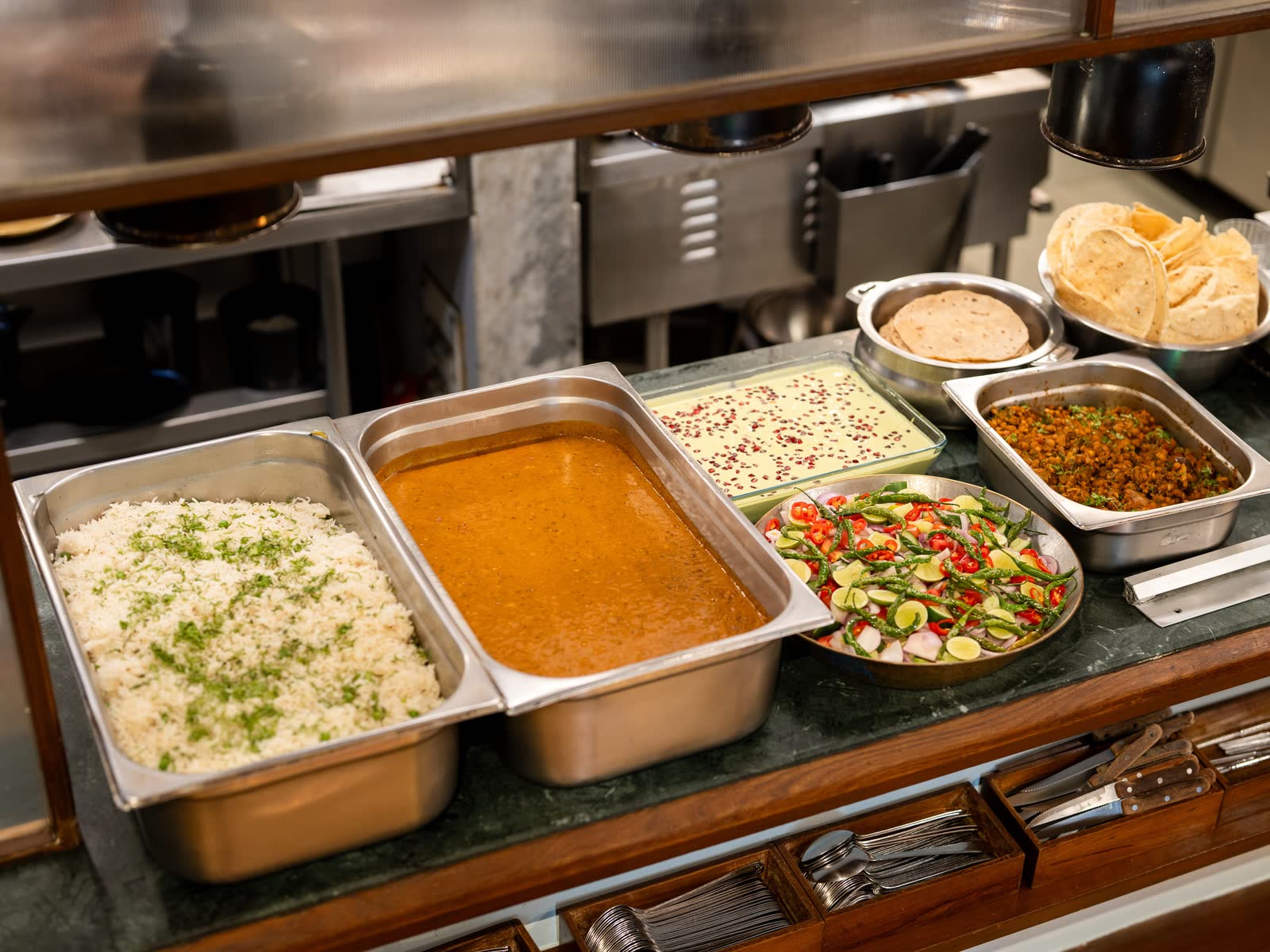
Before The Bombay Canteen opens its doors, the pass holds a second restaurant. There are broad pans of rice and dal, a bowl bright with sliced radish, cucumber, lime and chilli, stacks of flatbread and enough spoons for people who will soon be too busy to sit. Nothing has been tweezed into place. The food is ready to move in ladles.[1]
That difference in scale is the point. A dining room may be judged by the immaculate plate carried to table twelve, but its first consequential service is often the meal cooked for the people who will carry, explain, wash and reproduce every plate that follows. Staff meal—also called family meal—has a harder brief than its homely name suggests. It must be affordable without feeling punitive, fast without being careless, generous without consuming the mise en place, and familiar enough to nourish a mixed crew while leaving room for somebody's food to be new to everybody else.
Treat it as a spontaneous pot of leftovers and it becomes one more task squeezed into prep. Treat it as a miniature tasting menu and it steals labor from the night. The strongest kitchens treat staff meal as its own production: a roster, a headcount, a dietary map, a cooking window and, crucially, protected minutes in which the food can actually be eaten.
The second menu has the stricter brief
The famous counterexample to fine-dining extravagance came from elBulli. The restaurant that made guests puzzle over foams and transformations fed its own team with recognizable three-course meals. The elBullifoundation's record of Ferran Adrià's The Family Meal describes 31 menus, designed to scale as high as 75 people, cost less than €4 per person, and account for intolerances, diets, personal tastes and ingredients already in use.[2]
Those numbers strip away the romance. Feeding a brigade is purchasing and production. Seventy-five portions make a casual extra garnish into a procurement problem; one unrecorded allergy makes a communal pot exclusionary; a main dish that cannot hold for ten minutes may fail before half the front-of-house team arrives. The staff menu has to survive variables that a reservation book usually controls for paying guests.
At The Bombay Canteen and its sibling restaurants, Mint Lounge reports, senior chefs build a monthly roster. Breakfast might be idli, poha or besan cheela. Lunch follows a balanced frame of dal, vegetables, salad or raita, pickles and papad with rice and chapati; late supper becomes simpler and more indulgent. The useful detail is not any one dish. It is the change of gear across the shift. The roster acknowledges that breakfast, the pre-service pause and the post-service hunger are different operational moments.[1]
A good staff meal therefore begins before the cook reaches for a pan. How many people are present? Who cannot eat what? Which station owns the meal today? When must the burners and prep tables be released back to service? Which ingredients need using, and which must be ordered specifically because “scraps” are not a nutritionally complete menu? These questions are plain, but that is why they work. The most sophisticated part of the meal is often the schedule.
A roster turns improvisation into room for invention
Restaurant lore loves the heroic version: a junior cook opens the walk-in, rescues trimmings and somehow produces a feast. Resourcefulness matters. Michelin's reporting from Singapore shows cooks turning peach tops left after guest portions into a staff dessert, and its wider account of the custom ranges from using surplus product to buying ingredients for a colleague's hometown dish.[3] But rescue should be a technique, not the entire budget.
The distinction is dignity. If staff meal receives only what could not be sold, the hierarchy of the restaurant remains visible on the plate. If every ingredient is ordered specially, the kitchen may waste good surplus and miss a daily lesson in whole-product use. The intelligent middle is planned flexibility: staple rice, pulses, vegetables and seasonings provide a reliable floor; safe, sound trimmings can change the meal; a small allowance lets the assigned cook complete an idea instead of disguising scarcity.
Rosters make that middle possible. At Singapore's Meta, Michelin describes a weekly schedule pairing two or three chefs each day. They can cook the food of their childhoods, try an unfamiliar dish, or use offcuts and leftover produce, while the sous chefs keep responsibility visible.[4] At The Bombay Canteen, a senior-chef roster serves a similar purpose.[1] Assignment changes “someone should feed everyone” into a named piece of mise en place.
It also opens a low-stakes teaching kitchen. A prep cook can practice scaling seasoning across a deep pan rather than a sauté pan. A dishwasher or server can introduce a dish the brigade's formal hierarchy would never ask them to cook. Michelin's history of the custom records both possibilities: staff meal as a place for junior cooks to sharpen skills and as a chance for people outside the cooking ranks to share food from home.[3] The lesson travels in both directions. Technique moves down the brigade; taste and cultural authority can move up it.
Sometimes the guest menu benefits. Mint Lounge recounts how smoked tilapia brought from Manipur for staff meal at Sienna Calcutta was improvised into a rice-roti taco and later entered the restaurant's menu.[1] Celera in Manila uses staff meal to test sambals, broths, pickles and spice pastes, according to Michelin.[4] Yet this is where management has to resist extracting value from every pause. Staff lunch may generate an idea, but it should not have to audition for the dining room to justify its cost. Feeding people is already productive.
Sitting down changes the handoff
The photographic evidence from Mumbai stops just before the most fragile part. The food is ready, but will the crew be given time to eat it? A beautiful buffet taken back to stations between prep jobs is fuel, not a shared meal. That may be the only workable format on some days, but the difference should not disappear behind the word “family.”
Several kitchens make the pause explicit. The Bombay Canteen encourages people to wait for one another and eat without scrolling. At Celera, Michelin reports, phones go away, burners go off and the team sits together before service.[1][4] Those details are more persuasive than a speech about camaraderie. A switched-off burner says the break outranks production for a few minutes. A put-away phone says attention is part of the meal. A chair says eating is not another task to perform standing.
Front and back of house also meet here without the choreography imposed by guests. The server encounters the cook's comfort food; the pastry chef eats beside the porter; a new team member learns whose chilli threshold is not universal. That contact cannot erase rank, but it can give the coming service a little more shared vocabulary. The kitchen is no longer an anonymous hatch, and the dining room is no longer a stream of modifications arriving from elsewhere.
This is why the menu need not resemble the food sold that night. At 7th Door in Seoul, chef Kim Dae-chun's mother prepares home-style banchan for the staff on three busy days each week: rice, stews, kimchi, seasoned vegetables and braised or stir-fried sides served in compartment trays.[4] The practical luxury is not that employees receive a secret Michelin-level composition. It is that somebody has designed one dependable, substantial meal around the reality of a hard shift.
“Family” is a ritual, not an employment category
The name deserves resistance. Restaurants often describe themselves as families because the hours are intimate, the pressure is shared and the meal feels domestic. But a workplace still owes workers the clarity a family metaphor can blur: pay, safety, breaks, boundaries, routes for complaint and the right to leave without betrayal.
That boundary is especially important in fine dining now. Associated Press reporting on the 2026 reckoning around Noma placed allegations of abuse and unpaid labor beside the industry's entrenched brigade hierarchy and the prestige that can keep junior workers silent.[5] A generous curry cannot compensate for coercion. Twenty pleasant minutes cannot validate the other twelve hours. Calling everyone equal at the staff table means little if the organization makes them disposable when they stand up.
This does not make the ritual false. It makes the evidence specific. Staff meal can show that a restaurant planned food for its employees, recognized dietary needs, assigned labor, protected a pause and allowed knowledge to cross ranks. Those are real achievements. It cannot, by itself, prove that the workplace is just.
The best version is modest about that limit. It does not ask a tray of rice to perform the work of human resources, and it does not turn care into branding for guests. It simply feeds the whole crew well, on purpose, before asking them to create hospitality for somebody else.
Back at The Bombay Canteen, the open cutlery drawers beneath the food are the image's quiet center. The spoons are not polished into table settings or carried on a silver tray. They wait in rows for working hands. Soon the hotel pans will empty, the pass will be cleared and another menu will take over. The first service will vanish so the public one can begin. That invisibility is not a reason to sentimentalize staff meal. It is a reason to operate it properly.
Sources
- Rituparna Roy, “What's cooking for staff meals at India's restaurants?” Mint Lounge, April 4, 2026 — reporting on meal rosters, shift-specific menus, shared-table customs, ingredient use and the staff-meal photograph from The Bombay Canteen.
- elBullifoundation, “The Family Meal” — official account of the book's 31 staff menus, cost target, dietary planning, ingredient use and origins at elBulli.
- MICHELIN Guide, “Feeding the Family” — history and operating range of restaurant staff meal, from surplus use and special purchasing to skills practice and dishes contributed across job roles.
- MICHELIN Guide, “Feeding the Family: An Inside Look at Staff Meals in Asia's MICHELIN Restaurants” — current examples of rosters, cooking pairs, protected pauses, multicultural menus, ingredient use and staff-meal learning at Meta, Celera, 7th Door and other restaurants.
- Laurie Kellman, “Out of the frying pan? Noma's René Redzepi resigns, and fine dining confronts ‘brigade’ culture.” Associated Press, March 14, 2026 — reporting on hierarchy, labor, allegations of abuse and the industry's debate over kitchen culture.