As of April 22, 2026, the Federal Reserve Banks were still carrying $243.057 billion in "Earnings remittances due to the U.S. Treasury," a negative balance that represents the system's cumulative deferred asset.[1] Priced is the scary headline: the Fed stopped sending weekly remittances to Treasury and is sitting on a nine-figure accounting hole. New is narrower and more useful. The 2025 audited statements show that the hole stopped widening at anything like 2024 speed: net interest expense narrowed to $12.082 billion in 2025 from $68.010 billion in 2024, and the late-April H.4.1 release shows the deferred-asset balance sitting only slightly below the $243.481 billion reported at year-end 2025.[1][2]
The temptation is to read that line as hidden insolvency, stealth monetization, or a fiscal alarm bell that must force policy behavior. The Federal Reserve's own accounting treatment points to something more specific. When Reserve Bank earnings are insufficient to cover operating costs, dividends, and surplus requirements, remittances to Treasury are suspended and the shortfall is booked as a deferred asset to be worked off by future net earnings before remittances resume.[1][3] What sits on the balance sheet is therefore a claim on future earnings, not a demand for an immediate Treasury recapitalization.[3]
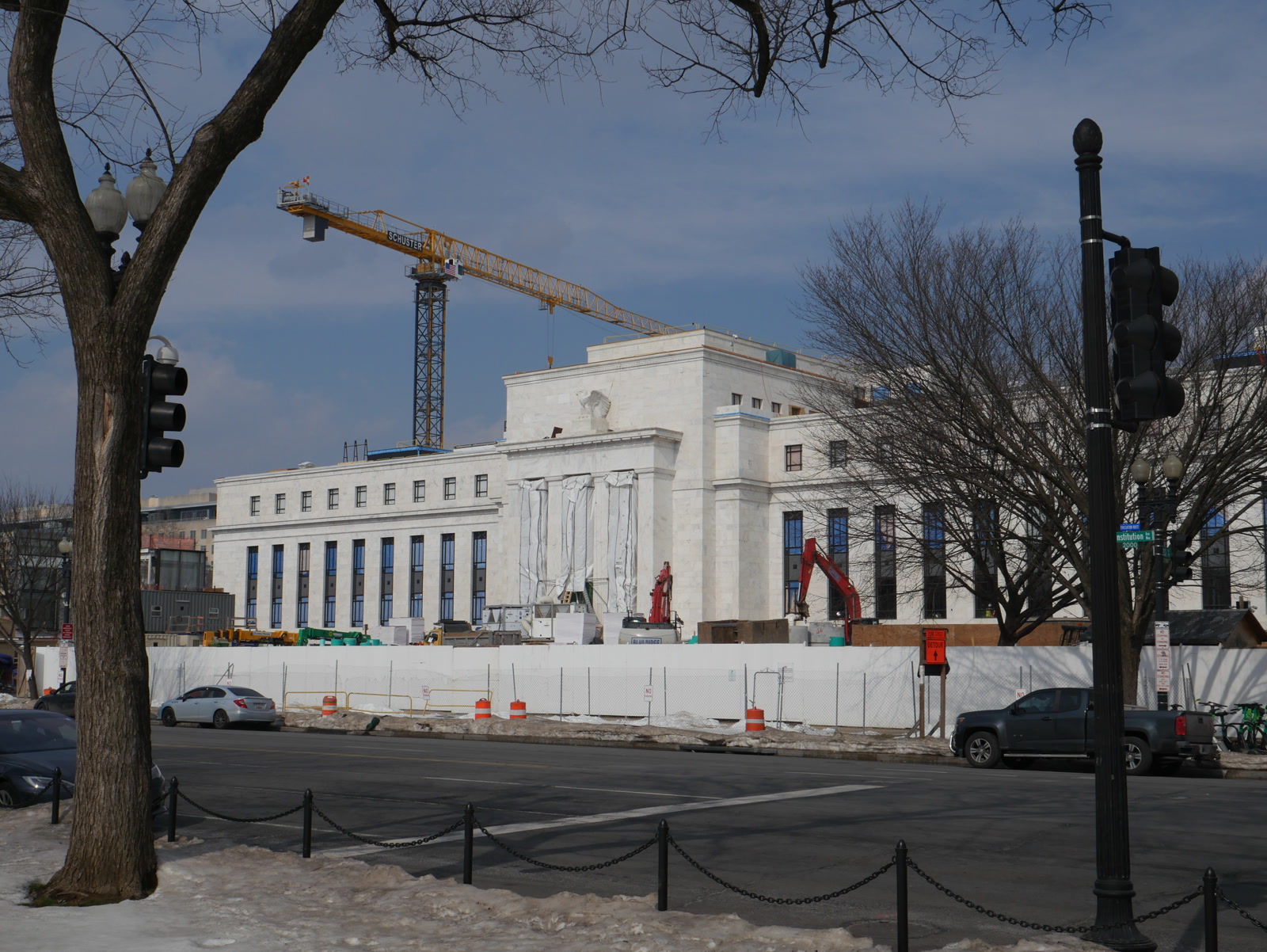
Image context: the cover uses a real 2026 photograph of the Federal Reserve building in Washington rather than a glowing market-chart graphic. That is the right anchor because the issue here is institutional sequence: how a central bank with a very large fixed-income portfolio records a period of negative net income while policy rates remain high enough to keep liability costs elevated.[6]
How the deferred asset actually works
The mechanics are plainer than the rhetoric around them. The H.4.1 footnote says the Reserve Banks remit residual net earnings to the U.S. Treasury after covering operating costs, dividends, and the amount needed to maintain surplus. Positive numbers on the remittances line mean estimated weekly payments due to Treasury. Negative numbers mean a cumulative deferred-asset position that future net earnings must first erase before remittances can restart.[1]
That sequencing matters. The Reserve Banks do not keep sending Treasury a smaller weekly check while they are below zero. They send nothing, and the accounting balance accumulates until future earnings first bring that line back to zero and then turn it positive again.[1][3] The phrase "deferred asset" is clumsy, but it is directionally accurate: the line records earnings that have already been spoken for.
Why the losses showed up in the first place
The mechanism is mostly interest-rate math. The Board's 2022 balance-sheet note explains that Fed interest income reacts slowly because the asset book is dominated by longer-duration Treasury securities and agency mortgage-backed securities purchased when yields were lower. Interest expense reacts quickly because it runs through administered rates on reserves and other short-term liabilities.[3] Once the policy rate rose sharply after the pandemic asset-purchase wave, the liability side repriced faster than the asset side.[3]
Scale amplified that mismatch. By the end of pandemic-era purchases in March 2022, the SOMA portfolio had reached about $8.5 trillion, more than double its size two years earlier.[3] Even after rates had come down from peak levels, the March 18, 2026 implementation note still left the federal funds target range at 3.50%-3.75% and the interest rate on reserve balances at 3.65%.[4] That is why the story cannot be reduced to "the Fed owns lots of bonds." The live variable is the spread between slowly resetting asset income and quickly resetting liability cost.
Why 2025 changed the discussion
The 2025 combined statements are the important reset. Total interest income was $155.299 billion. Total interest expense was $167.381 billion. Net interest expense therefore came to $12.082 billion, still negative but far less negative than the $68.010 billion reported for 2024.[2] Inside that expense line, the largest item remained "Depository institutions and others," but it fell to $147.662 billion from $186.478 billion a year earlier.[2]
That does not mean the system is back to normal. The deferred asset still rose to $243.481 billion at December 31, 2025, up from $215.955 billion a year earlier.[2] But it does mean the character of the story changed. The debate is no longer whether the Fed can record negative net income; the statements already answered that. The better 2026 question is how quickly lower short rates and ongoing balance-sheet runoff let the accounting IOU stop growing and then start shrinking in a durable way.
Six numeric anchors
- Current deferred-asset reading: the April 23, 2026 H.4.1 release showed -$243.057 billion on the remittances line for April 22, 2026, which the Fed's own footnote defines as the cumulative deferred-asset balance when the figure is negative.[1]
- Year-end stock: the 2025 audited statements reported a deferred asset of $243.481 billion, up from $215.955 billion at December 31, 2024.[2]
- Income versus expense: 2025 total interest income was $155.299 billion and total interest expense was $167.381 billion.[2]
- The rate-sensitive liability cost: interest expense for "Depository institutions and others" was $147.662 billion in 2025, down from $186.478 billion in 2024, which is the cleanest sign that rate pressure eased even before remittances resumed.[2]
- The loss rate slowed sharply: net interest expense improved to $12.082 billion in 2025 from $68.010 billion in 2024.[2]
- Policy rates still matter directly: as of the March 18, 2026 implementation note, the fed funds target range remained 3.50%-3.75% and the IORB rate remained 3.65%.[4]
Together, those anchors say the system is still underwater on remittances, but the underwater rate is much slower than it was a year earlier.
Strongest counterweight
The strongest pushback is that "timing issue" can still sound too casual. Treasury used to receive very large Federal Reserve remittances. The Board's 2022 note says they averaged around $90 billion per year from 2010 to 2017, then hit a record $109 billion in 2021.[3] When that stream stops, the fiscal effect is real even if it does not create a solvency event for the central bank.
There is also no guarantee that the repair path stays smooth. If inflation or funding conditions keep short rates higher for longer, or if reserve balances remain large enough that interest expense stays sticky, the deferred asset can sit on the books for years.[2][4] That would still be an accounting bridge into future remittances, but it would be a long bridge.
Falsifier
This repair-speed framing is wrong if the next several quarters show that 2025 was only a pause in the deterioration. Concretely, if policy rates stop easing or move back up, if the weekly H.4.1 line starts compounding materially more negative than the current $243 billion area, and if the next annual or quarterly financial statements show net interest expense widening again from the 2025 level, then the claim that the live issue is pace of repair rather than renewed slippage will have been too generous.[1][2][4][5]
Watchlist
- April 29, 2026 FOMC implementation note: the immediate question is whether the target range and IORB settings change, because the liability cost on reserves still feeds straight into Fed interest expense.[4]
- Each Thursday H.4.1 release in May 2026: the single most useful line is still the weekly remittances figure, because it shows whether the deferred asset is drifting, stalling, or beginning to heal.[1]
- June 16-17, 2026 FOMC meeting: a further rate cut would not repair the deferred asset overnight, but it would keep pressure moving in the right direction on the liability side.[4]
- The next Federal Reserve quarterly financial report: the Board's March 25 audited-statements release explicitly points readers to weekly and quarterly balance-sheet reporting, and that broader snapshot will show whether 2025's improvement is carrying forward beyond one annual print.[5]
Takeaway
The cleanest way to read Fed remittances in 2026 is through duration mismatch and accounting sequence, not through the language of insolvency. The deferred asset was created by an unusually large fixed-rate asset book sitting against short-rate-sensitive liabilities after the post-2022 hiking cycle.[1][2][3] It still matters, because Treasury is foregoing cash it once received routinely. The higher-signal question now is narrower: whether 2025's sharp improvement in net interest expense becomes the first leg of a long repair process, or whether the accounting hole starts widening again.
Sources
- Board of Governors of the Federal Reserve System, "Federal Reserve Balance Sheet: Factors Affecting Reserve Balances - H.4.1 - April 23, 2026" — weekly remittances line, deferred-asset footnote, and April 22, 2026 balance.
- Board of Governors of the Federal Reserve System, Federal Reserve Banks Combined Financial Statements 2025 — deferred asset, interest income, interest expense, and net interest expense.
- Board of Governors of the Federal Reserve System, "An Analysis of the Interest Rate Risk of the Federal Reserve's Balance Sheet, Part 1: Background and Historical Perspective" (July 15, 2022) — deferred-asset mechanics, duration mismatch, and remittance history.
- Board of Governors of the Federal Reserve System, "Implementation Note issued March 18, 2026" — current target range and IORB setting.
- Board of Governors of the Federal Reserve System, "Federal Reserve Board releases annual audited financial statements" (March 25, 2026) — release timing and links to weekly and quarterly reporting.
- Wikimedia Commons, "File:Federal reserve building 1160435.jpg" — source page for the Washington Federal Reserve building photograph used as the article image.