American Express did not need to prove in April 2026 that affluent customers still spend. The market already knew that part. What felt new in the first quarter was the speed and composition of the spend. Billed business rose to $428.0 billion, up 10% year over year, card-member spending growth reached its highest quarterly pace in three years, and diluted EPS rose 18% to $4.28 while the company still reaffirmed full-year guidance.[1][2][4]
That combination matters because it tightens the finance question. Priced was that American Express would keep acting like a premium payments-and-credit franchise. New was that younger-affluent engagement and fee growth accelerated at the same time management chose to carry a heavier benefits and refresh cycle. The next proof is no longer simple demand health. It is whether that demand can keep absorbing the cost of richer value propositions without bending margins or credit quality.[1][2][3][4]
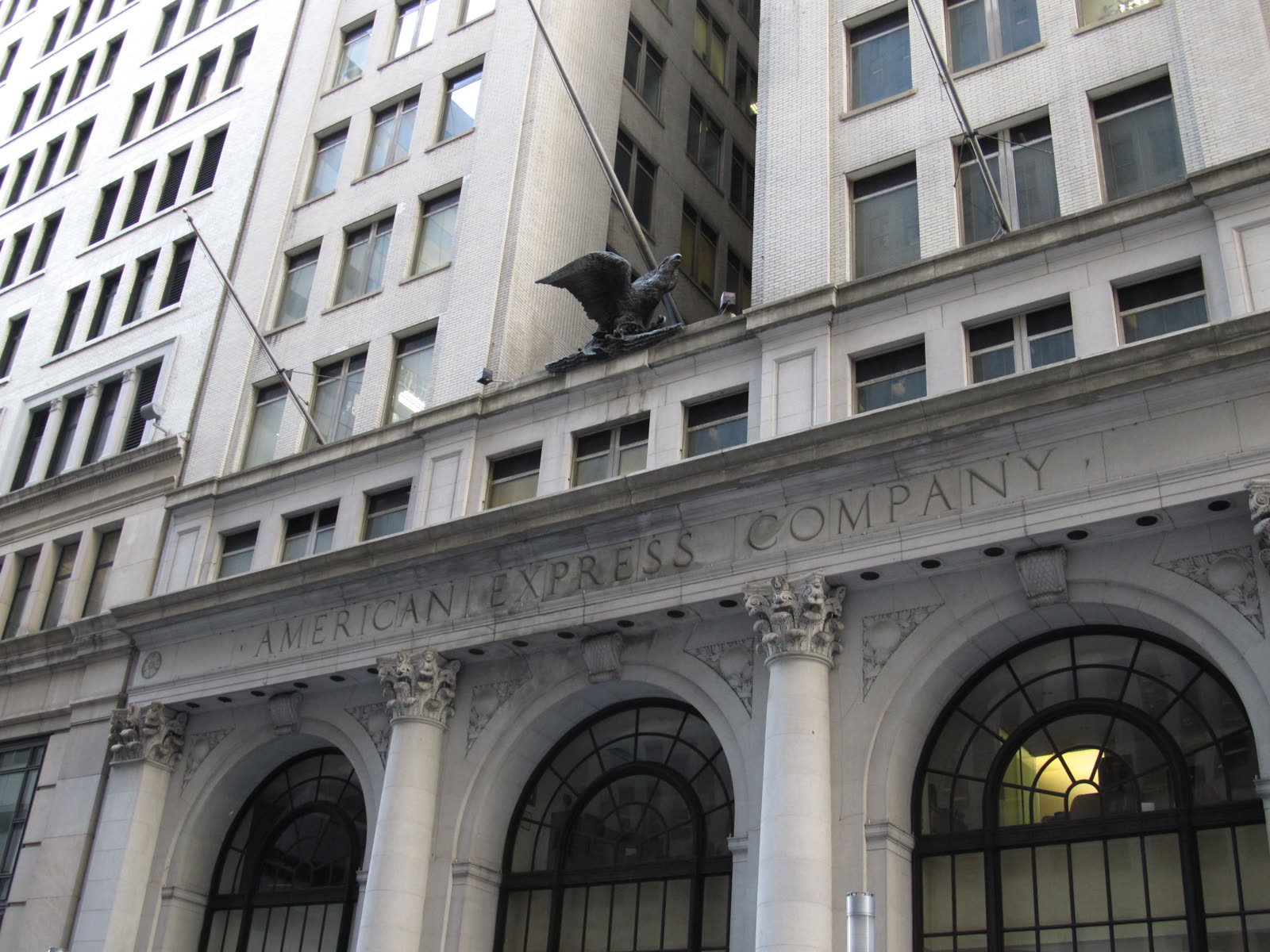
Image context: this archival American Express building photo belongs here because the quarter's signal came from the institution's long-built membership machine. The story was not a one-off macro bounce. It was premium-card demand, fee power, and the company's willingness to spend behind the brand at scale.[9]
Why this quarter landed differently
The mechanism ran through three linked lines. First, spending accelerated. The earnings release said Card Member spending grew 9% on an FX-adjusted basis, the fastest quarterly pace in three years, while the 10-Q shows billed business up 10% on a reported basis.[1][4] Inside that mix, U.S. Consumer Services billed business rose 10%, and management pointed directly to continued momentum from Millennial and Gen-Z Card Members plus an acceleration in U.S. Platinum spend.[2][4]
Second, the higher-spend customer was worth more on the fee line, not only on swipe volume. Net card fees reached $2.752 billion, up 18% year over year, with both the presentation and the 10-Q tying that gain to growth in the premium card portfolios.[2][3][4] That is the cleaner signal than raw billed business alone. It says the company is still adding customers who accept the annual-fee contract rather than only transacting more through an existing base.
Third, American Express did not harvest the quarter by cutting back on investment. Consolidated expenses rose 11% to $13.9 billion, and the company explicitly tied that increase to higher variable customer engagement costs, the U.S. Platinum Card refresh, stronger usage of travel and lifestyle benefits, and higher operating expenses.[1] The presentation shows variable customer engagement expenses at $8.457 billion, up 17%.[2] CEO Stephen Squeri then went a step further, saying the company would increase investments in marketing and technology to capitalize on long-term growth opportunities even after a strong quarter.[1]
That is why the quarter deserves a narrower reading than a standard beat. American Express posted faster spend, faster fee growth, and better earnings while leaning into costed-up premium servicing rather than hiding from it.
Six numeric anchors
- Top-line acceleration: total revenues net of interest expense reached $18.907 billion, up 11%, or 10% on an FX-adjusted basis.[1][2][3][4]
- Bottom-line follow-through: net income rose to $2.971 billion, and diluted EPS rose to $4.28 from $3.64.[1][2][3]
- Spend pace improved: billed business reached $428.0 billion, up 10% reported, while FX-adjusted Card Member spending growth was 9%, the highest quarterly pace in three years.[1][2][3][4]
- Younger-affluent demand stayed hot: U.S. Consumer Services billed business rose 10%, with Q1 billed business growth of 38% for Gen-Z Card Members and 13% for Millennials.[2]
- Fee power outpaced the base: net card fees reached $2.752 billion, up 18%, reflecting growth in the premium card portfolios.[2][3][4]
- Credit and capital stayed controlled: the principal-only net write-off rate for consumer and small business card balances improved to 2.0% from 2.1%, while the CET1 ratio held at 10.5% and the company repurchased 5 million shares in the quarter.[1][3][4]
Those anchors explain why the quarter can support a constructive read without becoming a blank-check quarter. Demand was real, monetization improved, and credit stayed clean enough to let the company keep investing.
Strongest counterweight
The strongest counterweight is that some of the quarter's good news arrived with an embedded cost obligation. American Express said expenses rose because of the U.S. Platinum refresh and higher travel-and-lifestyle benefit usage, and the presentation's 17% rise in variable customer engagement expense shows that premium spend is not free to serve.[1][2] If the company keeps widening lounge access, sports partnerships, dining inventory, and commercial-product coverage, the market will eventually want proof that the fee and spending lift lasts longer than the refresh bill.
There is also a mix boundary inside the operating segments. U.S. Consumer Services billed business grew 10%, but Commercial Services billed business rose only 4%.[3][4] That split does not break the quarter. It does mean the loudest strength came from premium consumer demand rather than from a broad-based step-up across every business line.
Falsifier
This bullish read weakens if the next two quarters show premium spending still growing while fee growth slows, variable customer engagement costs stay elevated, and credit starts drifting the wrong way. Concretely, if billed business holds up but net card fees lose momentum, principal-only write-offs move back above the recent 2.0% level, and expense growth keeps tracking revenue point for point, then this quarter will read less like operating leverage with investment and more like a temporary high-cost refresh window.[1][2][3][4]
Watchlist
- May 5, 2026: American Express will hold its 2026 Annual Meeting of Shareholders. Management commentary on investment pace, premium-product refreshes, and commercial growth will matter more than routine governance items.[7]
- May 8, 2026: the newly raised quarterly common dividend of $0.95 per share is payable. It is a small but concrete check on capital-return confidence after the Q1 print.[8]
- July 24, 2026: American Express has already scheduled its second-quarter 2026 earnings call for 8:30 a.m. ET. The key lines are billed business, net card fees, variable customer engagement costs, and the principal-only net write-off rate.[6]
Takeaway
American Express delivered a stronger quarter than the old premium-customer script alone would suggest. Billed business rose 10%, net card fees rose 18%, EPS rose 18%, younger cohorts remained unusually strong, and credit stayed orderly.[1][2][3][4] The next test is more specific: whether the company can keep turning that younger-affluent demand into durable fee and spending growth while absorbing the richer benefits, refresh, and technology spending needed to defend the franchise.
Sources
- American Express, "Q1 2026 Results" earnings press release PDF (April 23, 2026).
- American Express, "Q1 2026 Earnings Presentation" PDF (April 23, 2026).
- American Express, "Q1 2026 Earnings Tables" PDF (April 23, 2026).
- American Express, Form 10-Q for the quarter ended March 31, 2026 (filed April 23, 2026).
- American Express, 2025 Annual Report PDF.
- American Express, "American Express Announces Fourth-Quarter 2025 and 2026 Earnings Conference Call Dates - UPDATED*" (December 19, 2025).
- American Express, "American Express Updates First-Quarter 2026 Earnings Date and Plans to Host Live Audio Webcast of Annual Meeting of Shareholders" (March 4, 2026).
- American Express, "American Express Board Authorizes 16 Percent Increase in Common Shares Dividend" (March 2, 2026).
- Wikimedia Commons, "American Express Building (65 Broadway) (7237043610).jpg".