As of 2026-03-31 UTC, Lululemon's fourth quarter did two jobs at once. It beat the company's own setup on revenue and EPS, and it showed that the brand still has real pull outside North America. It also made the next valuation problem hard to dodge: fiscal 2026 revenue is guided up 2% to 4%, but diluted EPS is guided down to $12.10 to $12.30 from fiscal 2025's $13.26. In other words, the company is still growing, but management is signaling that growth will be expensive to protect while North America is reset toward better full-price selling and cleaner brand health.[1]
That split is why this quarter matters. The market no longer needs proof that Lululemon can open stores abroad or generate enthusiasm in China Mainland. The market now needs proof that the company's biggest profit pool can recover without living on markdowns, inventory creep, and leadership-transition patience.[1][2]
Priced vs new
Priced: investors already knew North America had become the soft part of the story, and the company had already moved into an interim leadership structure while the board searched for its next CEO.[1][2]
New: the quarter showed that international growth is not the problem. International net revenue grew 17% in Q4 and comparable sales grew 20%; China Mainland alone grew 24% in Q4 and 29% for the full year. Yet management still guided FY2026 EPS below the FY2025 result and explicitly said the outlook does not incorporate unknown future tariff or macro impacts. That means international strength is real, but not yet strong enough to offset margin and execution pressure elsewhere.[1]
Mechanism: why the quarter beat did not settle the stock
1. International still carries the growth story
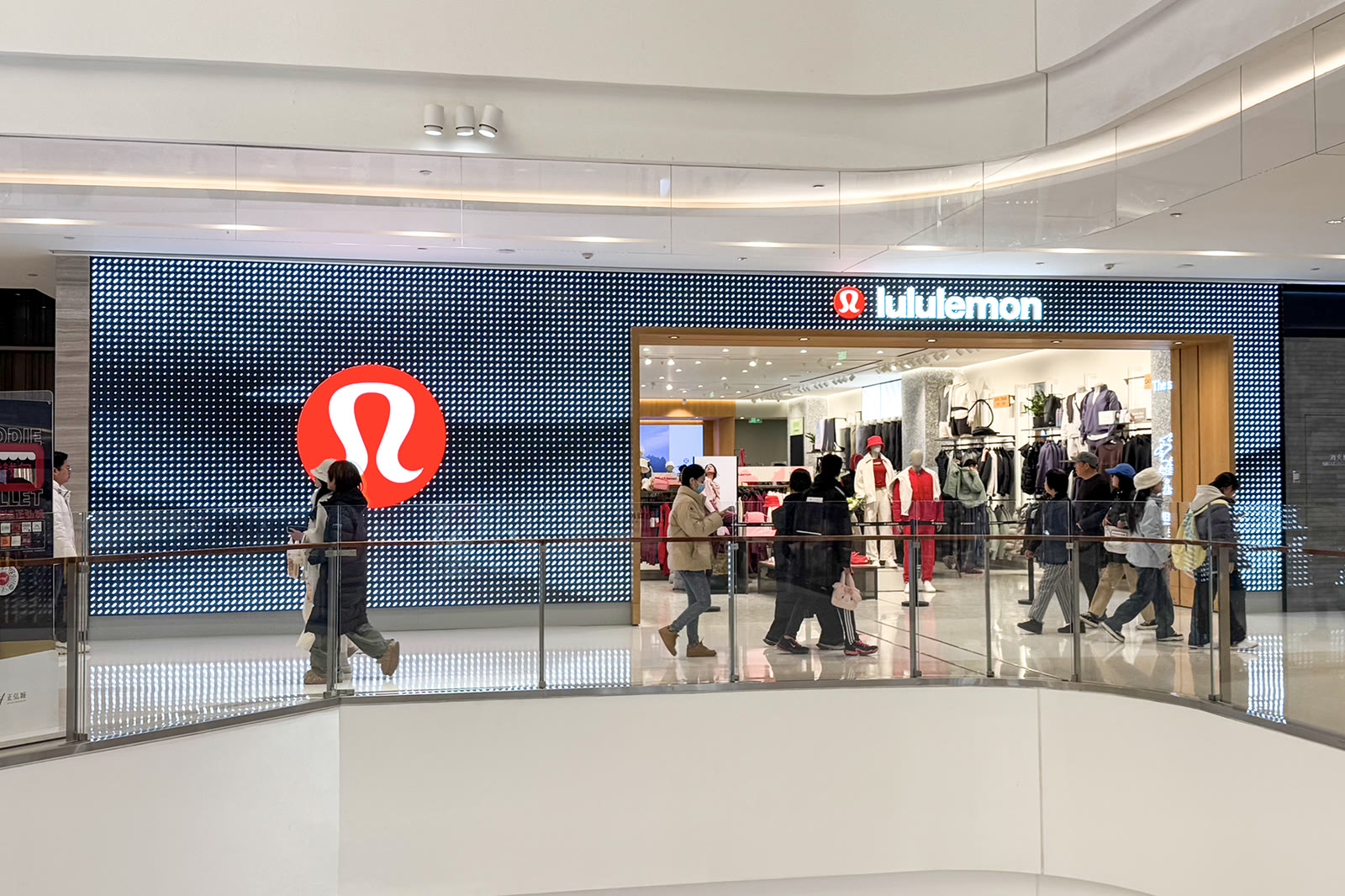
The cleanest bullish read from the release is that Lululemon's brand remains productive where store expansion and traffic are still in build mode. Q4 international net revenue rose 17%, comparable sales rose 20%, and China Mainland continued to outgrow the rest of the company.[1] The storefront image from Zhengzhou is useful for that reason: the quarter's visible proof came from a market where the brand is still expanding rather than defending maturity.[4]
That matters because Lululemon's business model still leans heavily on company-operated stores and direct-to-consumer distribution, which gives strong international traffic real P&L value instead of leaving it trapped at the franchise layer.[3] The brand is not in a wholesale-heavy structure where foreign demand can look good in headlines but arrive diluted in economics.
2. North America remains the earnings gate
The problem is that the profit center is still North America, and North America was weak again. Americas net revenue fell 4% in Q4, while Americas comparable sales fell 1%. Full-year Americas net revenue was down 1% and full-year Americas comparable sales were down 3%.[1] Management did not hide from that. Meghan Frank said improving full-price sales through 2026 is a key priority, "particularly in North America."[1]
The margin numbers show why this matters more than another traffic headline. Q4 gross margin fell 550 basis points to 54.9%, and operating margin fell 660 basis points to 22.3%.[1] A business can tolerate slower growth for a while; it cannot tolerate repeated margin leakage if the valuation still assumes premium retail quality. Once that happens, every quarter becomes less about whether the brand is admired and more about whether the sell-through engine is disciplined.
3. Inventory is better than the dollar headline, but not clean enough to relax
Inventory ended the year up 18% to $1.7 billion, but unit growth was only 6%.[1] That is an important distinction. It suggests not all of the increase came from a simple pileup of unsold pieces; product cost, mix, and timing matter too. Still, the market does not get to ignore the headline. If North America needs more promotional help to move through that inventory base, the margin repair story gets delayed again.
This is why FY2026 guidance matters more than the Q4 beat. The company is effectively telling you that line growth can continue while earnings still step down. That is the profile of a reset year, not a clean reacceleration year.[1]
4. Leadership transition turns a one-quarter beat into a duration question
The board is still searching for the next CEO, and its March 17 announcement adding Chip Bergh to the board made that explicit. The company described the appointment as part of ongoing board refreshment and said it remains focused on progressing the CEO search while overseeing execution of the current plan.[2] That does not create an operating crisis, but it does change how much valuation benefit investors are willing to give to a single quarter.
When the business is already absorbing a North America reset, a still-open CEO search lowers the market's willingness to pay for narrative alone. The stock needs visible operating proof, not just confidence that the board has hired experienced people around the problem.[2]
Six numeric anchors
- Q4 revenue / EPS: revenue rose 1% to $3.6 billion and diluted EPS came in at $5.01.[1]
- International engine: Q4 international net revenue grew 17% and comparable sales grew 20%; China Mainland net revenue grew 24% in Q4.[1]
- Americas drag: Q4 Americas net revenue fell 4% and comparable sales fell 1%; for the full year, Americas net revenue fell 1% and comparable sales fell 3%.[1]
- Margin pressure: Q4 gross margin fell to 54.9% and operating margin fell to 22.3%, down 550 bp and 660 bp respectively.[1]
- Inventory reality: year-end inventory rose 18% to $1.7 billion, while unit inventory rose 6%.[1]
- FY2026 guide: management expects revenue of $11.350 billion to $11.500 billion and diluted EPS of $12.10 to $12.30, versus FY2025 EPS of $13.26.[1]
Read together, those anchors say the beat was real, but the earnings shape is still constrained by North America and margin discipline.
Strongest counterweight
The strongest counterweight is that this could still be a classic reset year rather than a structural fade. International demand is healthy, China Mainland remains a real growth engine, and the inventory picture is less alarming in units than in dollars.[1] If North America full-price selling improves even modestly, the brand's operating leverage could return faster than today's annual guide implies. Because Lululemon still controls so much of its own store and digital economics, small improvements in traffic quality and markdown discipline can move profit faster than headline revenue growth alone would suggest.[3]
Falsifier
This cautious framing is wrong if Lululemon delivers two things together over the next several quarters: positive Americas comparable-sales growth and a credible gross-margin stabilization back toward the mid-50s or better without a fresh inventory bulge. If that happens while international stays in double-digit growth, FY2026 stops looking like a repair year and starts looking like an underwritten reacceleration.
Watchlist
- FY2026 Q1 results: can revenue land inside the $2.400 billion to $2.430 billion guide while showing that the Americas comp base is no longer slipping?[1]
- Gross-margin path: if gross margin stays stuck near or below the Q4 54.9% level, the reset is taking longer than bulls want.[1]
- Inventory discipline: watch whether year-end inventory growth decelerates from 18% and whether unit growth remains restrained.[1]
- CEO search and board follow-through: the next major governance signal is whether the board can turn its "ongoing refreshment" language into a permanent leadership handoff without losing operating tempo.[2]
Takeaway
Lululemon's quarter did not say the brand is broken. It said the opposite: international growth still works, and China Mainland remains one of the clearest proofs of brand momentum.[1][4] But the stock no longer needs another abstract debate about brand heat. It needs evidence that North America can return to cleaner full-price selling and that margins can recover while leadership is still in transition.[1][2]
Sources
- lululemon athletica inc., "lululemon athletica inc. Announces Fourth Quarter and Full Year Fiscal 2025 Results" (March 17, 2026).
- lululemon athletica inc., "Chip Bergh Joins lululemon Board of Directors" (March 17, 2026).
- lululemon athletica inc., Annual Report 2024.
- Wikimedia Commons, "File:20241231 Lululemon store at Grand Emporium.jpg" (documentary photograph used for the cover image).