Verisk is one of those finance names that can look expensive almost all the time and still keep earning the right to a premium. The company sits deep inside insurance workflow plumbing: forms, rules, loss-cost content, catastrophe tools, claims databases, fraud products, and policy-administration software that are harder to rip out than a standard dashboard vendor.[1][2]
As of 2026-03-31 16:20 UTC, that quality is still visible in the numbers. The stock trades around $190.41, implying a market cap near $35.14 billion and a trailing P/E around 38.1x.[5] That is not a “cheap compounder” setup. The valuation question is whether Verisk is still compounding through genuinely embedded underwriting workflows, or whether investors are paying a full multiple for a business that has already harvested most of its operating leverage.
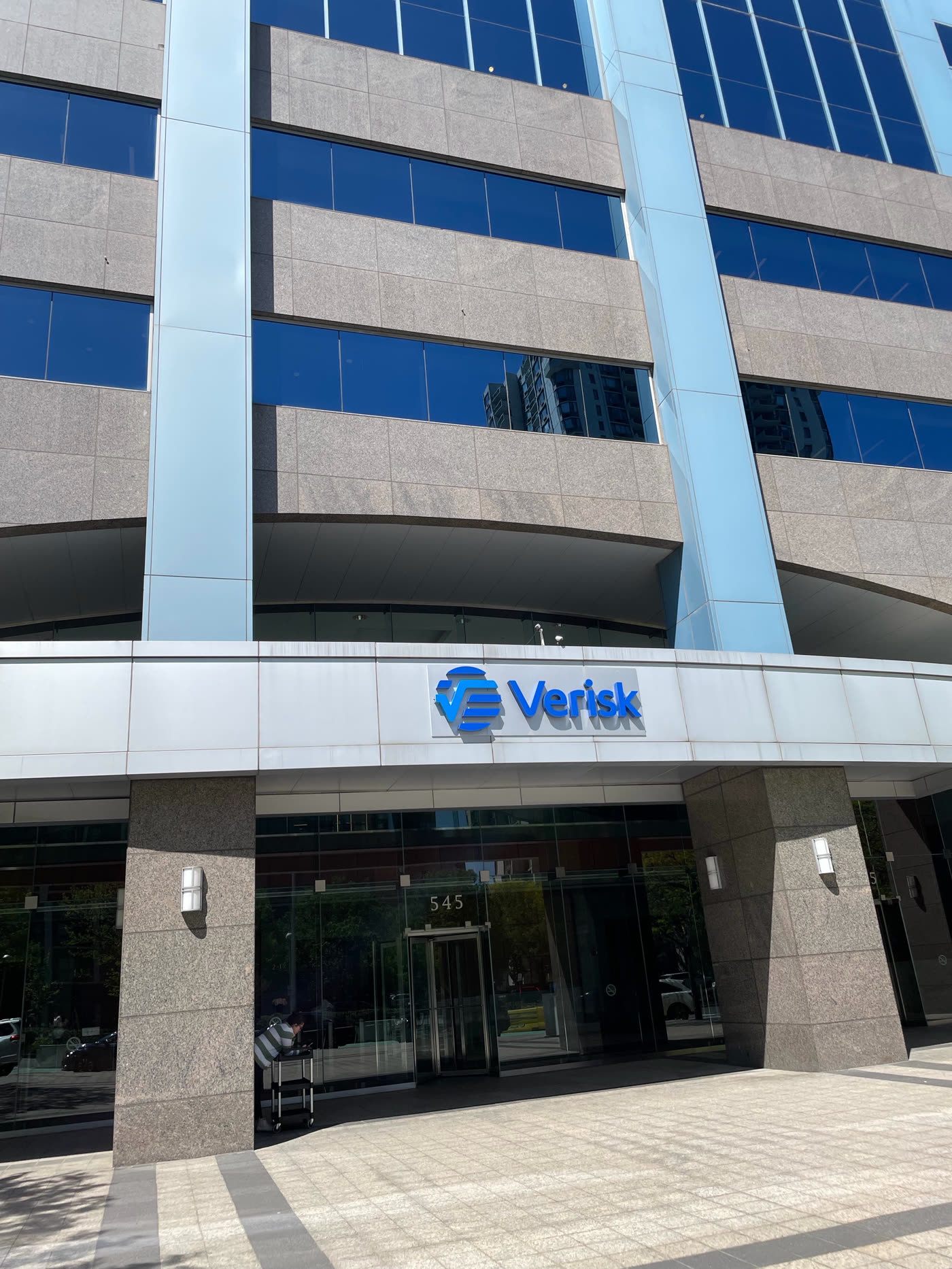
Image context: the cover shows Verisk's Jersey City headquarters, a fitting image for a company whose value comes from embedded industry infrastructure more than from consumer brand visibility.[6]
Priced vs new
Priced: investors already treat Verisk like a high-quality vertical-data platform with dependable renewals, pricing power, and capital return.[1][5]
New: 2025 showed that the durability story still holds even when weather activity runs unusually light and a large acquisition falls away. Revenue still grew 6.6%, underwriting revenue still rose 7.0% on an organic constant-currency basis, adjusted EBITDA margin still expanded to 56.2%, and free cash flow still reached $1.192 billion.[1] Even after Verisk walked away from the planned AccuLynx deal once FTC review ran past the contractual stop date, the business still did not need that acquisition to prove it could grow.[3][4]
That is the core valuation point. Verisk is expensive because the market believes its data and workflow position keeps turning routine insurance activity into recurring cash. The latest reported year did not break that belief.
Mechanism: why the premium can persist
First, the revenue model is unusually cash-friendly. Verisk says annual subscriptions or long-term agreements represented over 80% of 2025 revenue, and those contracts are typically prepaid quarterly or annually.[2] That means growth can create cash earlier than it does in a standard software model built around slower collections.
Second, the underwriting franchise remains the real engine. Underwriting produced $2.18 billion of 2025 revenue, about 71% of total company revenue, and grew 7.0% on an organic constant-currency basis.[1] This is not a side business. It is the part of Verisk that anchors forms, rules, loss costs, catastrophe products, and rating workflows inside insurer operations.[1][2]
Third, operating leverage is still showing up in hard numbers. Adjusted EBITDA rose to $1.727 billion from $1.576 billion, while margin improved from 54.7% to 56.2%.[1] That matters because the market rarely pays premium multiples for growth alone; it pays for growth that still drops through.
Fourth, capital return is no longer a side note. Free cash flow increased nearly 29.5% to $1.192 billion, the quarterly dividend was lifted from $0.45 to $0.50, and the board raised total buyback authorization to $2.5 billion, with management expecting to execute a $1.5 billion accelerated share repurchase program.[1] That does not make the stock cheap, but it does mean the company has real tools for keeping per-share growth ahead of reported net-income growth.
Six numeric anchors for the valuation map
- 2025 revenue: $3.073 billion, up 6.6%.[1]
- 2025 underwriting revenue: $2.180 billion, up 7.0% on an OCC basis.[1]
- 2025 adjusted EBITDA: $1.727 billion with 56.2% margin.[1]
- 2025 free cash flow: $1.192 billion, up 29.5%.[1]
- Revenue under annual subscriptions or long-term agreements: over 80% in 2025.[2]
- Current market anchor: about $35.14 billion market cap and 38.1x trailing earnings as of 2026-03-31 16:08 UTC.[5]
Read together, those anchors describe a business that still deserves to be discussed as infrastructure rather than as a cyclical software trade. The cash engine is real. The margin structure is real. The customer embedding is real.
Strongest counterweight
The strongest counterweight is that the market already knows all of that. At roughly 29x trailing free cash flow using current market value against 2025 reported FCF, investors are not paying for resilience alone.[1][5] They are paying for continued underwriting-led growth, margin discipline, and enough capital return to keep per-share math attractive even if weather-sensitive or transaction-sensitive lines stay soft.
There is also a strategic ceiling to the pure-quality argument. Claims revenue was basically flat in the fourth quarter on a reported basis, and 2025 benefited from the same operating discipline that can become harder to repeat once margins are already above 56%.[1] If underwriting growth eases into a lower gear, the multiple has less room for error.
Falsifier
This valuation framework is wrong if, over the next two reporting cycles, Verisk shows underwriting OCC growth below 5%, adjusted EBITDA margin slipping back toward 55%, and buybacks doing more to support EPS than the core business does. That combination would suggest investors are still paying an infrastructure multiple for a company that is gradually becoming a slower-growth workflow utility.
Watchlist
- By 2026-05-11 — Q1 2026 10-Q filing window: the key check is whether underwriting growth still clears the low end of 2026 guidance implied cadence.[1][2]
- 2026-06-01 — Atlantic hurricane season start: after management cited low weather activity as a temporary 2025 drag, a more active catastrophe backdrop could test demand for risk and estimating products.[1][2]
- Next quarterly capital-return disclosure: investors should watch how quickly the planned $1.5 billion ASR begins to reduce share count.[1]
- 2026 revenue guide versus margin guide: management's $3.19 billion to $3.24 billion revenue outlook and 56.0% to 56.5% EBITDA-margin guide leave little room for operational slippage.[1]
Takeaway
Verisk still looks like a premium asset because it behaves like one: prepaid revenue, deeply embedded underwriting content, strong cash conversion, and disciplined capital return. The stock does not need a heroic story from here. It does, however, need the underwriting core to keep proving that this is still a growth-and-leverage business, not just a very good franchise on a very full multiple.
Sources
- Verisk, "Verisk Reports Fourth-Quarter and Full-Year 2025 Financial Results" (February 18, 2026).
- Verisk, Annual Report on Form 10-K for the year ended December 31, 2025.
- Verisk, "Verisk Ends Effort to Acquire AccuLynx" (December 29, 2025).
- Reuters, "Verisk pulls plug on $2.4 billion AccuLynx deal after FTC review delay" (via Yahoo Finance, December 29, 2025).
- Google Finance, "Verisk Analytics, Inc. (NASDAQ: VRSK)" live quote page.
- Wikimedia Commons, "File:Verisk Headquarters.jpg."