A softer 7-year Treasury auction often gets translated too quickly into one macro sentence: growth fear, inflation repricing, or waning duration demand. Treasury's own documents point to a narrower and more useful first read. Priced is that coupon sizes are still flat and Treasury still expects bill supply, not coupon upsizing, to absorb the next quarter's cash swings. New is that the 7-year line remains a monthly new issue whose settlement regularly lands on awkward balance-sheet dates, while Treasury's own advisory committee says a quarterly new issue with reopenings could unlock dealer intermediation capacity measured in billions of dollars.[1][2][3][4]
That does not prove every weak 7-year result is harmless. It does mean the first question should be mechanical before it becomes macro. The inference from Treasury's issuance calendar and TBAC minutes is that some cheaper clears are paying for intermediation at the calendar edge, not solely for a change in the economic outlook.[2][3][4]
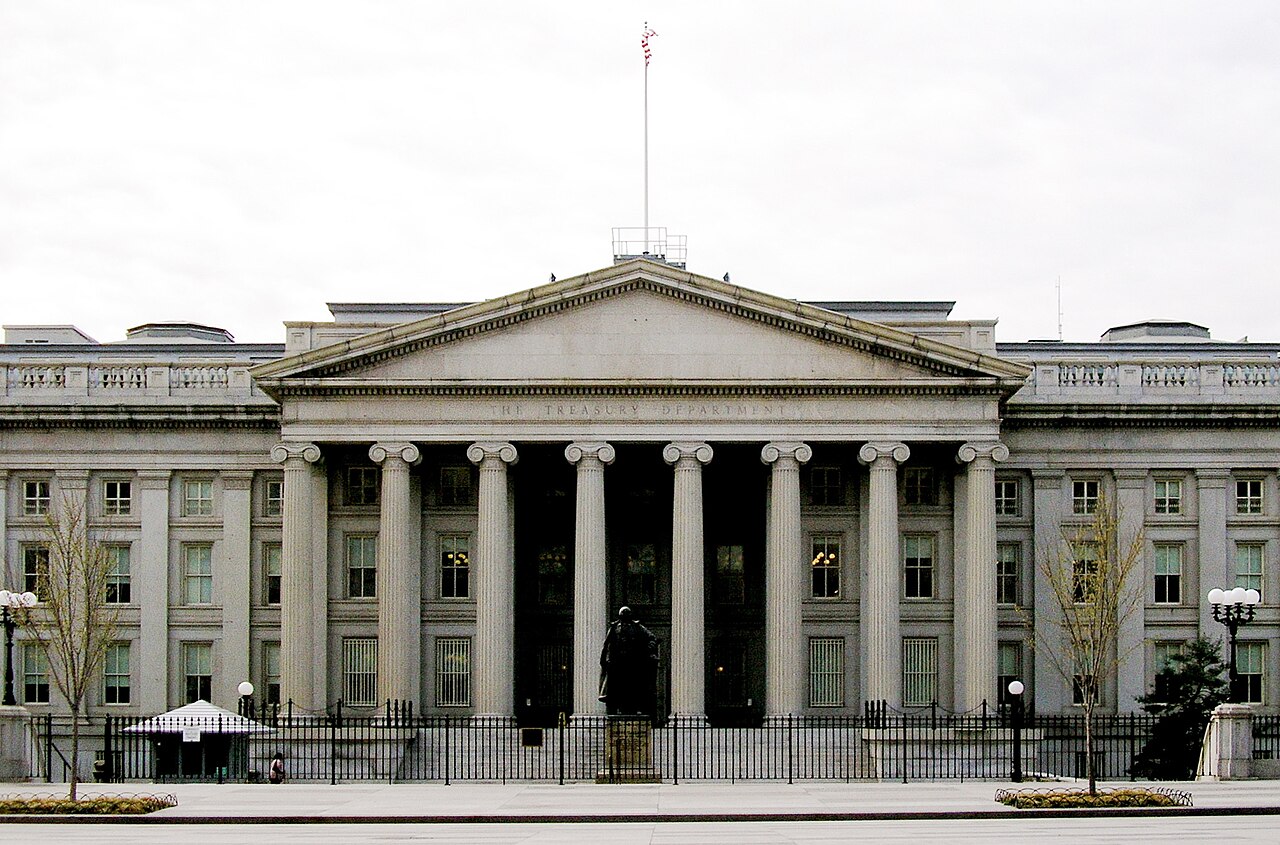
Image context: the Treasury Building works here because the article is about debt-management design and auction timing. The most relevant visual is the issuer itself, not a symbolic market graphic.[8]
Priced vs new
The priced part is straightforward. Treasury's February borrowing estimate for the April-June 2026 quarter was only $109 billion of privately held net marketable borrowing, assuming an end-of-June cash balance of $900 billion.[1] The quarterly refunding statement then said Treasury expects to keep nominal coupon and FRN auction sizes unchanged for at least the next several quarters, with the 7-year note staying at $44 billion in February, March, and April 2026.[2] In the same statement, Treasury said it expected benchmark bill sizes to be reduced by a cumulative $250 billion to $300 billion by early May and that the Treasury General Account could peak near $1.025 trillion, plus or minus $50 billion, by late April.[2]
That mix matters. Treasury is telling you the near-term financing shock absorber is bills and cash-balance management, not an immediate coupon-size reset.[1][2]
The newer signal sits inside the 7-year line itself. The tentative auction schedule shows the 7-year as a monthly new issue settling on March 31, April 30, and June 30, with the May auction settling on June 1.[4] Separately, the February TBAC minutes say dealers broadly supported moving the 7-year to a quarterly new issue with two reopenings because it could improve secondary-market liquidity and unlock billions of dollars of balance-sheet space for intermediation.[3] Read together, those sources imply that the current monthly-new-issue structure has a real balance-sheet cost.
Mechanism: why the calendar matters
The mechanism starts with auction plumbing, not economics. TreasuryDirect's auction FAQ says a primary dealer category on the result sheet refers to a primary dealer bidding for its own house account, while indirect bidders are customers placing competitive bids through a primary dealer or direct submitter.[7] That distinction matters because the 7-year result can weaken a bit even when end demand is still present, if more of the paper has to be warehoused by dealer balance sheets before it is distributed.
The March auction reads that way more than it reads like a demand collapse. The March 26, 2026 7-year note cleared at a 4.255% high yield with a 2.43 bid-to-cover ratio.[5] One month earlier, the February 26, 2026 7-year cleared at 3.790% with a 2.50 bid-to-cover ratio.[6] Some of that difference is plainly macro: the rate level in late March was higher than in late February. But the accepted allotments show only a modest shift in customer participation. Calculated from Treasury's accepted competitive awards, direct plus indirect bidders still took 87.6% of March's auction, down from 89.6% in February, while the primary-dealer accepted share rose to 12.4% from 10.4%.[5][6]
That is the useful split. A slightly larger dealer take does not automatically mean investors have vanished. It can also mean the market demanded a bit more compensation for balance-sheet intermediation around settlement. Treasury's own advisory committee effectively made that point in policy language when it said a reopening structure could free up billions of dollars of balance-sheet space.[3]
Six numeric anchors
- Treasury's current estimate for privately held net marketable borrowing in April-June 2026 is $109 billion, assuming an end-of-June cash balance of $900 billion.[1]
- Treasury kept the 7-year note auction size at $44 billion for February, March, and April 2026.[2]
- Treasury expects bill supply to decline by $250 billion to $300 billion by early May and estimates the TGA could peak near $1.025 trillion, plus or minus $50 billion, by late April.[2]
- The March 26, 2026 7-year auction cleared at 4.255% with a 2.43 bid-to-cover ratio.[5]
- The February 26, 2026 7-year auction cleared at 3.790% with a 2.50 bid-to-cover ratio.[6]
- Customer demand remained high in both auctions: direct plus indirect bidders took 87.6% of the March competitive awards and 89.6% of February's, leaving primary dealers with 12.4% and 10.4% respectively.[5][6]
Those anchors keep the argument disciplined. Treasury is not signaling a coupon-supply emergency, and the auction data do not show a cliff in end demand. The live question is how much calendar friction the market charges before the paper moves into final hands.
Strongest counterweight
The strongest counterweight is simple: one monthly auction is never pure microstructure. Between late February and late March, the entire Treasury rate surface moved, so a higher clearing yield by itself does not prove anything about dealer capacity.[5][6] A reader who wants to keep the story macro-first has a fair point. If the full curve reprices higher, the 7-year should clear higher too.
That is why the claim here is intentionally narrow. Treasury's own issuance guidance says coupon sizes are still steady, and Treasury's own advisory minutes say the 7-year's current design consumes intermediation space that a reopening structure could release.[2][3] In that setup, a softer 7-year should first be read as a mixed price: part macro level, part balance-sheet charge.
Falsifier
This framing fails if the next two 7-year auctions show materially weaker customer absorption even while Treasury keeps the line at $44 billion. Concretely, if direct plus indirect accepted shares fall well below the high-80s seen in February and March and primary dealers are left taking a much larger share of the paper, then the story has moved past calendar friction into genuine demand erosion.[2][5][6]
Watchlist
- April 28, 2026 7-year auction / April 30 settlement: another month-end settlement will test whether March's softer clear was mostly calendar pricing or something broader.[4]
- May 4, 2026 borrowing estimates release: Treasury's next cash and borrowing update will show whether bill management still carries the load for seasonal financing changes.[9]
- May 6, 2026 quarterly refunding announcement: this is the next official check on coupon-size stability and on whether Treasury says anything new about issuance design.[2]
- May 28, 2026 7-year auction / June 1 settlement: this print is useful as a comparator because the settlement shifts off the last calendar day of the month.[4]
Takeaway
Treasury's own documents argue for a cleaner reading of the 7-year line. Coupon sizes are steady, bills remain the near-term adjustment tool, and TBAC has already said a different 7-year structure could unlock dealer balance-sheet room for intermediation.[1][2][3] The inference is modest but important: a softer 7-year auction should first be read as a price for calendar-bound balance-sheet capacity, then as a macro warning if the weakness broadens and persists.
Sources
- U.S. Department of the Treasury, "Treasury Announces Current Estimates of Privately-Held Net Marketable Borrowing for the January - March 2026 and April - June 2026 Quarters" (February 2, 2026).
- U.S. Department of the Treasury, "Quarterly Refunding Statement of Deputy Assistant Secretary for Federal Finance Brian Smith" (February 4, 2026).
- U.S. Department of the Treasury, "Minutes of the Meeting of the Treasury Borrowing Advisory Committee February 3, 2026" (published February 4, 2026).
- U.S. Department of the Treasury, "Tentative Auction Schedule of U.S. Treasury Securities."
- TreasuryDirect, "Treasury Auction Results: 7-Year Note" (March 26, 2026 press release).
- TreasuryDirect, "Treasury Auction Results: 7-Year Note" (February 26, 2026 press release).
- TreasuryDirect, "FAQs about Auctions" (definitions of primary dealer, direct bidder, and indirect bidder).
- Wikimedia Commons, "File:US Treasury Building.jpg".
- U.S. Department of the Treasury, "Most Recent Quarterly Refunding Documents" (Treasury quarterly refunding hub noting the next release is scheduled for May 4, 2026).