Eli Lilly's obesity-drug demand is already in the share price. The newer 2026 question is whether the company can convert that demand into shipped supply, favorable access, and durable margins quickly enough to justify treating today's growth as a platform rather than a shortage premium.[1][2][4]
That distinction matters because Mounjaro and Zepbound have moved beyond the "promising category" stage. They are now large enough to reshape Lilly's revenue base, manufacturing budget, and payer negotiations. The investable question is no longer whether GLP-1 demand exists. It is whether Lilly can keep increasing volume without giving too much of the economics back through realized price, access concessions, execution costs, or capacity delays.
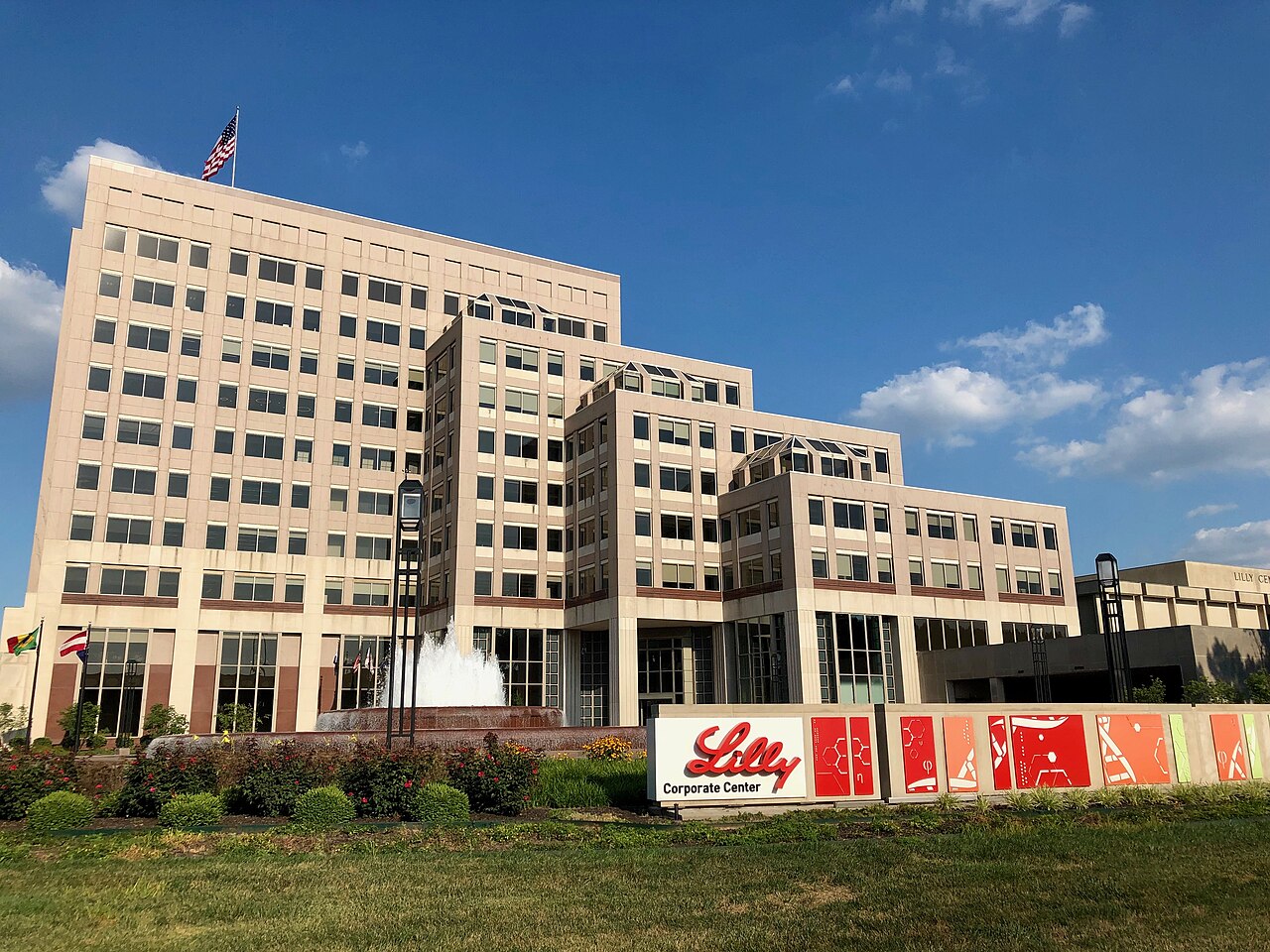
Image context: the cover uses a real photograph of Eli Lilly and Company's Corporate Center in Indianapolis. It fits this article because the financial issue is an execution problem inside a large drugmaker: science, manufacturing, reimbursement, device fill-finish, and capital allocation all have to clear together.[1][2][5]
Priced vs new
Priced: Lilly has one of the cleanest growth stories in large-cap pharmaceuticals. In Q4 2025, revenue rose 43% to $19.3 billion, and management attributed the increase largely to volume growth from Mounjaro and Zepbound.[1] That is not a subtle signal. The obesity and diabetes franchise is already the center of the model.
New: the bottleneck has shifted from demand discovery to conversion quality. Lilly's 2026 guidance calls for $80 billion to $83 billion of revenue and non-GAAP EPS of $33.50 to $35.00.[1] Those numbers imply that the market must now watch how much supply gets added, how that supply is allocated across geographies and channels, and whether realized prices fall faster than volume can absorb.
That is why a manufacturing press release can matter as much as a pipeline abstract. Lilly's newly announced Pennsylvania injectable medicine and device facility is a $3.5 billion project expected to become operational in 2031, with roughly 850 permanent jobs and 2,000 construction jobs.[2] The site will support next-generation weight-loss therapies, including retatrutide, and sits inside a broader U.S. manufacturing expansion of more than $50 billion in capital commitments since 2020.[2]
The Associated Press described the Pennsylvania project in the same practical frame: a Fogelsville-area plant meant to expand domestic production while Lilly rides surging sales of obesity and diabetes treatments.[3] That outside framing is useful because it keeps the thesis grounded in physical capacity rather than only in drug-demand enthusiasm.
Mechanism: demand is visible; conversion is the spread
1. The franchise is already too large to model casually
Mounjaro generated $7.4 billion of worldwide revenue in Q4 2025, up 110% from the prior year. Zepbound generated $4.2 billion of U.S. revenue, up 122%.[1] Those figures are large enough that small assumptions about access, supply, or realized price can move Lilly's whole income statement.
The geography also matters. Mounjaro's non-U.S. revenue rose to $3.3 billion in the quarter from $899 million a year earlier, while U.S. Mounjaro revenue rose 57% to $4.1 billion.[1] Lilly is no longer only scaling a U.S. launch. It is building a global obesity and diabetes franchise whose economics will differ by reimbursement system, list price, channel, and launch sequence.
2. Manufacturing is part of the valuation, not backstage plumbing
The Pennsylvania announcement is easy to read as ordinary corporate expansion. For Lilly, it is part of the valuation case. Obesity-drug demand can exist years before saleable pens, devices, and injectables exist at the required scale. A facility targeted for 2031 does not solve 2026 supply by itself, but it tells investors how far Lilly believes the category can compound and how much capital it is willing to commit ahead of later-stage products.[2]
Retatrutide is the important signal in the release because it points past the current Mounjaro-Zepbound cycle. If the next generation of weight-loss therapies expands the addressable market or improves the clinical bargain, Lilly needs enough manufacturing depth to avoid converting scientific advantage into customer frustration. If the manufacturing ramp arrives late or expensively, the growth story becomes more cyclical: demand spikes, access tightens, price concessions rise, and margins become harder to read.
3. Price and payer mix are the hidden scoreboard
The cleanest warning in the Q4 release is not weak growth. Growth was exceptional. The warning is that U.S. revenue rose 43% on a 50% volume increase, partially offset by a 7% decline from lower realized prices, with Lilly saying the volume increase and realized-price decline were driven by Zepbound and Mounjaro.[1]
That is the equity debate in one sentence. Volume can be spectacular while price mix becomes less friendly. In a category with large chronic-use potential, payers have incentive to demand access discipline, step edits, rebates, and channel controls. Lilly can still win that negotiation if outcomes, supply, adherence, and brand strength support reimbursement. But investors should not confuse prescription demand with captured economics.
The gross-margin line shows the balancing act. Lilly reported Q4 gross margin of 82.5%, and non-GAAP gross margin of 83.2%, broadly steady with the prior-year quarter on the non-GAAP basis.[1] That is encouraging, but it is also exactly why realized price deserves attention. A high-margin growth franchise can absorb some mix pressure; it cannot ignore it indefinitely.
Six numeric anchors
- Revenue scale reset: Q4 2025 revenue increased 43% to $19.3 billion.[1]
- Mounjaro is already a mega-product: Q4 worldwide revenue was $7.4 billion, up 110%.[1]
- Zepbound has become material quickly: Q4 U.S. revenue was $4.2 billion, up 122%.[1]
- Price mix is already visible: U.S. revenue growth of 43% came with 50% volume growth and a 7% negative impact from lower realized prices.[1]
- 2026 guidance requires conversion, not just demand: management guided to $80 billion to $83 billion of revenue and $33.50 to $35.00 of non-GAAP EPS.[1]
- Capacity is a multi-year capital claim: the Pennsylvania site alone is $3.5 billion, targets operation in 2031, and sits inside more than $50 billion of U.S. manufacturing commitments since 2020.[2]
Together, these anchors make Lilly less of a simple drug-launch story and more of an industrial growth story. The company has to scale science, supply chains, devices, payer access, and global commercialization at the same time.
Strongest counterweight
The strongest bullish counterweight is that Lilly may be one of the few companies able to manage this complexity. The company has current GLP-1 scale, a late-stage next-generation obesity pipeline, high gross margins, and the balance-sheet confidence to keep adding manufacturing capacity years before all of the demand is visible in reported sales.[1][2][4]
That is a powerful defense against ordinary valuation skepticism. Many expensive growth stocks need investors to imagine a future market. Lilly is already reporting very large product revenue, very high growth, and a specific capital program to meet demand.
The bearish counterweight is that this success gives every stakeholder a claim on the economics. Payers want affordability and utilization control. Governments want access. Competitors want share. Patients want supply. Manufacturing projects want capital. Each claim can be reasonable on its own; together they can make reported growth less valuable than prescription demand suggests.
Falsifier
The thesis breaks if, over the next several quarters, Mounjaro and Zepbound volume remains strong but realized-price pressure accelerates, supply additions lag demand, and gross margin or guidance starts to show that the company is paying too much to clear access and capacity constraints.[1][2][4] In that branch, Lilly would still own a remarkable franchise, but the market would have to value it more like a high-growth pharmaceutical cycle than a smoothly compounding platform.
The reverse would strengthen the thesis: volume growth remains high, realized-price pressure stays manageable, manufacturing updates arrive on schedule, and next-generation obesity assets progress without forcing investors to discount the current franchise too quickly.
Watchlist
- Next earnings split: whether U.S. revenue growth still trails volume growth by a widening realized-price gap.[1]
- Manufacturing milestones: whether the Pennsylvania site and broader U.S. capacity program remain on schedule, especially as the 2031 operational target becomes part of longer-term supply planning.[2]
- Pipeline handoff: whether retatrutide and oral orforglipron strengthen the portfolio without turning today's Mounjaro-Zepbound economics into a bridge product narrative too quickly.[1][2]
- Access quality: whether payer coverage improves through sustainable reimbursement, or through concessions that shift too much value away from Lilly.[1][4]
Takeaway
Lilly's obesity-drug story is no longer mainly about whether demand is real. The Q4 numbers already answer that. The better 2026 question is whether Lilly can manufacture enough product, allocate it intelligently, hold enough price, and keep the pipeline moving so that exceptional demand becomes durable earnings power. Capacity and payer mix are not secondary details. They are the proof that scarcity can become a platform.
Sources
- Eli Lilly and Company via PRNewswire, "Lilly reports fourth-quarter 2025 financial results and provides 2026 guidance" (February 4, 2026).
- Eli Lilly and Company via PRNewswire, "Lilly selects Pennsylvania as home for its newest injectable medicine and device manufacturing facility" (January 30, 2026).
- Associated Press, "Drugmaker Eli Lilly announces new plant in Pennsylvania as part of broader domestic expansion" (January 30, 2026).
- Eli Lilly and Company, 2025 Form 10-K for the fiscal year ended December 31, 2025.
- Wikimedia Commons, "File:Eli Lilly Corporate Center, Indianapolis, Indiana, USA.jpg."