Walmart is already priced as the scale retailer that can hold grocery traffic when consumers stay selective. The newer 2026 question is narrower: can advertising, membership, marketplace, and eCommerce economics keep turning that traffic into faster operating-income growth than sales growth.[1][2][3]
That is why the fourth-quarter report matters more than the headline revenue beat. Walmart's base business still did the job, but the margin story is no longer only about buying power and expense discipline. It is about whether the company can make a low-price retailer behave more like a commerce platform without losing the everyday-value trust that created the traffic in the first place.
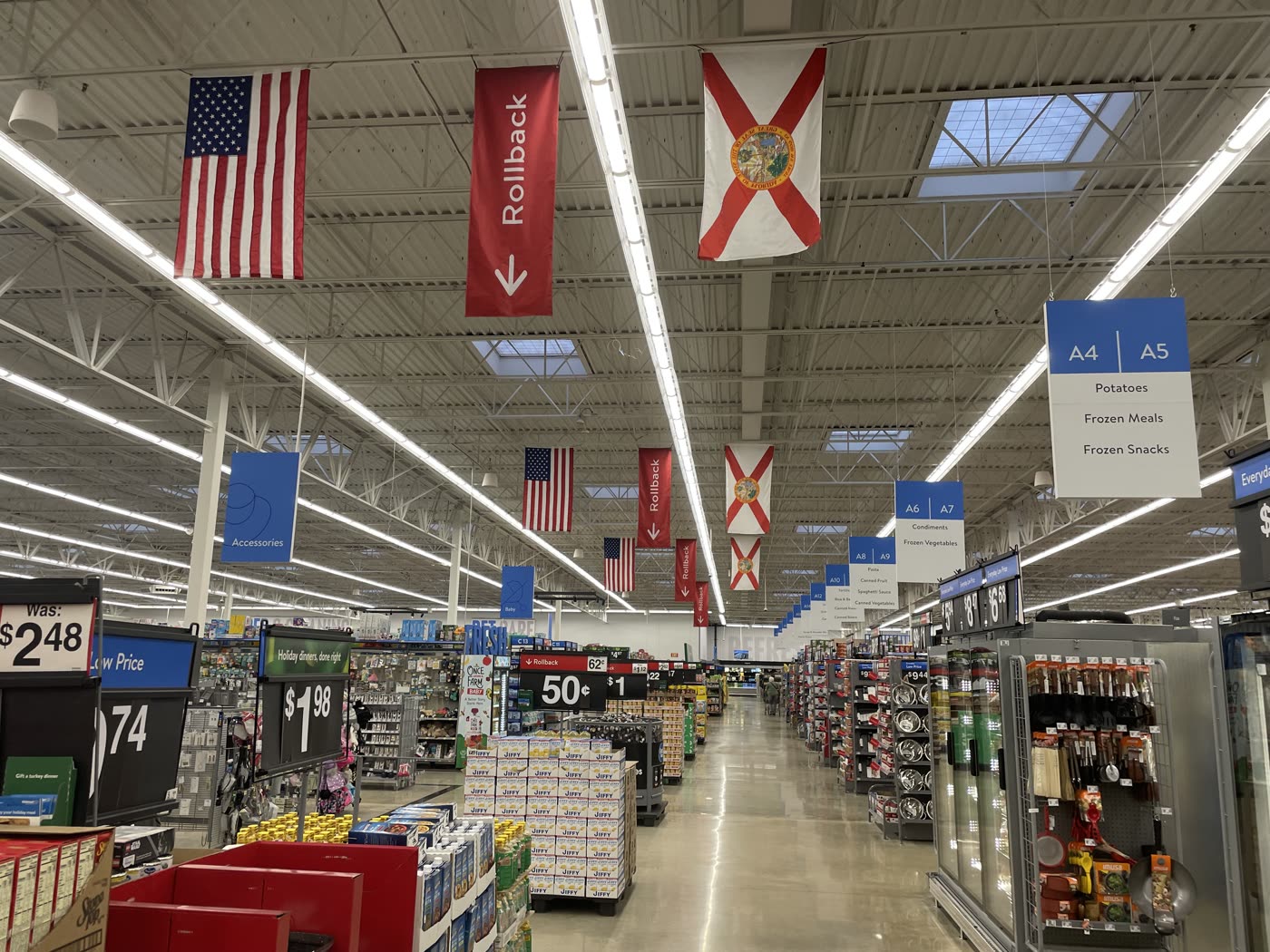
Image context: the cover uses a real 2024 Walmart Supercenter interior from Tallahassee, Florida. It fits this piece because the financial mechanism begins inside the physical store: grocery trips, pickup and delivery, marketplace attachment, and advertising inventory all rely on the same customer flow.[1][5]
Priced vs new
Priced: Walmart remains one of the cleanest defensive-consumer stories in large-cap retail. Fiscal 2026 revenue reached $713.2 billion, Walmart U.S. comparable sales rose 4.6% in Q4 excluding fuel, and the company still generated enough cash to lift the annual dividend.[1]
New: the higher-margin layers are now too large to treat as side businesses. Global advertising grew 46% for the full year to nearly $6.4 billion, membership fee revenue grew 15.1% globally in Q4, and management said advertising income plus membership fees represented nearly one-third of operating income in the quarter.[1][2]
That mix shift is the earnings question. If advertising and membership can keep compounding on top of store-fulfilled delivery and marketplace growth, Walmart gets operating leverage without needing a heroic consumer. If those lines slow, the stock falls back toward a safer but more ordinary grocery-led retail multiple.
Mechanism: the store is the demand engine, the platform is the margin release
1. The physical store is still doing the traffic work
Walmart's FY2026 report did not show a fragile core. Q4 revenue was $190.7 billion, up 5.6% as reported and 4.9% in constant currency, while global eCommerce grew 24%.[1] The company attributes that eCommerce growth to store-fulfilled pickup and delivery plus marketplace activity, which is important because Walmart is not building a separate online retailer beside the store network. It is asking the store network to become the fulfillment and media substrate.
That matters for valuation because the market already trusts Walmart's scale in grocery, consumables, and health and wellness. The incremental proof is not another quarter of "people shop at Walmart." It is whether those trips create digital order frequency, marketplace selection, ad impressions, and recurring membership value.
2. Advertising and membership change the income statement quality
Retailers normally fight a hard equation: low prices support traffic, but low prices also compress margin. Walmart's higher-margin lines loosen that equation. Advertising monetizes supplier demand for placement, measurement, and conversion. Membership fees turn repeat usage into recurring revenue. Marketplace deepens assortment without forcing Walmart to own every unit of inventory.
The 10-K gives the cleanest membership anchor: membership fee revenue was $4.4 billion in fiscal 2026, up from $3.8 billion in fiscal 2025 and $3.1 billion in fiscal 2024.[3] The earnings release gives the advertising anchor: nearly $6.4 billion of global advertising revenue for FY2026 after 46% growth, including VIZIO.[1] Those are no longer decorative numbers beside a $713 billion sales base. They are margin-shaping numbers.
3. Operating leverage is the scoreboard
The best single proof in Q4 was that operating income grew faster than sales. Walmart reported Q4 operating income up 10.8%, or 10.5% adjusted in constant currency, versus revenue growth of 5.6%.[1] For the full year, adjusted operating income grew 5.4% in constant currency while revenue grew 4.7% as reported.[1]
That spread is the thesis. Walmart does not need to become a software company. It needs the higher-margin mix to keep adding enough lift that a very large, low-price retail machine can still expand earnings quality. NRF's 2026 forecast for U.S. retail sales growth of 4.4% to $5.6 trillion gives a healthy but not explosive industry backdrop.[4] In that setting, internal mix matters more than broad category lift.
Six numeric anchors
- Scale remains the base: FY2026 revenue was $713.2 billion, up 4.7% as reported.[1]
- The quarter still had store momentum: Walmart U.S. Q4 comparable sales rose 4.6% excluding fuel.[1]
- Digital flow stayed strong: global eCommerce sales grew 24% in Q4.[1]
- Advertising is now material: global advertising grew 46% for FY2026 to nearly $6.4 billion.[1]
- Membership has a multi-year ramp: membership fee revenue was $4.4 billion in FY2026 versus $3.8 billion in FY2025 and $3.1 billion in FY2024.[3]
- The margin proof is visible but still narrow: Q4 operating income grew 10.8%, ahead of 5.6% revenue growth.[1]
Together, these anchors support a more specific read than "Walmart is defensive." The company is defensive, but the earnings upside comes from profit mix layered onto a defensive traffic base.
Strongest counterweight
The strongest counterargument is valuation fatigue. Investors already know Walmart has scale, grocery frequency, a growing ad business, and a membership flywheel. If the stock is already capitalizing that mix shift, then good execution may merely defend the multiple rather than expand it.
The other counterweight is customer trust. Walmart's low-price identity is not an ornament; it is the asset. If advertising load, marketplace quality, delivery fees, or membership design make the experience feel less like everyday value, the same monetization layers that support margin could start to weaken the traffic engine beneath them.
Falsifier
This earnings-mix thesis is wrong if, over the next few quarters, Walmart U.S. comps stay positive but advertising growth slows sharply, membership fee growth falls back toward ordinary sales growth, and operating income no longer grows faster than revenue.[1][2][3] In that branch, Walmart would still be a strong retailer, but the premium mix story would be less powerful.
Watchlist
- Next quarterly report: whether eCommerce growth remains led by store-fulfilled pickup and delivery rather than promotion-heavy digital sales.[1]
- Advertising growth ex-VIZIO: whether Walmart Connect keeps showing organic strength after acquisition effects fade.[1][2]
- Membership fee trajectory: whether the FY2026 step from $3.8 billion to $4.4 billion keeps compounding without visible pressure on value perception.[3]
- Operating-income spread: whether operating income continues to outgrow revenue in a retail market that NRF expects to grow but not boom.[1][4]
Takeaway
Walmart's Q4 FY2026 report is not mainly a story about a giant retailer getting bigger. The more investable story is that the traffic base is becoming more monetizable. Grocery and price trust bring the customer in; pickup, delivery, marketplace, advertising, and membership decide how much earnings quality Walmart can extract from that visit. The proof for 2026 is not revenue scale. The proof is whether the margin mix keeps showing up faster than sales.
Sources
- Walmart Inc., "Q4 FY26 earnings release" PDF (February 19, 2026).
- Walmart Inc., "Q4 FY26 earnings call transcript" PDF (February 19, 2026).
- Walmart Inc., Form 10-K for fiscal year ended January 31, 2026.
- National Retail Federation, "NRF Forecasts 4.4% Annual Retail Sales Growth with New Economic Model" (March 18, 2026).
- Wikimedia Commons, "File:Walmart Supercenter interior - Tallahassee, Leon County, FL - Thomasville Road.jpg."