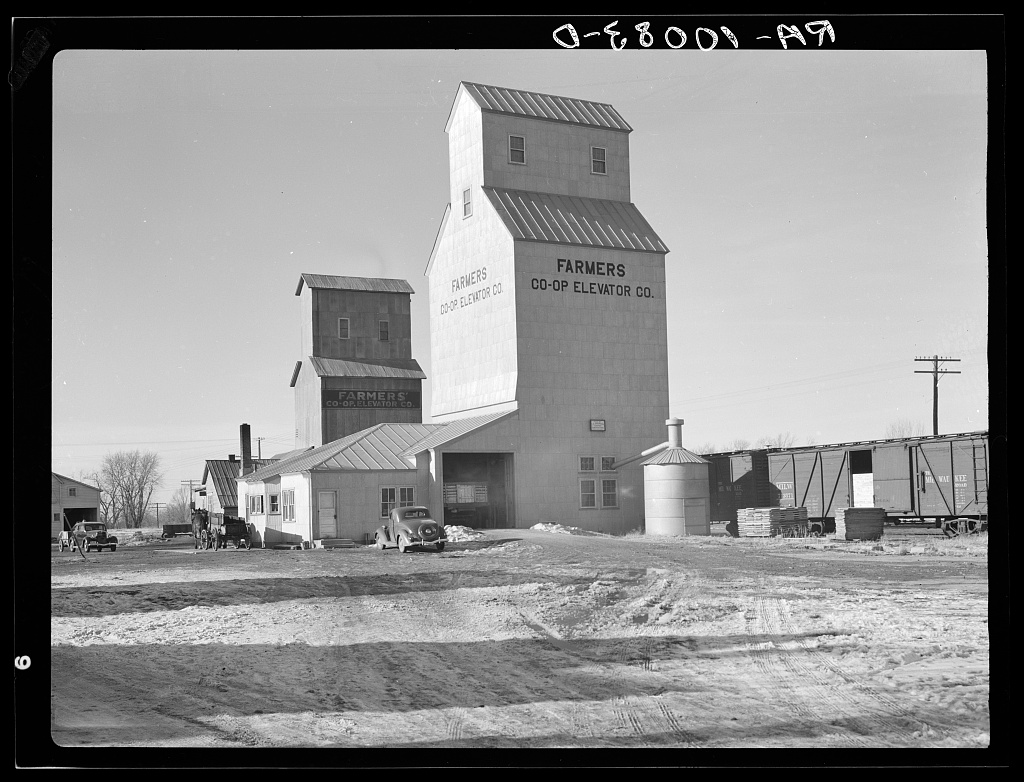
A cooperative's patronage statement can credit a farmer with a generous refund while leaving most of the money inside the business. The overlooked price is the wait: retained equity carries a face amount, but its cash value depends on when the cooperative redeems it.[1][2]
Consider an illustrative $10,000 allocation. With part paid immediately and the rest retained for a decade, the calculation below produces a present value of about $6,911. The cooperative need not lose a dollar for that gap to appear.
Sources checked on 20 October 2026. All valuation figures are original, hypothetical calculations for a single allocation. They are not a quote for any cooperative's equity or an estimate of the total benefits of membership.
Follow the refund into the elevator
An agricultural cooperative's customers can also be its owners. A farmer uses the grain elevator or buys farm supplies; after expenses, the cooperative allocates eligible earnings according to members' business with it. That is the logic of a patronage refund. The distribution follows use, rather than the size of an investor's shareholding.[1]
Some of the refund can arrive as cash. The retained portion becomes equity recorded in the member's name. The member has helped finance the enterprise without first writing a separate investment check. The cooperative has kept capital available for its operations.[1][2]
That is why the statement requires two readings. The allocation measures the earnings assigned to the member. The cash payment measures what has become available to spend. Combining them into one headline does not make them interchangeable.
In the revolving-equity model described by USDA, the cooperative redeems older allocations while acquiring capital from current users. Redemption can gradually move the financing burden toward the people now using the business. But the bylaws, available funds and board decisions govern the process; an expected revolving cycle is not necessarily a contractual maturity date.[3]
Put a date on the retained money
Assume the cooperative pays 20% in cash now and retains the balance. That means an immediate $2,000 payment and $8,000 of allocated equity. Assume the retained amount pays no interim dividend and is redeemed in full at the end of year ten.
Use a 5% annual discount rate to express the member's assumed opportunity cost. This is a modeling choice, not a current market yield or a judgment that cooperative equity has the same risk as a bond. Ignore taxes and fees for this first calculation, and assume full redemption occurs on the specified date.
The formula is:
Present value = cash now + retained amount ÷ (1 + discount rate)years
$2,000 + $8,000 ÷ 1.0510 = approximately $6,911.
The member still receives the full nominal allocation across the two dates. Discounting changes the unit of comparison: both payments are now expressed in today's dollars. The difference from face value is the modeled cost of waiting, before allowing for any failure to redeem.
Timing is the most revealing sensitivity. Keep the same cash split and discount rate, but postpone redemption until year fifteen. Present value falls to approximately $5,848. The amount printed beside the retained allocation can remain unchanged while its economic value declines.
Neither result is a sale price. The calculation describes a specified cash-flow scenario. A realistic valuation would need the cooperative's actual terms and a defensible treatment of uncertain redemption dates and amounts. Assigning a convenient discount rate cannot turn a discretionary payment into a guaranteed one.
The board controls an important valuation input
USDA's study of cooperative equity redemption distinguishes revolving plans from arrangements based on a member's age, estate or required capital contribution. Those structures can produce very different payment dates for otherwise similar account balances.[3]
For a member, the useful evidence is therefore the redemption policy and its execution. Which allocations were actually paid? Did the board retire the expected year of equity, reduce the payment, or defer it? A large aggregate cash distribution may include redemptions of earlier allocations, so it does not establish that this year's patronage was mostly paid in cash. CHS, for example, explicitly distinguishes cash patronage from redeemed equity in its explanation of owner distributions.[5]
There is also a loss boundary. Cooperative equity is risk capital: creditors stand ahead of equity holders, and operating losses can erode the capital supporting members' claims.[2] The worked example deliberately assumes full repayment. It isolates the time cost, leaving financial distress as an additional consideration rather than concealing it in the arithmetic.
The strongest case for keeping the capital
A smaller present value for one allocation does not prove that cooperative membership is a poor bargain. CHS describes retained member equity as funding maintenance and growth, alongside ownership benefits such as purchasing power and market access.[5]
Those services matter to the comparison. Suppose retaining capital allows a cooperative to improve grain handling or maintain a useful local outlet. A member who values only the future redemption check omits the benefit received while using that infrastructure. Equally, an attractive ownership story cannot establish that every retained dollar is productively invested. The board must make the case for the capital it keeps.
The right comparison combines the terms of doing business with the cooperative and the timing of patronage. Favorable prices, service or access may compensate for a slower refund. That is a separate economic argument from claiming the retained allocation is already equivalent to cash.
The timing-discount thesis would fail for an allocation fully payable in cash immediately, with no restriction or deduction. The delay driving this example would disappear. Better cooperative services can offset the cost of waiting, but they do not erase that delay from the allocation itself.
Tax can arrive on a different schedule
Tax labels introduce another timing distinction. IRS Publication 225 says farmers generally include the stated value of a qualified written notice of allocation in income when received. A nonqualified notice generally enters income upon sale, redemption or other disposition instead. Exceptions apply, including patronage associated with capital assets or personal purchases.[4]
“Qualified” therefore should not be read as “already received in cash.” Nor does a nonqualified notice make the eventual proceeds automatically tax-free. An after-tax valuation must identify the notice and underlying transaction, then place the relevant tax payments on the same timeline as the cash receipts. The pre-tax example above intentionally stops before that calculation.[4]
What to watch at the next distribution
- When the annual patronage notice arrives: separate cash, newly allocated equity and redemptions of older equity. Only the first two describe how the new allocation was divided.[1][5]
- At the next board redemption announcement or annual meeting: compare the equity years actually retired with the previous policy. A lengthening wait lowers modeled value even if face amounts stay unchanged.[3]
- When the next tax statement arrives: reconcile its treatment with the allocation notice and underlying purchases or sales before estimating the after-tax benefit.[4]
Sources
- Donald A. Frederick and Gene Ingalsbe, USDA, What Are Patronage Refunds?, Cooperative Information Report 9, revised January 1985 and reprinted June 1993 — allocation by use, retained refunds and member financing.
- Phil Kenkel, Oklahoma State University Extension, “Understanding Cooperative Equity,” January 2020 — allocated equity, retained patronage and the position of equity holders.
- E. Eldon Eversull, USDA, Cooperative Equity Redemption, Research Report 220, 2010, opening section — redemption methods, bylaws, board discretion and available funds; its historical survey is not used as a current market estimate.
- Internal Revenue Service, Publication 225 (2025), Farmer's Tax Guide, “Patronage Dividends” — qualified and nonqualified allocation notices and exceptions to income treatment.
- CHS, “Cooperative value” — member benefits, retained equity as business capital, and the distinction between cash patronage and redeemed equity.
- Russell Lee, farmers' cooperative elevator at Ruthven, Iowa, December 1936, Library of Congress official Flickr collection — archival photograph and catalog information, call number LC-USF34-010083-D.