Commercial HVAC has become one of the cleaner ways to express AI-infrastructure demand, but the easy part of the trade is now visible. Priced is that data centers need more cooling, that chip densities are rising, and that the best HVAC platforms sit closer to the project decision than many generic industrial suppliers. New is the burden of conversion: the order books have to turn into delivered equipment, service attachment, controls revenue, and margins without getting trapped in labor, components, customer timing, or project-mix drag.
That makes the 2026 setup narrower than "AI needs chillers." Trane Technologies reported first-quarter enterprise bookings of $6.69 billion, up 27% year over year, and a record backlog of $10.7 billion, up more than 30% from year-end 2025. Management specifically said enterprise bookings were led by nearly 40% growth in Americas Commercial HVAC.[1] Carrier's first-quarter release tells the same story from another angle: global Commercial HVAC orders rose 35%, helped by data-center orders that were up more than 500%, and backlog already covered expected 2026 data-center sales.[3] Johnson Controls then widened the read-through: fiscal second-quarter orders grew 30% organically and backlog reached a record $20.0 billion, up 26% organically.[4]
Those are not vague enthusiasm markers. They are hard backlog markers. The finance question is whether the market should treat them as a durable margin bridge or as peak-cycle evidence.
The Mechanism
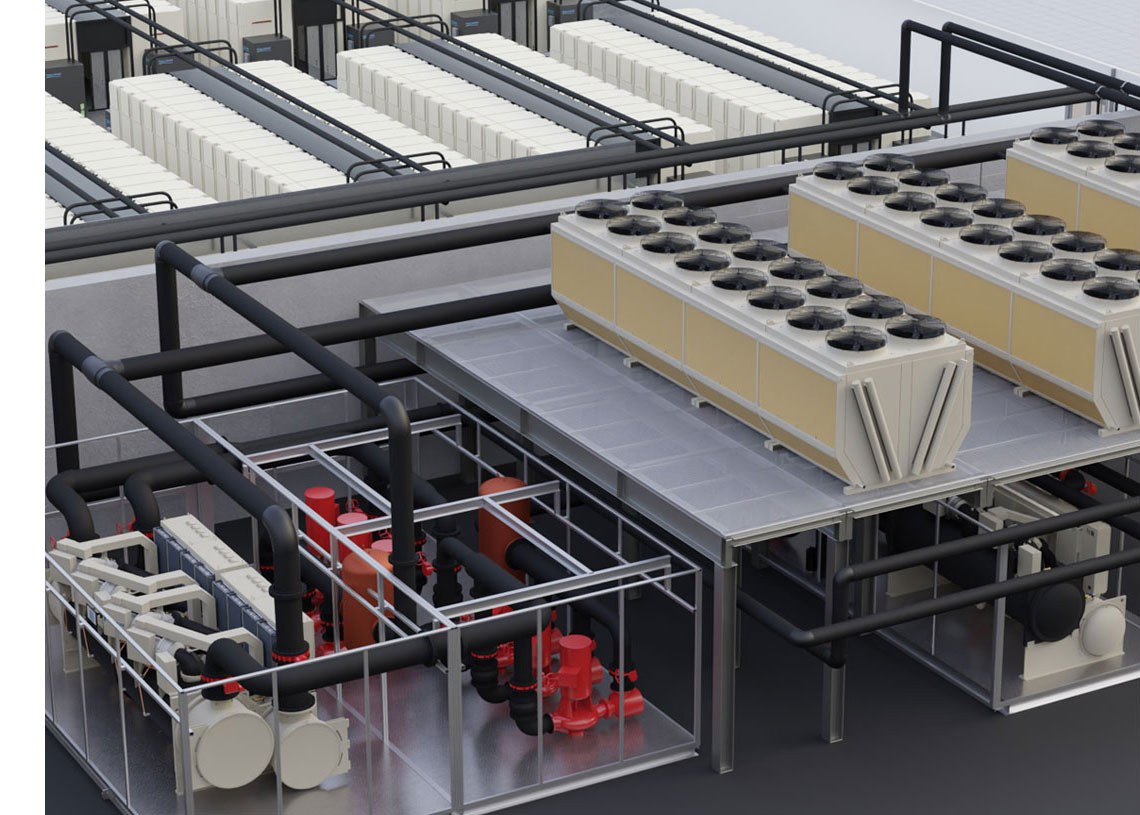
Data-center thermal management is not one product. It is a chain. Heat has to move from chip to rack, rack to room, room to water loop or air path, and building to outside environment. That chain uses chillers, cooling towers, air handlers, pumps, controls, power-aware automation, service contracts, and, for higher-density AI workloads, liquid distribution and direct-to-chip or immersion systems.
This is why Trane's LiquidStack deal matters. The company's acquisition announcement framed the asset as a way to extend its data-center thermal portfolio from chillers, heat rejection, and controls into liquid distribution and on-chip cooling.[2] The wording is strategically important. If AI workloads keep pushing rack densities higher, the economic prize shifts from selling one large box into coordinating a thermal system across the whole building. A supplier that can connect central plant, liquid loop, controls, and service has a better shot at owning the recurring decision layer.
Carrier's release points to the same handoff between product cycle and demand cycle. A 500%+ increase in data-center orders is eye-catching, but the more investable sentence is that backlog covers expected 2026 data-center sales.[3] That lowers near-term revenue uncertainty while raising execution scrutiny. If backlog is already spoken for, upside has to come from shipment timing, pricing discipline, aftermarket attachment, or more orders for 2027 and beyond, not from rediscovering that demand exists.
Johnson Controls adds the building-systems layer. Its release describes itself as a leader in thermal management, mission-critical building systems, energy efficiency, and decarbonization, then ties record backlog to data centers and other technology-driven operating environments.[4] That matters because data-center cooling is not only thermal hardware. Fire detection, controls, security, building automation, and service can sit beside HVAC in the same large project. The companies with broader building platforms can turn one data-center win into more than one revenue line, but only if project execution stays disciplined.
Five Numeric Anchors
- $6.69 billion: Trane Technologies' Q1 2026 enterprise bookings, up 27% year over year.[1]
- $10.7 billion: Trane's record backlog at quarter-end, up more than 30% from year-end 2025.[1]
- 500%+: Carrier's Q1 2026 data-center order growth, inside global Commercial HVAC orders that rose 35%.[3]
- $20.0 billion: Johnson Controls' Q2 FY2026 backlog, up 26% organically.[4]
- Nearly half: IEA's estimate that space cooling, data centers, and heat pumps make up almost half of worldwide buildings-sector electricity-demand growth out to 2030.[5]
The anchors describe a sector with real demand visibility. They do not prove the equity upside by themselves. Backlog is a claim on future work; valuation depends on what margin and cash conversion that work carries.
What Is Actually New
The new information is not that buildings use more power when they cool. That is old. The new information is that cooling has moved from ordinary building equipment into the critical path of AI capacity. A data center that cannot reject heat cannot monetize accelerators efficiently. A rack design that outruns room-level cooling creates stranded compute. A customer that changes chip roadmaps can change the thermal specification before a project is complete.
That shifts HVAC from cyclical construction exposure toward infrastructure choreography. In a normal commercial cycle, investors ask about office, institutional, residential, and retrofit demand. In the AI cycle, they also have to ask whether suppliers can keep pace with higher-density thermal design, utility constraints, liquid-cooling transitions, and hyperscaler procurement schedules. The customer is not merely buying comfort. It is buying uptime.
IEA's electricity-demand framing supports the structural side of the story without turning it into a blank check. The agency expects higher electricity use from space cooling, data centers, and heat pumps to represent almost half of buildings-sector demand growth worldwide through 2030.[5] That is a strong demand pool, but it also means competition will intensify. If cooling is central to the AI buildout, every major industrial platform will try to attach itself to that spend.
The better companies therefore need proof at three levels. First, they need product breadth: conventional air and water systems for today's facilities, plus liquid-cooling capability for higher-density designs. Second, they need project control: enough supply-chain, installation, and commissioning discipline to deliver on the backlog. Third, they need recurring value: service, controls, monitoring, and optimization that keep revenue alive after the initial equipment shipment.
The Counterweight
The strongest counterargument is that the market may already know the story too well. Trane, Carrier, Johnson Controls, and adjacent mechanical contractors have not been hiding inside the AI-infrastructure basket. When bookings and backlog are this visible, the next earnings surprise has to come from execution quality rather than from narrative discovery.
There is also a mix risk. Data-center work can be large, technically demanding, and schedule-sensitive. A backlog full of attractive logos can still pressure margins if projects require more engineering hours, expensive components, or customer-driven redesigns than expected. Liquid cooling is strategically attractive, but it also adds integration risk: fittings, coolant loops, chip-roadmap changes, leak management, service capability, and warranty exposure are different from selling familiar rooftop or central-plant equipment.
Carrier shows a second boundary. Its Q1 data-center order line was extremely strong, but the same release also noted pressure in residential and light commercial areas.[3] That is the sector problem in miniature. Commercial AI demand can be excellent while other HVAC end markets remain soft. Investors who underwrite only the data-center headline can overpay if portfolio drag offsets the high-growth piece.
Falsifier
This thesis is wrong if the backlog converts into revenue without margin leverage. The clean falsifier would be a three-part pattern over the next two or three reporting windows: data-center orders remain high, but adjusted margins fail to improve; companies cite project mix, commissioning delays, labor, or component costs as offsets; and service or controls attachment does not rise enough to make the installed base more valuable after shipment.[1][3][4]
If that pattern appears, commercial HVAC will still be a real AI-infrastructure supplier. It just will not be as clean an equity story. The market would have confused order growth with economic capture.
Watchlist
- Trane backlog and Americas Commercial HVAC bookings: the key test is whether record backlog keeps converting while LiquidStack and Stellar-type thermal assets broaden the system sale rather than distract from execution.[1][2]
- Carrier data-center backlog coverage: watch whether 2026 coverage rolls into visible 2027 demand, and whether commercial HVAC strength can offset residential softness without margin erosion.[3]
- Johnson Controls backlog conversion: its record $20.0 billion backlog is powerful only if orders become revenue with service, controls, and margin expansion attached.[4]
- IEA demand updates: if buildings-sector electricity growth keeps being driven by cooling, data centers, and heat pumps, the structural demand pool remains intact; if demand slows or power constraints delay projects, backlog duration can stretch.[5]
Commercial HVAC's AI story is now past the proof-of-demand phase. The orders are visible. The next phase is more demanding: prove that heat management is not just a bottleneck, but a high-quality business line with pricing, service, controls, and execution discipline behind it.
Sources
- Trane Technologies, "Trane Technologies Reports Strong First Quarter Results; Raises Full-Year Revenue and EPS Guidance" (SEC Exhibit 99.1, April 30, 2026) - Q1 bookings, backlog, commercial HVAC growth, and guidance details.
- Trane Technologies, "Trane Technologies to Acquire LiquidStack to Accelerate End-to-End Data Center Thermal Management Solutions" (February 10, 2026) - direct-to-chip, immersion, liquid distribution, controls, chillers, and heat-rejection portfolio rationale.
- Carrier Global, "Carrier Reports First Quarter 2026 Results" (SEC Exhibit 99.1, April 30, 2026) - global Commercial HVAC orders, data-center order growth, backlog coverage, and residential weakness.
- Johnson Controls, "Johnson Controls Reports Strong Q2 Results; Raises FY26 Guidance" (SEC Exhibit 99.1, May 6, 2026) - Q2 orders, record backlog, data-center demand, and margin/guidance details.
- International Energy Agency, "Demand - Electricity 2026" - buildings-sector electricity demand growth, including space cooling, data centers, and heat pumps through 2030.
- Daikin Applied, data-center chillers product photography - photographic source for the article image.