The priced story was already that Dell had become a serious AI infrastructure supplier. The new information in fiscal Q1 2027 is sharper: the order book is now large enough that the stock debate moves from "is there demand?" to "can Dell convert scarce parts into revenue without giving the margin back?"
Dell's May 28 report gave investors the kind of headline that usually ends an argument. Revenue reached $43.8 billion, up 88% year over year, while the Infrastructure Solutions Group nearly tripled. Inside that, AI-optimized server revenue was $16.1 billion, up 757%, and management raised full-year AI server revenue expectations to roughly $60 billion.[1] Reuters framed the market response as a repricing of Dell's role in Nvidia-powered data-center buildouts, not a normal PC-cycle beat.[5]
That is the right starting point, but it is not the full investment question. AI servers are high-ticket systems assembled out of constrained components: GPUs, memory, networking, storage, boards, power, cooling, integration work, and customer data-center readiness. Dell can win on scale and supplier access while still facing a mix problem if AI boxes outrun the storage, services, and software attach that would make the revenue more valuable. The quarter was excellent. The harder proof is whether this new revenue base behaves like durable infrastructure profit rather than a pass-through hardware surge.
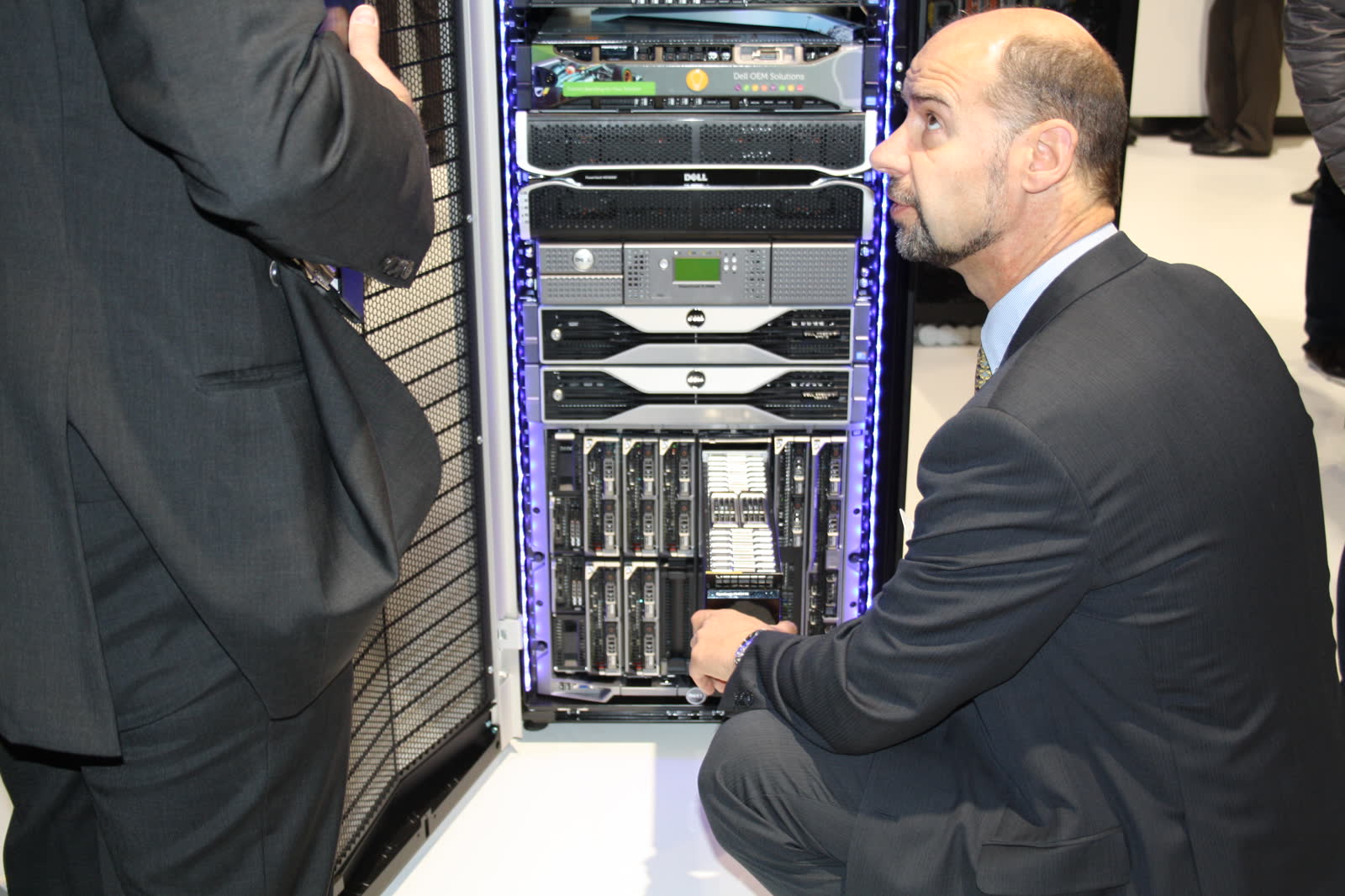
Cover image context: the photograph shows Dell server racks at CeBIT 2013. It is older than the current AI-server cycle, but it is a real Dell-published infrastructure photo and matches the article's operating question: whether racks, parts, and deployment capacity can turn AI demand into repeatable earnings.[6]
What Actually Changed
The most important line was not just the $16.1 billion of AI server revenue. It was the combination of revenue, orders, and backlog. Dell said it booked $24.4 billion in AI orders during the quarter and ended with $51.3 billion of AI backlog.[1][2] That stack tells a different story from a one-quarter shipment spike. Customers are not merely accepting near-term supply; they are trying to reserve future capacity.
The prior baseline was already high. At the end of fiscal 2026, Dell said it had closed more than $64 billion of AI-optimized server orders during the year, shipped more than $25 billion, and entered fiscal 2027 with about $43 billion of backlog.[3] Q1 did not just confirm that pipeline. It increased the full-year guide from roughly $50 billion of AI-optimized server revenue to roughly $60 billion.[1][3]
That is why the beat matters. Dell is no longer being valued only as a PC company with an AI sidecar, but the valuation still has to earn the difference between "big revenue" and "good revenue." A server sale can be strategically important and still carry thinner economics if it is a competitive, component-heavy build. The better earnings story is that AI infrastructure pulls through storage, services, networking, lifecycle support, and future refresh work. The weaker version is that Dell becomes the assembler of a very large but margin-sensitive supply chain.
The Margin Line
The quarter gave bulls some evidence. ISG operating income reached $3.1 billion, and ISG operating margin was 10.5%, up from 9.7% a year earlier, even with AI servers becoming a much larger part of the mix.[1] That is the number that keeps the beat from being dismissed as low-quality hardware volume.
Still, the consolidated gross margin rate moved lower because product revenue grew faster than services revenue.[1] That is not automatically bad. A mix shift into AI servers can dilute percentage margins while expanding gross profit dollars. The investor question is whether Dell can keep the absolute profit pool growing while the AI mix rises. If AI systems remain supply constrained, Dell may have enough pricing discipline to protect returns. If supply opens quickly and customers use the backlog to demand concessions, the same revenue ramp could start to look less premium.
Management's call commentary pointed directly at the constraint. Executives said demand continued to exceed supply, with memory the primary bottleneck, and later clarified that the issue was parts rather than factory capacity.[2] That matters because it defines the spread. If the constraint is customers, Dell has a demand problem. If the constraint is parts, Dell has an allocation problem, and scale can become an advantage.
Nvidia's own Q1 report reinforces the demand side of that reading. Nvidia reported record revenue of $81.6 billion and record data-center revenue of $75.2 billion, and guided for $91.0 billion of revenue in the next quarter while assuming no data-center compute revenue from China.[4] That is not a Dell guarantee, but it supports the idea that the AI infrastructure cycle remains capacity-led rather than purely speculative.
The Counterweight
The strongest bear case is that Dell's visible backlog attracts the wrong kind of multiple. AI infrastructure demand is real, but investors can overpay for revenue that depends on constrained inputs and customer deployment timing. A $51.3 billion backlog is powerful only if it converts into shipments, collections, and attached profit pools. Backlog that waits on memory, power, networking, or data-center readiness is not the same thing as free cash flow.
There is also a customer-concentration risk that does not disappear just because the customer list is broadening. The call described traction across neocloud, sovereign, and enterprise customers, and management pointed to more than 5,000 AI customers.[2] That breadth helps. But the largest AI projects are still capital-intensive, fast-changing, and tied to the economics of training and inference demand. If GPU supply, model efficiency, or cloud pricing changes the purchasing cadence, server vendors can feel it quickly.
The clean bull reply is that Dell is not selling only a box. Its best version is a deployment layer: rack-scale systems, storage, data management, services, and customer handoff. That is why storage attach and services matter more than a simple revenue beat. The durable earnings path comes from turning AI server demand into an installed base that needs expansion, refresh, support, and data plumbing.
Falsifier
The bullish earnings interpretation is wrong if the next several quarters show backlog conversion without margin durability. Specifically, watch for AI server revenue rising while ISG operating margin falls below the Q1 baseline, storage growth fails to attach, operating cash flow lags reported profit, and management keeps citing parts inflation without enough pricing recovery.
The interpretation gets stronger if Dell can ship against backlog, keep ISG margin around or above the Q1 level, and show that storage and services are following AI systems into customer environments. Under that path, the Q1 beat is not just a hardware spike. It is evidence that Dell has moved up the AI infrastructure value chain.
Watchlist
First, track backlog quality. A rising backlog is useful only if it converts on schedule and does not require margin giveaways. Management's statement that pipelines remain multiples of backlog is encouraging, but the proof is shipment cadence.[2]
Second, watch memory and component pricing. Dell said supply, especially memory, was the binding constraint.[2] If memory costs keep rising faster than Dell can reprice, revenue growth can coexist with margin pressure.
Third, watch storage attach. Dell reported storage revenue of $4.3 billion, up 8%, while AI servers grew far faster.[1] For the earnings quality to improve, storage needs to become more than a small stabilizer beside server growth.
Fourth, watch Nvidia's data-center trajectory. Dell's systems sit downstream of the accelerator cycle. Nvidia's $75.2 billion data-center quarter and $91.0 billion next-quarter revenue outlook keep the near-term demand backdrop favorable, but any break in accelerator growth would hit the server assembly layer quickly.[4]
Takeaway
Dell's Q1 was not a routine beat. It was a change in scale. The company showed that AI-server demand is broad enough to lift revenue, orders, backlog, and full-year guidance all at once. The market can price that as an AI infrastructure rerating, but the next proof is more old-fashioned: parts in, racks out, cash collected, margin held.
For investors, the clean read is not "Dell is now an AI stock" or "Dell is still just hardware." It is that Dell has earned a higher-quality question. The backlog is real. Now the margin has to make it count.
Sources
- Dell Technologies, Exhibit 99.1 to Form 8-K, "Dell Technologies Delivers First Quarter Fiscal 2027 Financial Results" (May 28, 2026) - official earnings release, segment results, and guidance.
- Dell Technologies, Q1 2027 Dell Technologies Inc Earnings Call transcript (May 28, 2026) - management discussion of AI orders, backlog, customer breadth, and supply constraints.
- Dell Technologies, "Dell Technologies Delivers Fourth Quarter and Full-Year Fiscal 2026 Results" (Feb. 2026) - prior AI server orders, shipments, backlog, and original fiscal 2027 guide.
- NVIDIA, "NVIDIA Announces Financial Results for First Quarter Fiscal 2027" (May 20, 2026) - accelerator and data-center demand context for Dell's AI server cycle.
- Reuters via Investing.com, "Dell lifts forecasts as AI data center buildout fuels demand, shares soar" (May 28, 2026) - market reaction, external estimates, and supplier-scale framing.
- Wikimedia Commons, "File:Experience our server racks (8531003630).jpg" - Dell Inc. photograph used as the article cover image.