On Servitengasse, the church draws the eye along a narrow procession of shopfronts. Vienna’s local walking guide STADTBEKANNT describes the small businesses crowded along the paved approach; in the city’s r/wien community, an architecture recommendation sends visitors to the surrounding Servitenviertel simply to walk among its Gründerzeit buildings.[1][2] That is a good beginning. Leave enough time, though, for the objects closer to your feet.
This short piece of the 9th district holds two reasons to slow down: a street redesigned for lingering and a memorial that asks whose ordinary lives once filled it. The public-space project added trees and seating in 2023.[3] The memorial was already there, carrying individual names beneath glass.[7] Walking between them brings an intimate scale to a city often approached through its grand buildings.
Give the street an hour
Begin at Berggasse and Servitengasse, then follow Servitengasse toward the church. The junction and the succession of little shopfronts give you the same approach described in STADTBEKANNT’s neighborhood walk.[1] There is no need to assemble a larger circuit before allowing this small stretch to hold your attention.
For a first visit, I would choose Thursday, 10:30–12:00, and allow 45–60 minutes. Those are suggested viewing allowances. Thursday adds the weekly market to the forecourt, giving the street a practical neighborhood purpose beyond looking handsome. Vienna’s municipal listing, updated July 1, 2026 and checked for this article on October 23, identifies working Thursdays between February 15 and December 24, with maximum permitted hours of 08:00–18:00.[5] That maximum is not a promise that every stall stays until six. Late morning is a sensible way to avoid relying on the edges of the trading day.
Let the façades pull your gaze upward, then choose a public bench for a pause. The redesign provided 27 additional seating places, alongside new planting and a drinking fountain.[3] A café terrace has its own pleasures, but a public seat lets the street supply the entertainment without adding an order. Budget €0–10 per person, excluding transport and shopping: the walk and outdoor memorial require no admission purchase; the upper figure is simply an optional refreshment allowance, not a quoted menu price.
The visit is self-guided, with no ticket slot or reservation for the public street. A bench may be occupied, so keep the pause flexible. There is also a small navigation distinction worth noticing: the pedestrian zone runs from Servitengasse 6 toward Grünentorgasse and around the corner toward Müllnergasse. Cycling remains permitted, and deliveries have time-based exceptions.[3] Before stepping back to frame a façade, look behind you.
The stop below the church
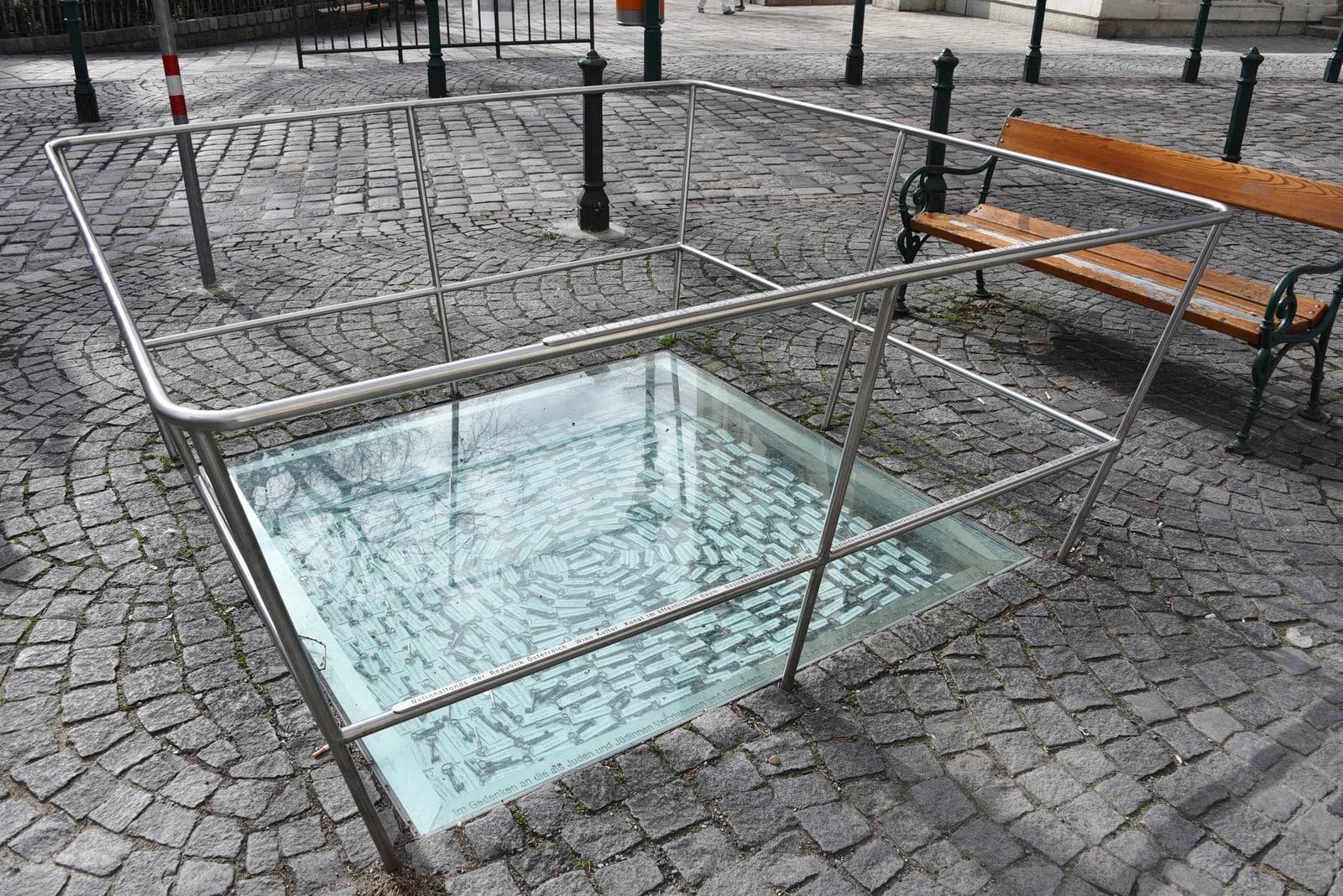
The first easy mistake is to spend the whole visit at shop-window height. Goodnight.at’s local neighborhood guide pairs the pleasure of strolling across Servitenplatz with the memorial embedded in its ground.[6] ORF’s account of a guided walk likewise finishes opposite the church, where the group looks down through the glass.[8] Follow that change of attention: at the forecourt, find the low railing around “Schlüssel gegen das Vergessen” — “Keys Against Forgetting.”
Julia Schulz’s memorial, unveiled in 2008, contains 462 keys bearing name tags. The community project behind it researched people connected with the street who were persecuted as Jews under National Socialism.[7] An address here had meant a home, a business, a place from which someone expected to come back. A key gives that expectation a familiar physical shape.
A second mistake is to assume the displayed keys are recovered possessions of the people named. The wording of the older Goodnight guide can leave that impression.[6] The project’s own account is more precise: residents across the Rossau neighborhood donated old keys as symbols of those the persecuted had been forced to surrender.[7] The names carry the researched identities; the donated objects are a later community’s act of remembrance.
Read from outside the railing. It was designed to prevent people stepping onto the glass and to be detectable with a cane.[7] Give the names 5–10 minutes of your hour. That is a suggested pause, with room to move aside if others are already reading. Choose a few names you can make out and consider the nearby doors; trying to take in the whole installation at once can make individuals disappear back into a quantity.
A place people return to
The association describes neighbors bringing visitors to the memorial and descendants looking for relatives’ names.[7] That continuing use matters. This is a stop within a lived-in street, where someone else may have a much more personal reason to stand beside you.
When you walk back toward Berggasse, take another look at the spaces between the storefronts: entrances, seats, room for someone to stop. The new benches make staying easier. The older memorial gives staying another purpose. An hour here can accommodate both the light pleasure of watching a neighborhood go about its day and the deliberate work of remembering who once belonged to it.
Sources
- STADTBEKANNT, “Ein Spaziergang durch das Servitenviertel” — local walking guide, Berggasse approach and the shop-lined route toward the church.
- r/wien, “I have four days in Vienna and love architecture. What should I see?”, June 27, 2024 — community recommendation to walk the Servitenviertel for its Gründerzeit architecture.
- Gebietsbetreuung Stadterneuerung, “Klimafitte Servitengasse” — completed 2023 redesign, public seating, pedestrian-zone boundaries, cycling and delivery access.
- Christian Michelides, “Denkmal Servitengasse – Schlüssel gegen das Vergessen,” February 13, 2016, Wikimedia Commons — source photograph, CC BY-SA 4.0.
- Stadt Wien, “Servitenmarkt” — Thursday location, seasonal dates and maximum opening hours; updated July 1, 2026, checked October 23, 2026.
- Robin Simsa, “Grätzl Guide: Servitenviertel,” Goodnight.at, September 20, 2018 — local account of the square and pavement memorial; key provenance clarified against the project’s own account.
- Verein Servitengasse 1938, “Gedenksymbol ‘Schlüssel gegen das Vergessen’” — research, Julia Schulz’s design, donated keys, accessibility considerations and continuing community remembrance.
- ORF extra, “Historischer Spaziergang durch das Wiener Servitenviertel” — reported neighborhood walk ending at the memorial opposite the Servitenkirche.