At Tokyo’s Metropolitan Government Building, begin by looking out and finish by looking up. From the south observatory, the illuminated towers of Shinjuku spread across the windows. Later, from the plaza below, you watch the building itself carry moving pictures. The observatory and the facade make a compact night out: one address, two very different distances from the city.[1][2]
Upstairs, the view begins on the 45th floor, 202 metres above the ground. Admission is free, as is the outdoor TOKYO Night & Light projection show.[2] That matters to the pace of the visit. You can give a window ten minutes, leave a photograph untaken, or wait for the next programme downstairs without calculating how much spectacle a ticket ought to buy.
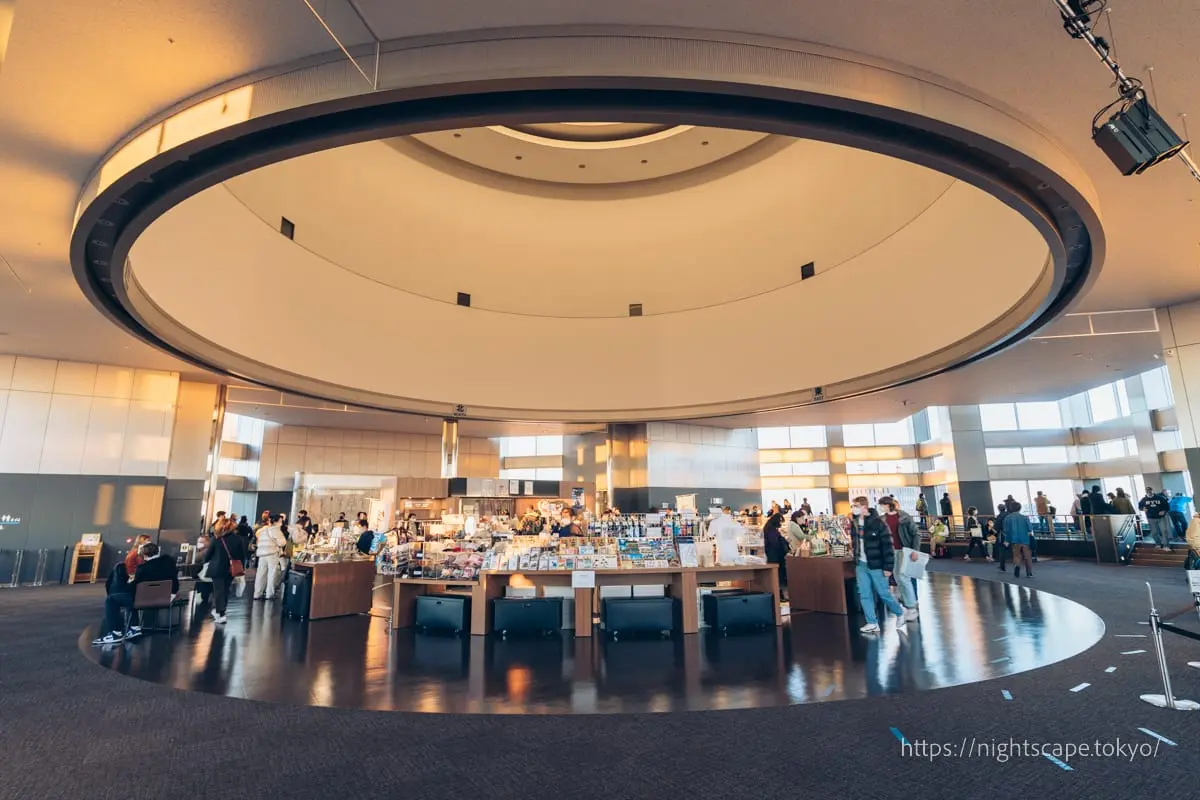
For the approach, Tochomae Station, Exit A4, is the useful name to save; GO TOKYO gives the remaining walk as about one minute.[2] Head for Main Building No. 1 and its dedicated observatory lift on the first floor. On Saturdays, Sundays and public holidays, the second-floor entrances are closed: go to the first-floor main entrance. Security staff can help with an internal lift route if stairs are difficult.[3] The destination is high above you, but getting the ground-floor door right saves the first unnecessary circuit.
The south room normally closes at 22:00, with admission ending at 21:30. It closes on the first and third Tuesdays; the north room normally covers those evenings, with holiday shifts and inspection closures governed by the official calendar.[3] Check that calendar before travelling. A remembered closing time is less useful than knowing which tower is receiving visitors tonight.
Tokyo Nightscape Navi, a Japanese specialist site whose editors photograph the places they review, warns of lift queues around sunset.[1] Arriving at the building as the sun disappears can therefore mean watching the best colour from the wrong floor. For twilight, my suggested margin is 60 minutes before local sunset; for a visit focused on darkness and the piano, choose 19:00–21:00 instead.[1][6] These are planning windows, not guarantees of a short queue. The official live indicator distinguishes 0–5 minutes, 5–30 minutes and over 30 minutes, and advance reservations are not accepted.[3]
Once upstairs, begin with the nearby buildings. The triangular crowns of Shinjuku Park Tower make a useful recognition point towards the southwest; the illuminated Docomo Tower helps orient the view towards Shinjuku Station.[1] Let your eyes move from those identifiable shapes into the less easily named city beyond. A panorama becomes more interesting when a few of its lights acquire an address.
The glass deserves a little patience. In a July 2026 discussion among JET Programme participants, one visitor praised the observatory as a retreat from the busyness below while warning about reflections in photographs.[4] Treat that as a practical limit, rather than a reason to abandon the room. Try a different window or camera angle, then put the phone down if the reflection keeps winning. Tripods are not permitted.[3] There is no obligation to turn every good view into a clean image.
The room also contains something whose scale is comfortably human. Its Omoide Piano, or memory piano, began with a Tokyo resident’s donated grand piano. Yayoi Kusama supervised its decoration, and the city announced its installation in 2019 as a way for visitors to make memories by playing or listening.[5] A personal possession became a shared instrument inside the metropolitan headquarters. That history gives the room a warmer centre than its height might suggest.
Evening playing hours are 19:00–21:00, with a five-minute limit per person.[6] There may be music when you arrive; the timetable offers an opportunity, not a booked concert. If someone is playing, make room for listeners and people passing through. Ask permission before posting a photograph or video that identifies the performer, as the piano rules require.[6] For a few minutes, the city beyond the windows can be the background to somebody else’s small act of courage.
Allow roughly 90 minutes to two hours for the whole visit, including the lift queue and one projection programme; that is a suggested allowance, not an official duration. Admission costs ¥0. A personal on-site budget of ¥0–1,000 leaves optional room for a drink or small purchase; transport is separate, and the upper figure is an allowance rather than a quoted menu price.[2] Nothing in this route requires a purchase.
Downstairs, turn towards the Citizens’ Plaza facing the building’s east wall, the projection surface.[1][8] The change is the pleasure: the building that held your viewing room now becomes the image in front of you. In a June 2026 r/Tokyo discussion, a visitor described watching from the lawn; another recalled expecting Godzilla and finding different characters instead.[7] The useful lesson is to leave space for the evening you actually find. Check the programme before promising anyone a particular character.
The official schedule checked on 22 October 2026 listed starts from 18:00 through 21:30 at half-hour intervals. Programmes and seasonal start times change, and stormy weather can interrupt screenings.[8] Save the current timetable rather than copying a summer start time from an old post. Choose a listed show and leave yourself time to descend; the observatory’s closing time is not the projection timetable.
You need not stay for every sequence. After looking down across Shinjuku, seeing people gather at the foot of the same building completes the change of scale. Upstairs the city stretches beyond easy comprehension. Down here, it is a patch of shared ground, a wall of light, and enough room to stop.
Sources
- Tokyo Nightscape Navi, “Tokyo Metropolitan Government Building South and North Observatories,” updated 25 September 2026 — Japanese-language local photographic report; sunset queues, landmarks, plaza and article photograph.
- GO TOKYO, “Tokyo Metropolitan Government No.1 Building,” updated 13 July 2026 — official tourism guide; observatory height, free admission, free projection show and Tochomae Exit A4.
- Tokyo Metropolitan Government Bureau of Finance, “Observatory visitor information,” checked 22 October 2026 — entrances, hours, closure calendar, live queue bands, reservation policy and tripod restriction.
- r/JETProgramme, “For JETs at Tokyo Orientation … visit the top of the Tokyo Metropolitan Government Building,” 27 July 2026 — participant discussion of evening visits and reflective glass; anecdotal evidence, with hours checked against the operator.
- Tokyo Metropolitan Government Bureau of Finance, “Installation of the Tocho Omoide Piano,” 1 March 2019 — original announcement describing the resident’s donation, Kusama’s supervision and the purpose of the shared instrument.
- Tokyo Metropolitan Government Bureau of Finance, “Notes about Piano Playing,” checked 22 October 2026 — current bilingual rules, evening playing hours, five-minute turns and permission before posting performers’ images.
- r/Tokyo, “Tokyo Night & Light @Tokyo Metropolitan Office Building,” 6 June 2026 — community discussion of lawn viewing and changing programmes; individual reports, not a current timetable.
- Tokyo Projection Mapping Executive Committee, “TOKYO Night & Light,” checked 22 October 2026 — official daily timetable, east-wall projection location and weather qualification.