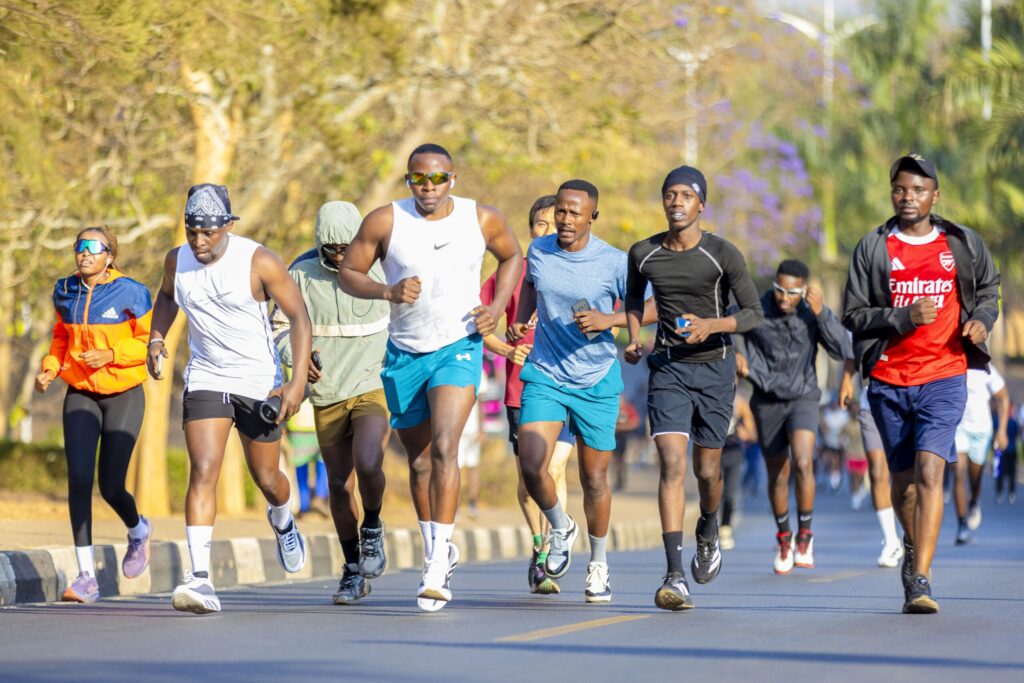
The yellow centre line runs between the runners’ feet. In KT Press’s photograph of Kigali’s Car Free Day, a loose group fills the lane, with black-and-white kerbstones at one side and flowering trees behind.[2] The road markings remain; the usual traffic has given way to people.
There is room for several speeds. RwandaLink’s local account describes walkers, runners, cyclists and exercise groups sharing the morning, with ages and abilities mixed together.[1] The invitation is easy to miss if you arrive looking for a race: walking is already participation.
In Kicukiro, give that invitation a specific shape. A September 2026 edition followed the road from Sonatube to IPRC Kigali, the technical college where the activity concluded.[2] These two names are enough for a morning. The pleasure is in joining a stretch of ordinary city life while its rules briefly change.
The morning begins with a date check
Living in Kigali, a community guide written from the city, places Car Free Day within its everyday transport advice. It dates the programme to 2016 and describes a twice-monthly interruption to vehicle traffic.[3] That setting matters: the event belongs to the same practical city as buses, commutes and journeys home. Visitors can enter its rhythm without making a separate excursion out of it.
The guide and RwandaLink give the familiar first and third Sunday pattern; the latter specifies 07:00–10:00.[1][3] Treat those as the normal framework, then check the City of Kigali’s announcement for your actual weekend. Its own notice advertised February 8, 2026, a second Sunday, and named IPRC Kigali as the Kicukiro site.[4] KT Press subsequently reported the Sonatube–IPRC route on September 13, also a second Sunday.[2]
That is the first visitor trap: counting Sundays and assuming the street closure follows. The local guides orient you, but a dated notice settles the morning. Check both the day and the district. RwandaLink lists sites across Kigali’s three districts, with arrangements that can vary by edition.[1] A pin labelled simply “Car Free Day” is less useful than a confirmed meeting point.
For an edition confirming this route and a 07:00 start, I would reach the Sonatube junction around 06:45, then keep 07:00–08:30 free. Those are suggested arrival and visiting allowances, not an official timetable. Ask a steward where the Kicukiro group is assembling before stepping into the road. Use IPRC Kigali as the onward landmark only after the day’s route is confirmed; September’s reporting establishes a precedent, not a permanent closure map.[2]
Walk into the company
Bring comfortable shoes and water, and start at a pace at which conversation would be possible. Living in Kigali points out the city’s rolling terrain in its cycling advice.[3] There is little reason to turn a first encounter with these roads into a test of stamina. My suggestion is to allow 60–90 minutes, including pauses, rather than promise yourself a distance you have not checked.
The second trap is assuming that a named run or a paid social package is the entrance ticket. In an r/Rwanda discussion about the expense of visiting, a community contributor specifically points to Car Free Day as an activity open to everyone without payment.[5] It is one person’s recommendation, not a survey of the city, but it is a useful correction to the idea that every outing needs a booking.
The distinction has a concrete example. RwandaLink advertised a separate September 13 run meeting at Fab Cafe Kigali, priced at RWF 3,000.[6] That fee belonged to an organised outing. Budget RWF 0 for joining the public activity on foot, plus whatever you spend reaching the route and buying refreshments.[5] Someone choosing a separate running group might pay more: the dated listing illustrates a RWF 0–3,000 range of participation choices, without promising that the same paid offer will be available next time.
Join the public walking activity without reserving a ticket. If you want a separately organised run, check that organiser’s current terms. If you stop beside an exercise group, leave space for people already moving and begin at the edge. These are simple ways to join without making the morning revolve around your arrival.
Leave room for the rest of the ritual
The gathering also has a less photogenic purpose. Kigali’s municipal account describes exercise alongside checks for non-communicable diseases; the February 2026 announcement likewise offered free screening.[7][4] A temporary health service belongs to the occasion as much as the moving crowd. Give consultations privacy. If you want to enquire about screening, ask staff about availability and the queue; the sources do not establish a dependable waiting time for visitors.
Finally, remember that the closure has an end. The community guides describe selected roads opening to people for a few hours, not unrestricted pedestrian access across Kigali.[1][3] That is the third trap: letting an unusually generous stretch of road change your assumptions about the next junction. Follow stewards at crossings, and return to ordinary pavement use when the restriction finishes.
There is no need to stay until the last exercise session. A good visit might consist of a walk, a pause beside the group and an unhurried departure. What makes it particular to this morning is the temporary permission to occupy a road together. Sonatube and IPRC remain useful directions afterwards; for a while, the space between them also gives people somewhere to meet.
Practical information checked October 23, 2026. Confirm the next edition’s date, meeting point and road closures with the City of Kigali.
Sources
- RwandaLink, “Three Hours Without Cars: Experiencing Kigali Car Free Day,” August 23, 2026 — local account of participation, usual hours and district sites.
- Sam Nkurunziza, “When Thousands Leave Their Cars Behind, Kigali Turns Streets into Spaces for Health,” KT Press, September 13, 2026 — recent reporting on the Sonatube–IPRC Kigali route and source of the photograph.
- Living in Kigali, “Transport in Kigali: A Beginners Guide,” September 25, 2021 — local community guide; programme history, terrain and the normal recurring pattern, checked against dated 2026 notices.
- City of Kigali, official Car Free Day announcement for February 8, 2026, on LinkedIn — primary confirmation of the date, IPRC Kigali meeting site and screening programme.
- r/Rwanda, “Why nobody talks about this?”, November 2024 — community discussion of visitor costs; one contributor identifies Car Free Day as free to join.
- RwandaLink, “Car Free Day Run,” September 13, 2026 — dated event listing for a separate RWF 3,000 organised run at Fab Cafe Kigali.
- City of Kigali, “City of Kigali shortlisted for global award,” 2019 — primary background on the recurring street programme and its public-health purpose.