
The Met's short video The Artist Project: Zarina Hashmi is not a survey of Zarina's career. It is narrower and more revealing: the artist stands inside the museum's collection and speaks about Arabic calligraphy, script, and what happens when language becomes separated from daily life.[1] That narrowness is the video's strength. Zarina's art is often described through minimalism, geometry, maps, and paper, but this clip reminds the viewer that the apparent spareness is not cold reduction. It is a way of giving loss a form strict enough to survive sentimentality.
Zarina, born in Aligarh in 1937 and later based in New York, worked across printmaking, paper, drawing, and sculpture. Her biography is inseparable from travel, Partition's afterlife, family dispersal, and the problem of home as a place that can become unreachable even while memory keeps redrawing it.[2][3][4] The Met's record for Home is a Foreign Place describes a 1999 portfolio of thirty-six woodcuts, each pairing an abstract image with an Urdu word.[2] Hammer Museum's retrospective page gives the larger frame: paper was central to her practice not only as a surface, but as a material with its own history, skin, vulnerability, and capacity to carry exile.[3]
The video is worth watching because it gives the written record a voice. Zarina does not treat script as ornament. She treats it as a bodily attachment: a way of touching memory after geography has failed.[1] A reader who cannot play the video should still retain the central argument. Zarina's lines, words, and maps do not explain displacement from the outside. They make displacement into a visual grammar: spare, portable, wounded, and exact.
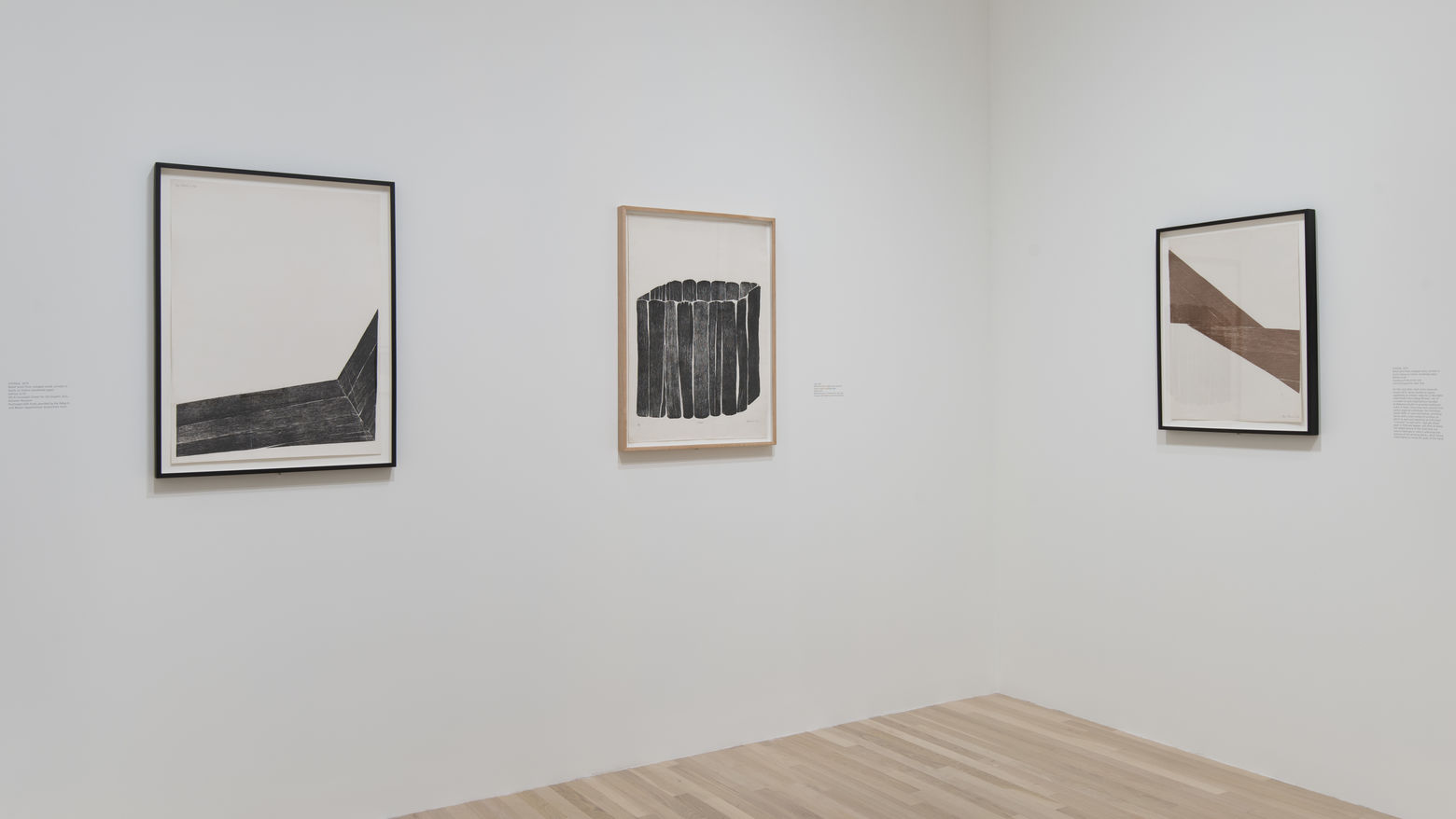
Image context: the cover photograph comes from Hammer Museum's 2012 retrospective Zarina: Paper Like Skin. It shows framed works installed with enough space around them to make the article's point visible. Zarina's small marks and reduced forms need distance; the emptiness around them is not neutral gallery air, but part of how her work lets memory remain both present and withheld.[3]
The opening makes script tactile before it becomes symbolic
The first thing to notice is that Zarina's attention to calligraphy is not merely literary.[1] She is not discussing text as information, nor is she treating script as decorative cultural flavor. The video frames written form as something that can be seen, handled, remembered, and lost. That emphasis matters because Zarina's own work repeatedly asks words to carry more than definition. In Home is a Foreign Place, words such as memory, distance, road, threshold, or home do not sit beside images as simple labels. The Met describes the portfolio as a suite where abstract images and Urdu words work together, binding modernist reduction to the artist's mother tongue and to a life shaped by movement.[2]
That is why the clip should be watched slowly. Zarina's voice makes clear that language is not interchangeable. Translation can carry meaning, but it cannot always carry touch, sound, childhood proximity, or the private architecture of a word first learned at home.[1][2] Her art keeps returning to that gap. The image may be reduced to a line, a dark plane, a grid, or a map-like mark, but the reduction does not empty the work. It concentrates what cannot be recovered fully.
Around the middle, loss becomes a problem of form
The most useful way to read Zarina is to avoid the lazy contrast between minimal form and emotional content. Her strongest works prove that the two are the same problem. Hammer's retrospective description is precise on this point: her vocabulary is minimal yet rich in associations with displacement and exile, and paper is central both as a working surface and as material.[3] The Guggenheim similarly places her work across printmaking, paper, and sculpture, with a career rooted in modernist form but marked by personal histories of migration.[4]
The Met video sharpens those institutional summaries because it shows how little Zarina needs in order to make loss legible.[1] A single word in Urdu can behave like a room. A line can behave like a route. A paper surface can become a border, a wall, or a skin. In the Whitney's collection record for Wall, the work is described as a relief collagraph from 1969, a medium that depends on pressure, texture, and printing from a built surface.[5] That object helps explain the later language works. Zarina's walls are not only barriers in subject matter. They are made through material pressure: pressed, inked, transferred, and held at the edge between drawing and object.
The video turns home into a portable structure
The phrase Home is a Foreign Place can sound paradoxical until the video gives it emotional logic.[1][2] For Zarina, home is not simply a house left behind or a nation remembered from abroad. It is a structure made from language, orientation, family history, and repeated acts of naming. When those supports scatter, home does not disappear cleanly. It becomes foreign from within. The place one longs for can survive as script, map, plan, route, or word even after it stops being an address.
This is where her work differs from generic nostalgia. Nostalgia often tries to refill the lost place with atmosphere. Zarina does the opposite. She removes almost everything that would make memory picturesque. No crowded domestic scene. No sentimental family tableau. No lush color standing in for belonging. What remains is the skeleton of orientation: line, paper, word, edge, pressure, and spacing.[2][3][4] The result is not less emotional. It is more disciplined. The viewer has to feel how much has been withheld.
That discipline also keeps the work from becoming biography alone. Zarina's life matters, but the art does not ask for sympathy as a substitute for looking. It asks the viewer to notice how a form carries experience. The blackness of a printed block, the fragile authority of handmade paper, the pause around an Urdu word, and the severe distance between framed works all become ways of measuring displacement.[2][3][5]
The closing lesson is that language is not outside the artwork
The Met clip is short, but it changes how one reads Zarina's spare images.[1] After watching it, the words in her prints no longer seem added to abstraction. They are one of abstraction's materials. They give line and space a memory of speech; they let paper hold the pressure of a lost tongue without turning the work into illustration. This is why her art can belong to modernism and still resist the idea that modernism must purify form away from history.[2][4]
The Hammer installation photograph used here reinforces that point.[3] On the wall, Zarina's works do not shout. They wait. Their scale asks the viewer to approach, but their restraint keeps full possession out of reach. That tension is the right one for an art of exile. The work lets home appear as a word, a mark, a map, a surface, and a silence, but never as something easily restored.
Zarina's achievement is to make that difficulty beautiful without making it easy.[1][2][3] The video gives a clear viewing method: listen for language as material, then look at paper as a place where language has been pressed, carried, and partly lost. Once seen that way, the spareness stops looking empty. It becomes the exact amount of form needed for memory to keep moving.
Sources
- The Metropolitan Museum of Art, "The Artist Project: Zarina Hashmi," YouTube video.
- The Metropolitan Museum of Art Collection API, object 499720, "Zarina - Home is a Foreign Place" - collection metadata for the 1999 portfolio of thirty-six woodcuts with Urdu text.
- Hammer Museum, "Zarina: Paper Like Skin" - exhibition page for the 2012 retrospective and source for the installation photograph used as the article image.
- The Guggenheim Museums and Foundation, "Zarina" - artist page covering biography, media, Venice Biennale participation, and exhibition context.
- Whitney Museum of American Art, "Zarina, Wall, 1969" - collection record for the relief collagraph and its medium, dimensions, and collection context.