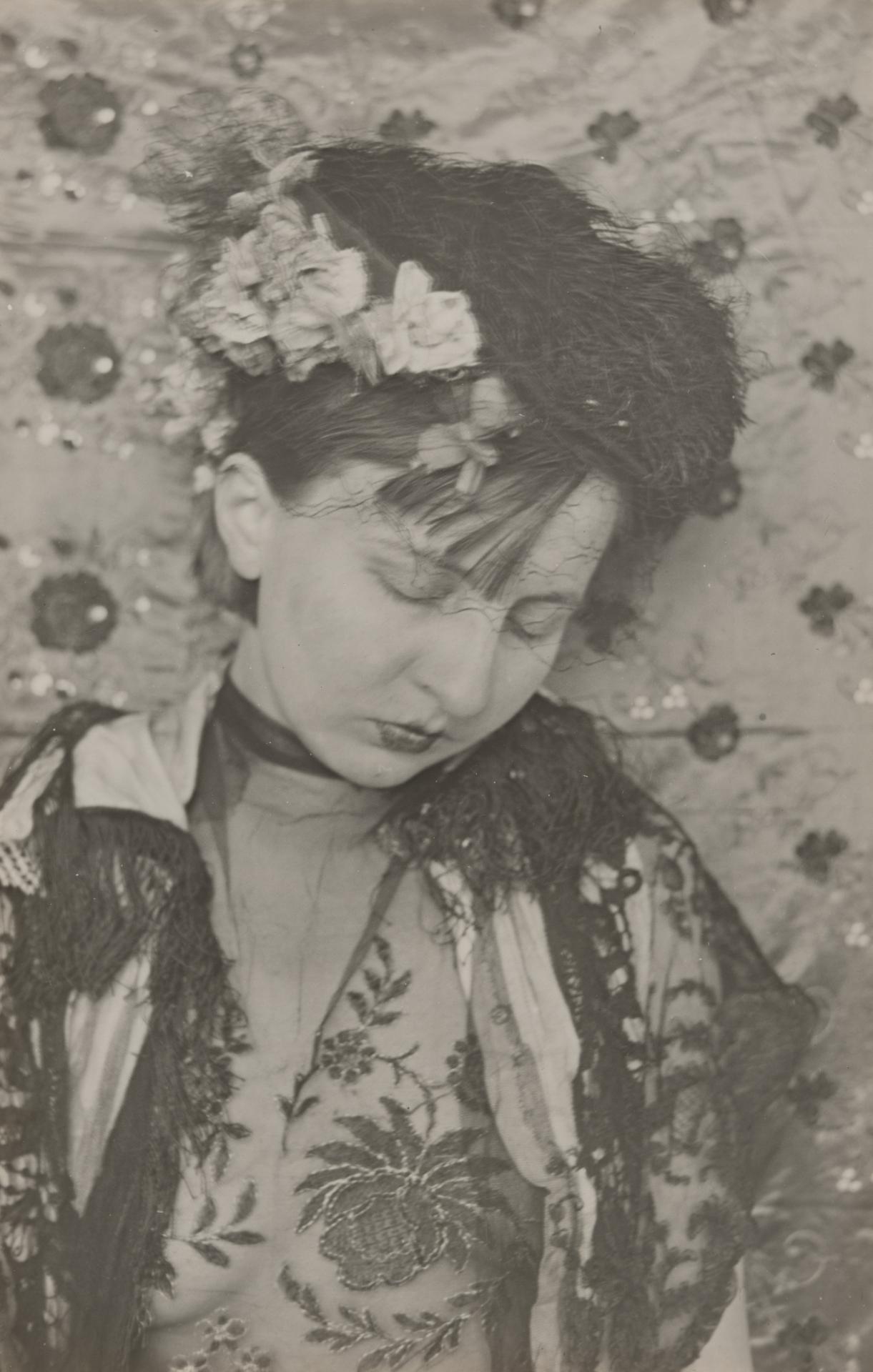
Gertrud Arndt's mask portraits look quiet only if you mistake quietness for compliance. In Mask self-portrait no. 11, she lowers her face beneath flowers, lace, netting, and patterned fabric. The pose is soft, almost withdrawn. The photograph is not. It makes femininity look like a construction assembled in front of the lens, tested once, then tested again in another costume.
That is the reason Arndt deserves more than a footnote inside Bauhaus history. Her strongest photographs do not simply document a woman trying on theatrical identities. They turn the self-portrait into a studio experiment about how little is needed to make a person appear socially legible: a veil, a textile, a tilt of the head, a backdrop, a direct stare or its refusal. The National Gallery of Victoria identifies Mask self-portrait no. 11 as a 1930 gelatin silver photograph from the series Arndt called "mask portraits," made with stylized settings, costume, and textured materials.[1] The work is small, but the problem it opens is large: when a face becomes an image, where does the self end and the role begin?
From Architecture To A Private Stage
Arndt entered the Bauhaus with an architectural ambition. The Bauhaus-Archiv notes that she originally wanted to become an architect, but because a regular architecture course was not yet offered, Georg Muche drew her into the weaving workshop, where she became a textile specialist and made a carpet for Walter Gropius's office.[4] That path matters because it keeps the photographs from looking like an accidental hobby detached from training. Arndt's mask portraits are full of textile intelligence: surface, pattern, drape, edge, density, and optical rhythm.
After completing her apprenticeship, the Bauhaus-Archiv says, Arndt turned fully toward photography and, beginning in 1929, made the self-portrait series she called Mask Portraits.[4] The move from weaving to photography was not a clean break. It was a translation. In the cover image, fabric does not sit passively around the body. It does the work of staging. A patterned backdrop presses forward. Lace and netting soften and interrupt the face. A dark garment cuts the shoulder line. Flowers add a theatrical accent that is pretty enough to be suspicious.
This is why the portraits should not be reduced to "dress-up." Dress-up implies escape from seriousness. Arndt uses dressing as analysis. She shows that portrait identity is made from codes the camera can amplify: widow, child, coquette, society woman, exoticized figure, melancholic performer. The codes are recognizable, but they never become stable. Each image seems to ask whether a role is being inhabited, mocked, borrowed, or exposed.
The Face As A Switch
The strongest fact about the mask portraits is how economical they are. NGV describes the series as 43 self-portraits made through costume and stylized settings, while MoMA's artist page places Arndt at the intersection of architecture, Bauhaus, photography, self-portrait, and textile.[1][2] That combination is the key. These are not lavish theater productions. They are small acts of photographic switching, built from available things.
That economy gives the images their bite. A little fabric near the eye changes the face. A patterned wall behind the head changes the social temperature. A lowered gaze can make the sitter look demure, absent, bored, resistant, or strategically unreadable. In Mask self-portrait no. 11, the face is not hidden; it is withheld by degrees. One eye is partly screened. The mouth is closed and dark. The head turns downward as if refusing the usual portrait bargain, where a sitter offers the viewer enough access to feel in control.
MoMA's object record for Arndt's 1930 Untitled (Masked Self-Portrait, Dessau) places the work squarely in photography: a gelatin silver print, 9 by 5 5/8 inches, now classified under Bauhaus, self-portrait, textile, and photography terms.[3] That cluster of categories is useful because the mask portraits work only when those terms collide. They are photographic, but they depend on fabric. They are self-portraits, but they multiply the self into roles. They belong to Bauhaus history, but they push against the clean, functional image of Bauhaus modernism by making theatrical ambiguity central.
Against The Smooth Bauhaus Myth
The Bauhaus is often remembered through clarity: steel tube chairs, sans serif order, glass, grid, workshop rationality. Arndt complicates that memory without leaving it. Her portraits are formally disciplined. They use tight framing, frontal staging, tonal control, and repeated procedures. But the discipline serves instability. Instead of presenting the modern subject as cleanly designed, Arndt presents identity as something provisional, theatrical, and materially mediated.
NGV's note on Mask self-portrait no. 11 is especially sharp here because it says Arndt strayed from the sharp angles and abstracted patterns common in modernist photography of the period, choosing instead an experimental portrait focused on identity.[1] That does not make her less modern. It makes her modern by another route. She is not modern because she photographs a bridge from below or turns the city into geometry. She is modern because she understands the self as a constructed image.
Smarthistory's essay on Self-Portrait with Veil emphasizes the way Arndt's mask portraits use costume, domestic materials, and photographic setup to trouble fixed ideas of femininity.[5] That reading matters because the series can look playful at first glance. It is playful, but play is not the opposite of critique. Play is the method. By repeating herself as different figures, Arndt makes femininity look less like essence than arrangement.
The Domestic Is Not Minor
The portraits also resist a hierarchy that would put public architecture above domestic material. If Arndt had made buildings, art history might have found her ambition easier to name. Instead she made photographs with veils, patterned cloth, flowers, and improvised props. The risk is that those materials get treated as smaller, softer, less serious. The photographs refuse that demotion.
In Arndt's hands, domestic materials become instruments of analysis. A curtain can behave like a stage set. Lace can behave like a filter. Pattern can flatten space until face and background compete. Costume can reveal how gendered signs attach themselves to a body. The series is not arguing that identity is fake. It is arguing that identity becomes visible through surfaces, gestures, and expectations that can be recombined.
That is why the camera matters so much. A mirror lets a person test an appearance privately. A camera fixes that test and makes it available for comparison. Across a series, the viewer begins to see identity not as a single revelation but as a set of variables. Change the textile, change the gaze, change the crop, and the person changes without disappearing. The mask is not a lie placed over a true self. It is a device for showing how many selves a portrait can summon.
Why Arndt Still Feels Sharp
Arndt's photographs now sit easily beside later conversations about performance, self-fashioning, gender, and the staged photograph. That can make them sound like precursors, valuable mainly because they point toward later artists. The better reason to look at them is that they remain visually exact on their own terms.
The cover image holds because it never resolves. The lowered face could be modesty, melancholy, masquerade, parody, or concentration. The floral ornament could be decorative excess or a clue that decoration itself is the subject. The veil could conceal or produce the face. The patterned backdrop could be a room, a textile, a theatrical wall, or a second skin. Nothing in the photograph lets the viewer settle into one answer.
That refusal is Arndt's achievement. She used the most available materials around her to make the self-portrait unstable in a disciplined way. The Bauhaus trained artists to understand form, material, and process. Arndt applied that lesson to identity. In the mask portraits, the face is not a destination. It is a switchboard. The photograph does not uncover the true Gertrud Arndt behind the costume. It shows how a costume, a camera, and a face can make truth more complicated than exposure.
Sources
- National Gallery of Victoria, "Mask self-portrait no. 11, Gertrud Arndt" - object page for the 1930 gelatin silver photograph used as the cover image, with series context and description of Arndt's staged materials.
- The Museum of Modern Art, "Gertrud Arndt" - artist page listing Arndt's Bauhaus, architecture, photography, self-portrait, and textile contexts and her online MoMA works.
- The Museum of Modern Art, "Gertrud Arndt. Untitled (Masked Self-Portrait, Dessau). 1930" - collection record with medium, dimensions, object number, and photography/Bauhaus classification context.
- Das Bauhaus-Archiv / Museum fur Gestaltung, "Female Bauhaus: Gertrud Arndt" - exhibition page on Arndt's architecture ambitions, weaving workshop path, Gropius carpet, and turn to Mask Portraits from 1929.
- Smarthistory, "Gertrud Arndt, Self-Portrait with Veil" - close-reading essay on Arndt's masked self-portraits, costume, domestic materials, and staged femininity.