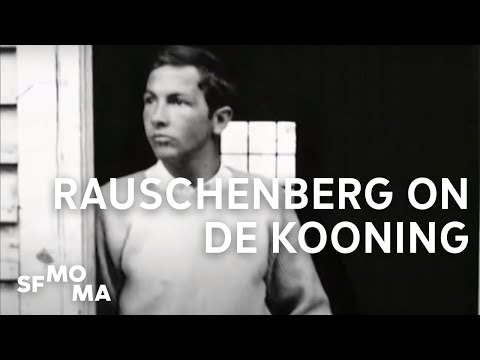
Robert Rauschenberg's Erased de Kooning Drawing can sound like an art-world anecdote that already explains itself: a young artist asks Willem de Kooning for a drawing, erases it, and exhibits the result. The SFMOMA video embedded below is useful because it slows that story back down. It lets Rauschenberg describe the act as a problem he had to make harder before it could become art, and it keeps the viewer inside the tension between destruction, permission, homage, and authorship.[1][2]
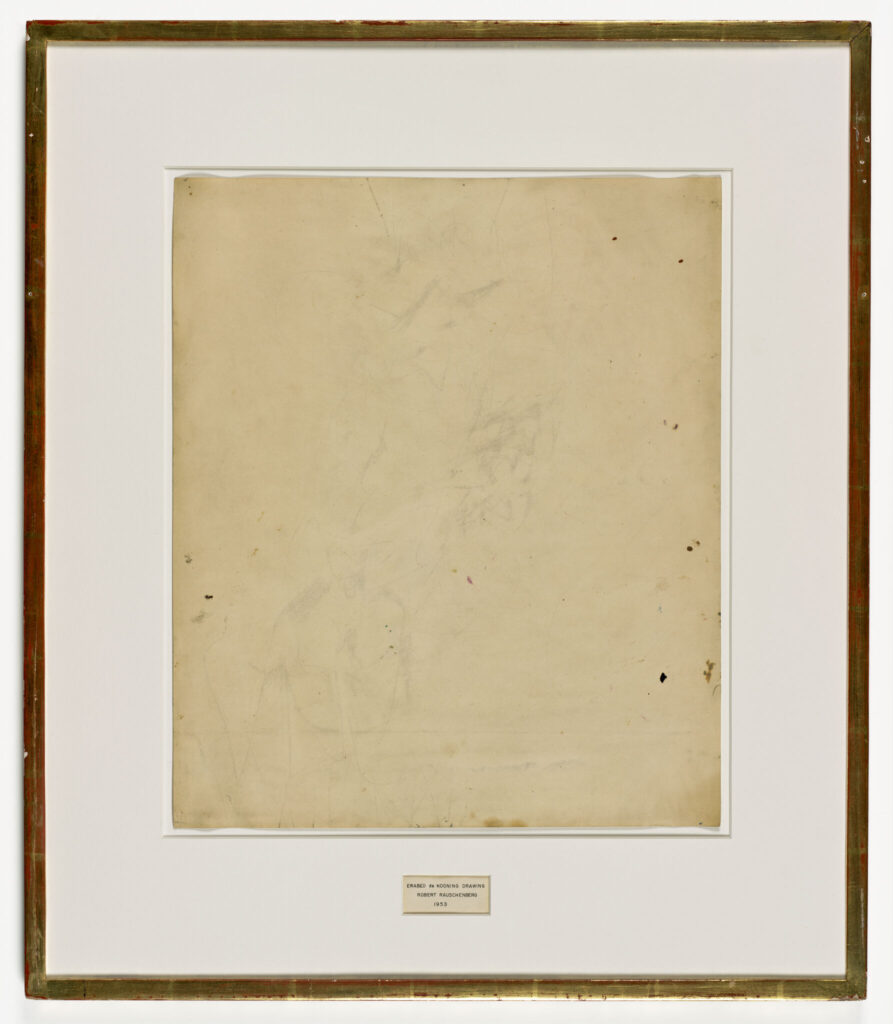
The object's visible facts are almost perversely modest. SFMOMA identifies it as traces of drawing media on paper with a hand-lettered label and gilded frame, made in 1953 and acquired by the museum in 1998.[3] The Robert Rauschenberg Foundation gives the same basic material identity and dimensions: 25 1/4 by 21 3/4 inches, with the work now in SFMOMA's collection.[5] Those measurements matter because the piece is not monumental by size. Its scale is domestic, drawable, nearly intimate. The force comes from the gap between what happened to the sheet and what little remains to see.
Before watching, hold onto one interpretive guardrail: the work is not simply a stunt against Abstract Expressionism. It depends on de Kooning's participation. SFMOMA's object essay stresses that Rauschenberg had already tried erasing his own drawings and found the result insufficient; he needed a drawing that was already unquestionably art, by an artist he respected, for the act of removal to carry weight.[3] De Kooning's reluctant agreement is therefore not a footnote. It is the condition that keeps the work from collapsing into vandalism. The erased drawing remains a collaboration under pressure, even if the collaboration consists of one artist making a mark field and another artist nearly removing it.
The lead image is a real photographic reproduction of the finished object from SFMOMA's collection page.[3] It belongs here because this article depends on presentation, not just backstory: the sheet, the low-contrast traces, Jasper Johns's label, and the gilded frame are all parts of the final work. The eye has to read not only an absence but the devices that tell us how to treat that absence.
Watch for how Rauschenberg turns difficulty into evidence
The video's key lesson is that erasure alone was not enough.[1][2] Rauschenberg's own drawings could be erased, but that only made a private studio exercise. The act became legible as an artwork when the starting object had art-historical authority before he touched it. That is why de Kooning matters as more than a famous name. His status raises the ethical and formal stakes: if the drawing is valuable before erasure, then removal becomes a visible decision rather than a blank technical effect.[3]
This is also why the story should not be flattened into rebellion. The work certainly challenges the heroic mythology of gesture that surrounded postwar New York painting. Yet it does so by accepting that the erased sheet needed a meaningful gesture to begin with. Rauschenberg does not erase a random scrap. He erases a drawing whose prior authority makes absence charged. The finished work keeps de Kooning present by making his lost marks the thing the viewer most wants to recover.
The paradox is that the finished object asks for close looking while withholding the usual reward of close looking. One stares at the sheet and finds faint residues, pressure ghosts, and the behavioral evidence of labor. SFMOMA's 2010 imaging project sharpened that paradox. Its digitally enhanced infrared scan made some remaining graphite and charcoal traces visible to the naked eye, suggesting several figure studies on the original sheet, including a figure likely related to de Kooning's Woman series.[4] But SFMOMA's essay is careful about the result: the enhanced image does not solve the work by replacing absence with content. It shows what Rauschenberg had to grapple with, then returns the viewer to the finished piece's more difficult condition.[3][4]
The frame and label are not accessories
The SFMOMA object page emphasizes that the simple gilded frame and understated inscription are integral to the artwork.[3] That is exactly right. Without the label, the sheet might read as damaged paper, failed conservation, or an unfinished study. With the label, the pale field becomes a record of a named action: Rauschenberg, de Kooning, drawing, erasure, 1953. The label does not decorate the work. It supplies the minimum language needed for the viewer to understand that the nearly blank sheet is not empty by accident.
Jasper Johns's role in labeling and framing the work matters for the same reason.[3] The frame gives the erased sheet a historical posture: a modest work on paper treated with the ceremony of a preserved drawing. That ceremony is slightly absurd and completely necessary. The gold edge gives importance to what the eye can barely find. It also prevents the work from becoming pure concept. The object remains materially present: paper, label, frame, residual marks, and institutional display all have to cooperate.
That is where the SFMOMA video is strongest as an anchor for viewing.[1][2] Hearing the account makes the work less chilly. The piece is often described as conceptual, but the process was physical and time-bound: erasers, pressure, paper fibers, the stubborn survival of marks, and the uncertainty of how much removal could be enough. The finished object preserves that labor not by showing a dramatic before-and-after contrast, but by forcing the viewer to imagine the effort from the traces that escaped it.
Absence becomes a medium
The usual verb for drawing is additive: line is put down, tone is built, form accumulates. Erased de Kooning Drawing reverses the direction without leaving drawing behind. It is still about touch, pressure, surface, and mark. The difference is that the decisive gesture works by subtraction. Removal becomes the mark-making system.
That reversal is why the 2010 infrared scan is fascinating but also slightly dangerous for interpretation.[4] It satisfies curiosity, yet the artwork's power does not depend on reconstructing de Kooning's lost composition. If the scan became the main event, the viewer could treat Rauschenberg's work as a puzzle with a recovered answer. The better use of the scan is more disciplined: it confirms that something worked, dense, and figural was there, while the finished object insists that the art now lies in the transformation from visible drawing to charged remnant.[3][4]
The piece also clarifies a broader problem in postwar art: how to move beyond expressive gesture without pretending gesture never mattered. Rauschenberg's answer was neither pure negation nor pure homage. He made a work that needed de Kooning's mark, de Kooning's consent, Rauschenberg's labor, Johns's inscription, and the viewer's knowledge of the exchange. Authorship becomes distributed, but not dissolved. Each participant changes what the sheet can mean.
That is why the object still feels sharp. It does not merely ask whether destruction can be creative. It asks what has to be in place before removal can count as creation: a prior artwork, a social permission, a visible frame, a naming device, a surviving trace, and an audience willing to look at nearly nothing long enough for the conditions to appear.[1][3][5]
What to carry away
Use the SFMOMA video as a corrective to the shortest version of the story.[1][2] Erased de Kooning Drawing is not strong because it is outrageous. It is strong because every support around the act is unusually exact. De Kooning's consent keeps the work inside an ethical exchange. Rauschenberg's labor makes erasure materially serious. Johns's label and frame make the result readable. SFMOMA's later imaging reminds us that the lost drawing remains present as pressure, not as recoverable spectacle.[3][4]
The finished work makes absence behave like drawing because it never lets absence float free. It ties absence to paper, hand, name, frame, institution, and memory. That is why the piece remains difficult after the anecdote is known. The story gets the viewer to the frame. The art begins when the viewer stays there, looking at a surface that has been almost cleared but not emptied.[3][5]
Sources
- SFMOMA, "Robert Rauschenberg, Willem de Kooning, and a bottle of Jack Daniels" - YouTube video embedded in this post.
- San Francisco Museum of Modern Art, "Robert Rauschenberg, Willem de Kooning, and a bottle of Jack Daniels" - SFMOMA video page identifying the clip's subject and provenance.
- San Francisco Museum of Modern Art, "Robert Rauschenberg, Erased de Kooning Drawing, 1953" - official object page, collection record, and interpretive essay.
- San Francisco Museum of Modern Art, "Digitally enhanced infrared scan of Robert Rauschenberg's Erased de Kooning Drawing" - research material on the 2010 imaging project and remaining traces.
- Robert Rauschenberg Foundation, "Erased de Kooning Drawing" - foundation artwork record with medium, dimensions, collection, and catalogue identifier.