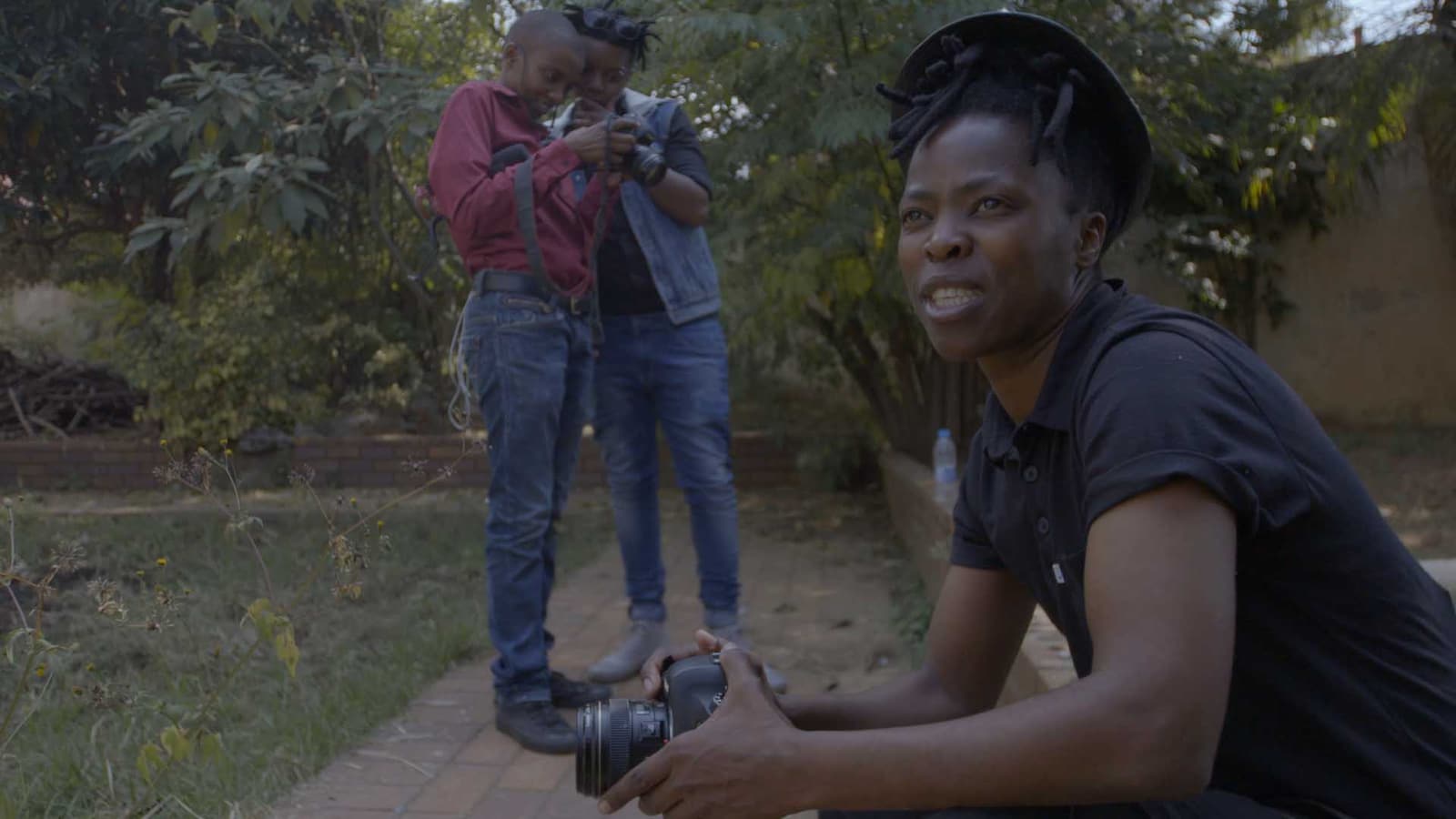

A photographic studio is usually imagined as a controlled room: lights stay fixed, backgrounds wait, and people enter the photographer's territory. Zanele Muholi's Mobile Studios begins elsewhere. In Daveyton, east of Johannesburg, a fur coat, a camera, a patch of shade, several collaborators, and a participant ready to be photographed are enough to make a temporary studio. The location is not a picturesque substitute for a proper room. It is the first decision in a different account of what a portrait session can be.
Art21's film lasts less than four minutes, but it follows the photograph farther than most accounts of portrait making do. It starts with direction and posing, then names people working around the camera, travels with participants into a Cape Town exhibition, and ends at a wall where they write their own words beside the images. That movement—from session to display to testimony—is the video's real subject.[1][2]
Muholi identifies as a visual activist. Their long-term projects include Faces and Phases, a growing portrait archive of Black lesbian, transgender, and queer people, and Brave Beauties, which centers trans women and gender-nonbinary participants, many connected to beauty-pageant culture.[2][3][4] The film is worth watching not because it offers a frictionless formula for collaborative photography, but because it makes four normally hidden questions visible: Who chooses the site? Who receives credit? What happens to a portrait after the shutter closes? And can the person pictured address the gallery in a voice that is not confined to the image?
0:08 — A site becomes part of the method
The opening exchange is practical and warm. Muholi asks a participant to show their eyes, breathe, and reassures them that they can do it; a joke about the fur coat loosens the session. There is direction here, not the fiction that the camera simply witnesses an untouched reality. Muholi controls framing and timing, while the person in front of the lens negotiates how to appear.
Around 0:28, the film widens from one pose to the idea of “mobile studios.” Muholi does not want portrait making fixed in one designated space. A few seconds later, that mobility is tied to citizenship: people live here, pay taxes, and inhabit a country that calls itself democratic. When Muholi says that any space can be a possible space, “space” means more than a usable background.[1] It means that a township home, yard, or community setting can support a formal image without needing cultural permission from a downtown studio or museum.
That claim has a political edge because legal recognition and lived safety have not moved in parallel. Stevenson made the tension explicit in its 2017 Cape Town exhibition: democratic milestones mattered, but they had not made social mobilization unnecessary while violence persisted.[3] The mobile studio does not solve that contradiction. It refuses to let it dictate where a serious portrait may be made.
0:57 — Naming the network around the camera
At roughly 0:57, Muholi starts naming people: Bathini, Collen, Carla, and project coordinator Lerato. The sequence is brief, yet it corrects the familiar image of the solitary photographer producing a subject through private vision. Mobile Studios shows a small network carrying clothes, coordination, local knowledge, encouragement, and trust into the frame even when only one person will appear in the finished photograph.[1]
Muholi then distinguishes participants in Faces and Phases from those in Brave Beauties. The categories give the archive structure, but the filming resists turning them into types. A pose is adjusted person by person. The laughter at the shoot is as important as the formal, frontal images later seen in the gallery: it preserves evidence that self-presentation is work, pleasure, performance, and conversation before it becomes a print.
There is still an imbalance of authority. Muholi selects the exposure, the portrait, and the series; gallery presentation introduces further choices about scale, sequence, and placement. Calling a process collaborative should not make those choices disappear. What the named credits do is make responsibility easier to see. The image is authored, but its conditions are collective. That is a stronger ethical proposition than pretending the photographer has withdrawn.
1:34 — The portrait does not end at the shutter
The film's decisive turn comes around 1:34, when Muholi explains that participants travel to exhibitions and see what happens to their photographs. This follow-through changes the time span of the relationship. The film does not let that relationship appear to end when the camera clicks; circulation, scale, audience, and gallery context enter its account of portrait making.
At the exhibition, Muholi asks how many participants have visited a gallery before. At least one answers that they have not.[1] The exchange makes visible an institutional border that the finished prints could easily conceal. A museum or commercial gallery may celebrate a marginalized sitter while remaining unfamiliar territory to that same person. Bringing participants into the room does not automatically redistribute curatorial power, but it lets them inspect the destination rather than merely supply its imagery.
That practice belongs to a larger archival commitment. Art21 describes Faces and Phases as an ongoing, lifetime project rather than a finished portfolio, and places it beside Brave Beauties and Muholi's self-portraiture as related ways of asserting presence.[4] The International Center of Photography similarly describes Muholi's work as made with and within communities, and as an effort to build the queer South African visual archive that official history failed to preserve.[5] In this context, an exhibition visit is not an educational bonus. It is one checkpoint in the image's public life.
2:05 — Writing interrupts the beautiful wall
At about 2:13, a participant explains what exhibition means to them: public evidence of existence and humanity. The video then arrives at its most important device, the “activist wall.” Participants write testimonials and declarations directly onto the gallery surface beside the Brave Beauties portraits. Stevenson described this wall as an interactive element sharing experiences from trans women and gender-nonbinary people; the exhibition paired joy with the brutality that Black LGBTQI communities continued to face.[3]
Muholi says the writing destabilizes the gallery's peaceful imagery.[1] That phrase identifies a risk inside even admiring portraiture. A beautifully lit face, enlarged and evenly spaced on a white wall, can be praised while the viewer remains insulated from the person's history. Formal dignity may counter degrading representation, but elegance can also make conflict feel resolved. The handwritten wall breaks that calm. It gives the pictured person a second form: not only likeness, but language.
The writing should not be treated as a caption that explains a supposedly incomplete photograph. Image and testimony do different work. The portrait makes posture, styling, gaze, and scale public; the wall allows first-person statements to enter a setting where museum labels normally hold explanatory authority. Together they keep the gallery from closing the meaning around either victimhood or beauty.
2:57 — An archive is a set of returns
In the final minute, Mobile Studios alternates between Muholi's account of historical visibility and the participants' ease before the camera. One person jokes that the lens may zoom in because they have no pimples. The line matters. It lets humor survive the heavy institutional vocabulary of representation, citizenship, and archive. These are not generic symbols recruited to illustrate a social issue; they are people actively styling how they meet a lens.[1]
The film is compressed enough to make the process look smoother than it can be. It does not show disagreement over a selected photograph, control of future reproduction, or what happens when artist and participant want different things. Mobility by itself guarantees none of those negotiations. Nor does an activist wall dissolve the authority of the photographer, gallery, or filmmaker.
What the video does show is a practice designed around return. The camera goes to the participant rather than requiring the participant to enter a fixed studio. Muholi names the people who make the session possible. Participants follow their photographs into the exhibition. Their writing then comes back toward the viewer, interrupting a one-way gaze. Each return adds a chance to see how representation is working and to answer it.
Watch the film once for the making of a portrait and again for everything that surrounds it: locations, names, travel, wall text, laughter. The second viewing reveals that the mobile studio is not simply portable equipment. It is an effort to keep the photograph connected to the social world from which it came—and to let the person inside the frame speak after the image has begun to circulate.
Sources
- Art21, “Zanele Muholi: Mobile Studios | Art21 ‘Extended Play,’” official YouTube video, May 29, 2019.
- Art21, “Zanele Muholi: Mobile Studios (Short)” — official film page with production provenance, credits, series context, and project overview.
- Stevenson, “Zanele Muholi,” Cape Town exhibition, August 31–October 7, 2017 — institutional account of Brave Beauties, the activism wall, and the exhibition's democratic context.
- Art21, “Zanele Muholi” — institutional artist profile describing Faces and Phases, Brave Beauties, self-portraiture, and the larger visual-activist practice.
- International Center of Photography, “Shifting the Negative: An Evening with Zanele Muholi,” 2016 — institutional essay on visual activism, portraiture, community, and archive building.
- Art21 Magazine, “New Video: Zanele Muholi Unplugs from the Studio,” 2019 — source and caption record for the Daveyton production still used as the cover image.