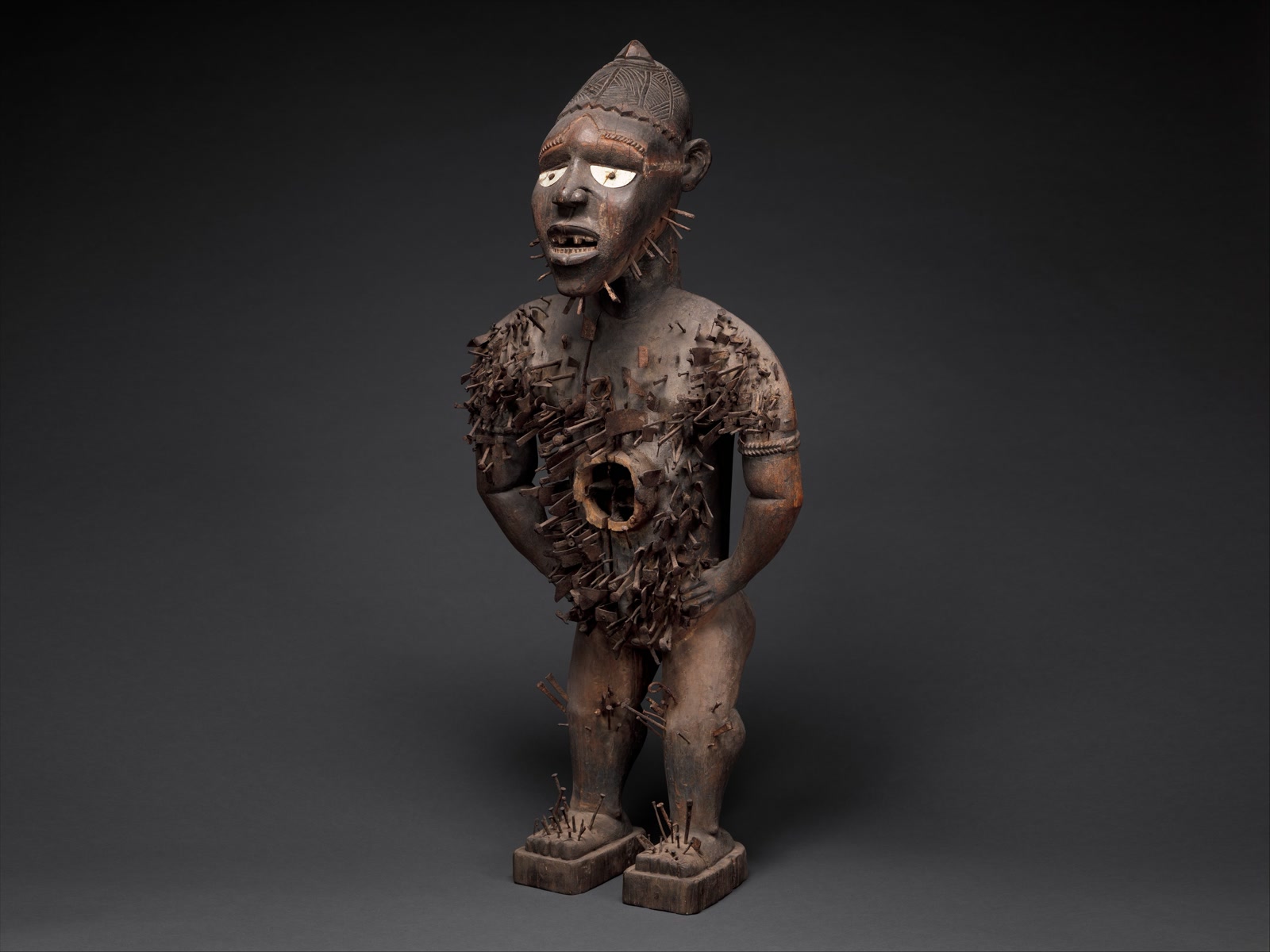
First the eyes: two white ceramic shapes, each fixed on the viewer by an iron pupil. Then the open mouth, the forward-leaning head, and the hands pressed hard against the hips. Only after that confrontation does the surface resolve into hundreds of separate pieces of iron. They crowd the shoulders, chest, abdomen, thighs, and feet. At the center of that accumulation is a round opening. Whatever it once held is gone.
The Metropolitan Museum of Art dates this Mangaaka Power Figure (Nkisi N'Kondi) to about 1880–1900 and attributes it jointly to a Yombe-Kongo artist and a nganga, or ritual specialist, from the Chiloango River region of present-day Republic of the Congo or Cabinda, Angola. It stands 118 centimeters high and weighs 24 kilograms—nearly four feet tall, and large enough for its forward pitch to feel bodily rather than symbolic.[1]
Calling it a wooden figure with nails is technically true and interpretively disastrous. The description makes the carving sound complete before the metal arrived, as if use merely decorated an already finished sculpture. Mangaaka was instead built through stages: carving, the preparation and concealment of spiritually charged matter, consecration, repeated consultations, and additions to the surface. Its present state records a final stage as well. The iron remains, but the medicine was removed—a condition the 2015 catalogue interprets as deliberate deconsecration.[2][3][4]
The body makes authority arrive first
The pose does not wait for a label. Mangaaka leans into the viewer's space with elbows pushed back and hands planted at the waist. The compact cap and powerful torso carry the attributes of leadership, while the enlarged head concentrates attention on eyes, ears, and mouth—the organs through which vigilance becomes visible. An audio commentary on the Met's object page describes the figure as seeming to advance, its posture announcing that the person before it is dealing with Mangaaka.[1]
That threat is composed rather than chaotic. The arms form two clean arcs around the metal-charged torso. The feet remain square on separate blocks. Bright eyes interrupt the dark head with an almost electrical contrast. Technical study of related Mangaaka figures found that such white inlays were cut from lead-tin-glazed ceramic tile and set over cavities with resin. The overall black coating was a plant-derived material in a protein binder; white kaolin and red iron-rich clay supplied further accents.[3]
Those materials keep the sculpture from being mistaken for an isolated survival outside history. A cowrie shell imported from the Indian Ocean covered the abdominal packet on many Mangaaka figures. European-made tile became vision. Machine-produced hardware entered a surface shaped by Kongo ritual knowledge. The work's authority did not depend on material purity. It could absorb things moving through nineteenth-century trade and assign them new jobs.[3][4]
The carver made a body; the nganga made an instrument
The Met's double attribution is unusually important. A sculptor carved the durable figurative receptacle. A nganga prepared bilongo—spiritually charged medicinal matter—and placed it at key sites, including behind the eyes, in the abdomen, around the jaw, and at the waist. Resin, fiber, pigment, animal and plant matter, ceramic, metal, and ritual action turned the carved body into an instrument associated with Mangaaka, a force of law and order invoked to defend a community.[2][3]
“Medicine” here is broader than a modern biomedical remedy. Minkisi could address bodily illness, but they could also bear on broken oaths, theft, conflict, and other injuries to social life. Mangaaka was a particularly monumental form, connected with adjudication and protection in communities around the Chiloango River. Its aggressive body gives an immaterial power a public human presence: alert, confrontational, and prepared to act.[1][2][5]
The collaboration also unsettles the habit of looking for one solitary maker. Around twenty Mangaaka figures survive, and close comparison has weakened an older claim that they came from a single atelier. They are now better understood as a coherent genre made by different sculptors in the second half of the nineteenth century.[2] Each carving has formal intelligence, but no carving tells the whole authorship story. Carver, ritual specialist, blacksmith, clients, and repeated acts of use all entered the object that a museum now inventories under one accession number.
Iron turns the surface into duration
The metal is densest across the front of the Met's figure, but it never becomes a uniform crust. Long narrow blades, bent strips, nails, screws, and small fittings overlap at different depths and angles. Some lie nearly flat against the wood; others project far enough to cast their own shadows. The quieter viewer-right upper arm—the figure's left—makes the opposite shoulder feel even more active. What looks from a distance like one rough texture becomes, up close, an accumulation of decisions.
The exhibition catalogue counts 380 pieces of iron hammered into this Mangaaka during invocation rites. They include European machine-made nails, screws, and furniture fittings, many altered by a blacksmith before insertion. The density reflects many consultations over time.[4] It does not give us 380 recoverable case files. The circumstances of each addition are no longer known, and it would be false precision to assign one dispute, oath, cure, or accusation to every visible fragment.
That limit makes the surface more, not less, compelling. Historical and curatorial sources describe Mangaaka as guaranteeing covenants, ending disputes, pursuing criminals, deterring antisocial conduct, sanctioning social rules, punishing thieves, and helping open or close trade routes.[2][5] The Met figure's iron is therefore a social record whose index has been lost. We can see that the instrument was repeatedly addressed without pretending to know every voice that addressed it.
This is why “nail-studded” is too static a description. The surface was not a style applied once. It changed as the figure worked. Each new intervention made prior use visible to the next client, so efficacy acquired a material history. The frightening appearance and the record of repeated consultation were the same thing viewed from two sides.
The empty abdomen is also an action
The opening at the center of the torso breaks the metal field like a missing eye. Conservation study shows that Mangaaka abdominal cavities were lined with resin and divided into compartments for different charged ingredients. Once filled, the packet was normally sealed, often beneath a cowrie shell or mirror.[3][4] On the Met's figure, the packet is empty. The resin-built compartments survive, but the substances that made them consequential do not.
The 2015 catalogue calls this the most thoroughly divested example in the surviving Mangaaka corpus. Its 380 iron additions preserve evidence of invocation, yet the beard, lower-body attachments, and empowering contents have been stripped away. The catalogue interprets that removal as deliberate decommissioning by people the figure had once protected, returning it toward the condition of sculpture before it passed into another world of ownership.[4]
Comparative evidence makes that reading plausible while also setting a boundary around it. Zachary Kingdon's study of a Liverpool Mangaaka shows how Kongo owners could remove medicines, pupils, shells, beards, and garments before an object left Central Africa. Deconsecration could make a potent instrument safe for another owner and could frustrate a European collector's desire for a “complete” specimen. The same historical record also contains coercion: Portuguese colonial officials attempted to suppress and forcibly remove minkisi in the region.[5]
For the Met's Mangaaka, however, no witnessed deconsecration account survives. Its published provenance starts with an unnamed private collection in Germany, a listing that ends in 1953, leaving the circumstances of its earlier departure unknown.[4] The open abdomen is firm evidence that matter was removed; the exact actor, ceremony, pressure, and moment are not equally secure. Keeping that distinction visible is better than converting a gap in provenance into a smooth story.
A museum can conserve the remainder, not restore the relation
The Met's studio photograph is useful because it refuses spectacle. Against a dark neutral ground, the exact work can be studied from cap to foot blocks. The white eyes, varied hardware, bare viewer-right arm, damaged attachments, and abdominal void stay in one visual field.[1] Yet the clarity has a cost. Isolation can make Mangaaka appear self-contained—the very condition its making history contradicts.
The footing also carries a less obvious museum history. The exact-object study records that the front portions of the feet were lost and that new or partially new feet and blocks were supplied during restoration in Europe.[2] Those additions help the sculpture stand, but they should not pass silently as a wholly surviving nineteenth-century base. The photographed object holds restoration as well as ritual use and deconsecration.
A museum can stabilize wood, metal, resin, ceramic, fiber, textile, and pigment. It cannot reconstruct the confidential composition of missing bilongo, recover the intentions attached to each iron piece, or restore a community's ritual and judicial relationship to the figure. Nor should an empty cavity be treated as a conservation error waiting for a speculative fill. Removal belongs to the object's history just as surely as accumulation does.
That recognition changes the close reading. The active Mangaaka and the deconsecrated museum object are not simply an authentic whole followed by a damaged remnant. Both states were produced through purposeful acts. Power was assembled, invoked, and made visible; power could also be withdrawn. The iron tells us that the figure had a public life. The hollow center tells us that this life was not transferred intact with the wood.
Look once more from the eyes to the iron and then to the opening. Mangaaka is crowded with evidence and structured by absence. What survives is not a mute statue made strange by nails. It is the material remainder of a sculpture that was never only a sculpture—and whose emptiness still refuses the fantasy that a museum acquired everything.
Sources
- The Metropolitan Museum of Art, “Mangaaka Power Figure (Nkisi N'Kondi),” object 2008.30 — official record, attribution, date, geography, dimensions, materials, audio commentary, and source page for the open-access photograph used as the cover.
- Alisa LaGamma, “The Recently Acquired Kongo Magaaka Power Figure,” Metropolitan Museum Journal 43, 2008 — exact-object study of the artist-nganga collaboration, posture, jurisprudential function, materials, surviving corpus, restoration, and deconsecration evidence.
- Ellen Howe and Adriana Rizzo, “The Materials That Make Mangaaka,” The Metropolitan Museum of Art, October 20, 2015 — technical study of wood, resin, bilongo sites, cowrie shells, ceramic eye inlays, and pigments.
- The Metropolitan Museum of Art, Kongo: Power and Majesty, “Power Figure (Nkisi N'Kondi: Mangaaka)” catalogue extract, 2015 — comparative object records and the Met figure's 380 iron additions, empty abdominal pack, decommissioned state, and published provenance.
- Zachary Kingdon, “The Deconsecration of Mangaaka Figures in Africa,” The Metropolitan Museum of Art, November 16, 2015 — comparative evidence for deliberate disassembly, judicial use, Kongo owner agency, collecting, and colonial suppression.