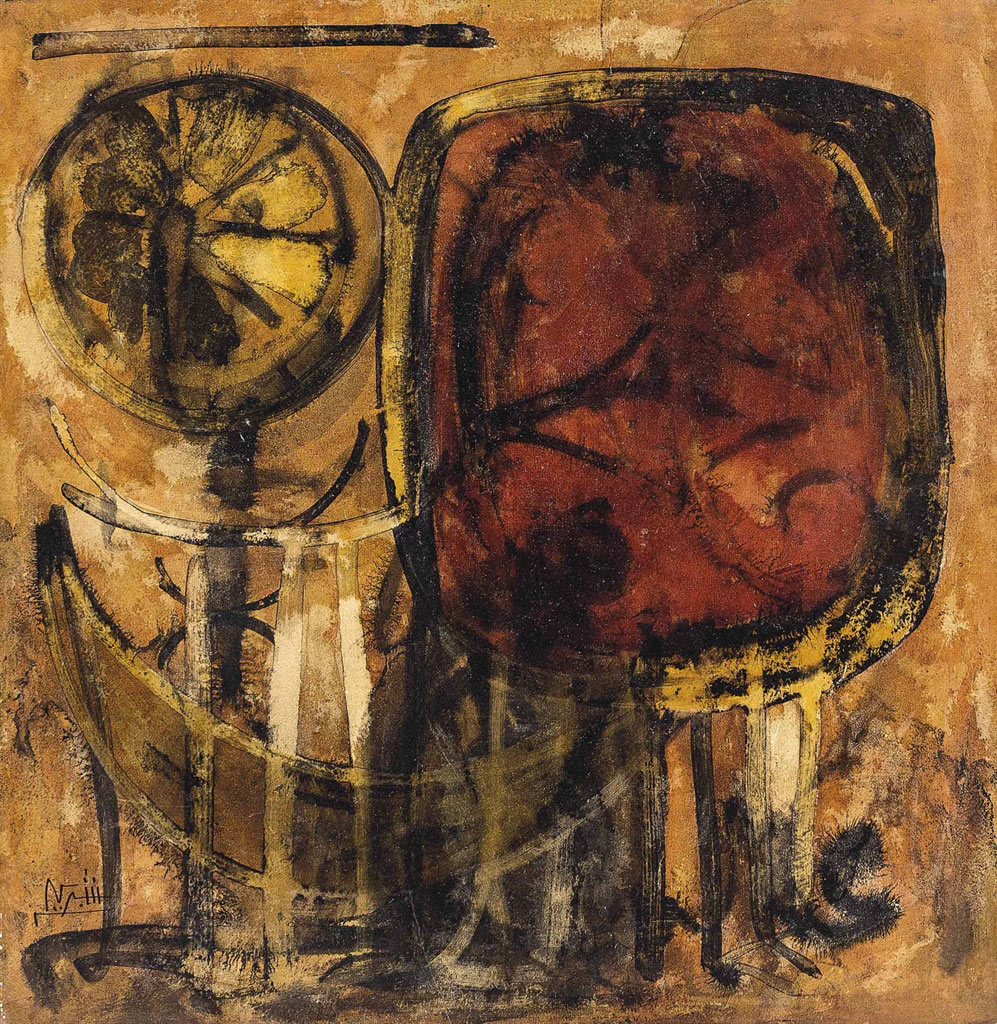
Image context: this article uses one verified reproduction of Ahmad Shibrain's Untitled (Red), painted in 1965, when the visual language associated with the Khartoum School was taking shape. Its official collection record identifies the artist, date, medium, and dimensions; the image has not been generated or analytically altered.[2]
Ahmad Shibrain's Untitled (Red) looks like a message that has outgrown the need to be read aloud. Two rounded compartments occupy the ochre field. On the left, a dark circular form appears to turn around a vertical stroke; on the right, rust-red pigment gathers inside a heavy black boundary. Bars, hooks, loops, and upright marks meet near the bottom like the remains of an alphabet, a scaffold, or both. Nothing settles into a sentence. Everything feels written.
That uncertainty is a strong entrance into the Khartoum School. The movement is often compressed into an elegant formula: after Sudanese independence, artists joined European modernism to African forms and Arabic calligraphy, producing a new national style. The formula names real ingredients, but it makes the history look far more settled than it was. “Khartoum School” was a contested label from the beginning; some artists associated with it rejected the name, and a younger generation built new practices by attacking its assumptions.[1]
The movement's real achievement was therefore not one Sudanese look. It made visual identity into a problem artists could work on together—and then disagree about. Painting, calligraphy, ceramics, photography, teaching, criticism, exhibition-making, and conceptual performance all became ways of asking who could represent a newly independent nation, which inheritances counted as living knowledge, and when the search for cultural identity hardened into another form of authority.
A national vocabulary had no single alphabet
Sudan became independent in 1956. In the years around that change, artists connected to Khartoum's College of Fine and Applied Art faced an assignment that was political even when no politician had set it: how could modern art address a society whose identity could not be contained by the colonial academy's categories? The Metropolitan Museum of Art describes the early Khartoum School as pursuing a new Arab-African national aesthetic; Barjeel Art Foundation uses the term Sudanawiyya for a visual language that brought local and Pan-African traditions into contact with Western influences.[3][4]
The important word is contact, not fusion. Fusion suggests that established components were blended into a stable whole. The strongest works keep their components active and sometimes abrasive. Arabic letters do not simply decorate a modernist surface. A mask-like face does not certify African authenticity. Geometry does not arrive as a neutral international language. Each element changes its neighbors and raises a question about who has the authority to name what is Sudanese.
Ibrahim El-Salahi made that tension explicit in his search for a “new visual alphabet.” In works such as The Mosque, calligraphic inscriptions, abstract lines, devotional meaning, and composite figures occupy the same field without becoming interchangeable.[5] His Alphabet No. 2, begun in 1962 and reworked in 1968, contains open mouths, a spoked circle, religious text, and forms that hover between sign and figure. The Met proposes that its evocation of recitation and mourning makes the canvas something to be heard as well as seen.[4] This is not writing used as a national logo. It is writing treated as rhythm, memory, sound, and structure.
Shibrain's route was related but distinct. He studied in Khartoum and at London's Central School of Arts, then returned to teach, eventually leading the graphics department and serving as dean of his former college.[3] In Untitled (Red), the painted marks retain the pressure of the hand. Some look almost architectural; others flare or bend like cursive forms. The large red chamber could be read as a body, a tablet, or a field held open by its black rim. The work does not illustrate the Khartoum School's theory. It shows why a theory was needed: line could carry several cultural memories at once without agreeing to become only one of them.[2][3]
The “school” was an ecosystem, not a roster
The name can sound more organized than the movement was. There was a real institution at its center, but no single manifesto bound every artist into a uniform program. Sharjah Art Foundation's major historical survey describes “Khartoum School” as a term coined in the early 1960s and contested by founders and successors alike. Its curators retained the label not to claim consensus, but to hold together a fluid modernist field that moved across Sudan, Africa, and the Arab world.[1]
That distinction changes how the movement should be pictured. A short roster of heroic painters misses the teachers, students, potters, photographers, designers, critics, and filmmakers through whom its questions circulated. The same Sharjah survey placed painting and drawing beside pottery, ceramics, sculpture, photography, film, video, and performance. It also brought studio photographers Rashid Mahdi and Gadalla Gubara into a history of decolonization and self-representation.[1] Modernism was not confined to the autonomous canvas. It passed through classrooms, kilns, newspapers, portrait studios, and public debate.
Teaching mattered especially because it made style reproducible without making it identical. Shibrain's long institutional career did more than give him a job after studying abroad. It placed graphic thinking and calligraphic experiment inside the education of later artists.[3] Kamala Ibrahim Ishag, who graduated from the college in 1963 and later taught there for decades, became both a defining participant in Sudanese modernism and one of its most consequential internal critics.[7]
This is where the word school earns a better meaning. It does not name a classroom in which a master transmitted the correct Sudanese image. It names a setting in which methods, categories, and authority could be inherited—and challenged. The network survived because its students did not merely repeat its answers.
Calligraphy opened outward, not backward
It is tempting to treat the Khartoum School's use of Arabic script as a return to tradition after European training. That account is too linear. El-Salahi and Shibrain did not travel backward from modern painting into an intact calligraphic past. They used the letter as a device that could move among legibility and abstraction, devotion and experiment, page and canvas.
Nor was that inquiry sealed within Sudan's borders. MoMA's comparative study of El-Salahi places his work beside other calligraphic modernisms developing across the Arab world and South Asia. Artists in Iran, Iraq, and Pakistan were also testing how the letter could enter modern art without becoming either a quotation from heritage or an imitation of European abstraction.[5] The Khartoum School was national in urgency but transnational in conversation.
This wider frame prevents two opposite mistakes. One is to praise the artists for finally making Sudan legible to a supposedly universal modernism whose standards were already fixed elsewhere. The other is to demand a pure national style untouched by travel, colonial education, Islam, Africa, or international exchange. Neither purity existed. Artists returned from London with new techniques; they also found that imported training could not decide what their work should address. Calligraphy was powerful partly because it crossed those boundaries while refusing to erase them.
In Shibrain's painting, this mobility is visible in the gap between mark and meaning. The strokes do not require a viewer to decode a word before sensing weight, enclosure, repetition, and interruption. Yet they never become anonymous geometry. They carry the memory of writing even when they do not deliver a readable phrase. The image makes cultural inheritance operate as a verb: something handled, pressured, redirected, and made newly present.
The Crystalists refused the inheritance
By the 1970s, the search for a national visual language had become authoritative enough to provoke a counter-movement. Ishag and younger artists Muhammad Hamid Shaddad and Naiyla Al Tayib helped form the Crystalist Group, which challenged both the Khartoum School's emphasis on heritage and the male-dominated, identity-centered account of Sudanese art built around it.[6][7]
Their manifesto appeared in the arts pages of the Khartoum newspaper al-Ayyam on January 21, 1976. It imagined the world not as a collection of stable objects but as something changeable, transparent, many-sided, and dependent on a viewer's position. The Crystalists were interested in contradiction, perception, pleasure, and the shifting relation between appearance and essence. Their crystal was less a motif to paint than a model for refusing fixed categories.[6]
That refusal changed the shape of an artwork. Later in 1976, Al Tayib's Ordinary Mirrors made fragments of mirror and the gallery itself into the material of an installation. Shaddad's 1978 exhibition used stacked ice blocks and bags of colored water; melting was not damage to a finished object but part of the event.[6] These works did not simply exchange calligraphic abstraction for a newer international fashion. They questioned the demand that art stabilize a people, a heritage, or even an object.
Ishag's position makes the break more complicated and more interesting. She had participated in the earlier modernist formation, but her work drew increasingly on women's lives, spiritual experience, zār ceremonies, plants, family stories, and distorted or intertwined bodies. Serpentine's account of her career emphasizes that she refuses definition by any single movement or style even though she was integral to both the Khartoum School and the Crystalists.[7] Her example prevents a neat succession story in which one generation simply becomes obsolete. The critique came from inside the educational and artistic world it revised.
The Crystalists exposed a risk within every postcolonial search for cultural identity: a language invented to resist colonial authority can become prescriptive in turn. Who gets included in the national “we”? Which forms are chosen as representative? Whose spiritual and domestic knowledge is treated as serious thought? What happens when heritage becomes a requirement rather than a resource? By forcing those questions into the open, the younger group did not end Sudanese modernism. It proved that the movement was still alive.
Disagreement is the durable form
Seen from a distance, the Khartoum School can become a tidy museum category: independence, calligraphy, hybrid identity, three or four famous names. Seen through its arguments, it becomes something harder and more valuable. Its early artists refused the idea that colonial academic training already contained a universal modern language. They made letters, figures, materials, and regional histories answer the present. Their successors then refused the idea that this new language should become a national orthodoxy.
The later criticism does not cancel the early paintings. It teaches us how to look at them without turning them into illustrations of identity. Shibrain's Untitled (Red) matters not because its marks can be assigned cleanly to Africa, Islam, Europe, or Sudan. It matters because the painting keeps those frames under pressure. The red form is enclosed but not still; the wheel-like form is structured but not mechanically legible; the calligraphic strokes remember writing while escaping a sentence.
That unsettled quality is the movement's most convincing legacy. The Khartoum School did not solve the question of Sudanese modernism. It built an artistic ecosystem in which the question could move—from canvas to classroom, from letter to body, from national vocabulary to feminist and conceptual dissent. Its shared form was not agreement. It was the sustained right to revise what modern art in Sudan could be.
Sources
- Sharjah Art Foundation, “The Khartoum School: The Making of Modern Art in Sudan (1945–Present)” within its 2016 exhibition announcement — movement chronology, contested terminology, media range, foundational artists, later groups, and photography context.
- Barjeel Art Foundation, “Untitled (Red)” — official collection record and image for Ahmad Shibrain's 1965 oil, ink, and watercolour work used as the cover.
- Barjeel Art Foundation, “Ahmad Shibrain” — artist biography covering Sudanawiyya, calligraphic practice, education, and institutional teaching roles.
- The Metropolitan Museum of Art, “Ibrahim El-Salahi: Alphabet No. 2” — work record on the Khartoum School's post-independence aesthetic, calligraphy, iconography, sound, date, and medium.
- Julián Sánchez González, “Rubem Valentim and Ibrahim El-Salahi: Strategies of Hybridization and Abstraction in the Global South,” post at MoMA (January 16, 2019) — El-Salahi's visual alphabet, the movement's transnational context, and criticism of reductive national motifs.
- Anneka Lenssen, “'We Painted the Crystal, We Thought About the Crystal'—The Crystalist Manifesto (Khartoum, 1976) in Context,” post at MoMA — publication history, aesthetic positions, contemporary debates, and installation examples.
- Serpentine Galleries, “Kamala Ibrahim Ishag: States of Oneness” — Ishag's relationship to the Khartoum School and Crystalists, teaching, subjects, media, and refusal of a single stylistic identity.