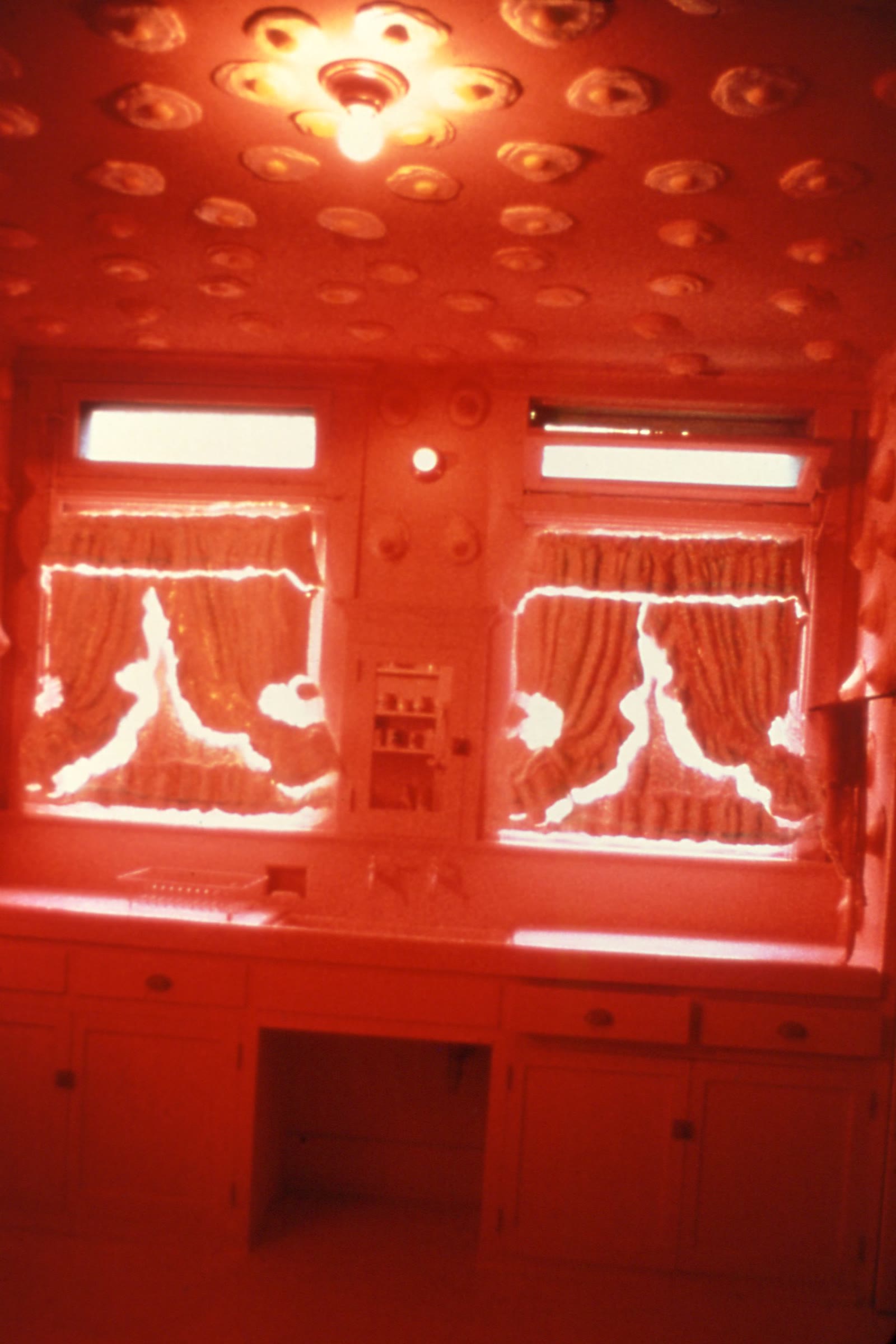

*Image context: the cover is an archival photograph of the original 1972 *Nurturant Kitchen, not a later reconstruction. Its ordinary fixtures remain legible beneath the pink-red intervention, making the project's method visible at a glance: the artists did not abandon the domestic room but forced its assigned meanings to proliferate across every surface.[5]
The camera keeps finding thresholds. A doorway encloses one installation; a stair carries the eye toward another; a performer sits in a room while viewers gather close enough to become part of its atmosphere. Johanna Demetrakas's film Womanhouse does not give us a single definitive image of the 1972 project because no such image could contain it. The artwork was a route through a house—and, before that, a way of teaching.
That distinction matters. Womanhouse is often summarized as a landmark feminist exhibition about domestic life. It was that, but the noun “exhibition” can make the finished rooms sound as if they arrived ready for display. In fact, the Feminist Art Program led by Judy Chicago and Miriam Schapiro made a dilapidated Los Angeles mansion into an installation and performance space. Students renovated the building, developed content through group work, selected media, tested formats, and eventually met an audience there.[3][4] The house did not merely illustrate the curriculum. It became the curriculum's full-scale material.
The project grew from early feminist art programs at Fresno State and the California Institute of the Arts. Their women-centered structure created space for conversations and source material that conventional art education had minimized or omitted.[4][8] Research into women's experiences and attention to personal history were not treated as preliminary therapy before “real” art began. They were methods for finding form. Womanhouse made that premise public: domestic work, menstruation, aging, sexual roles, nurture, costume, waiting, and anger could organize serious art because they already organized lives.
During the project's month-long public run, more than ten thousand people visited, according to Chicago's project history.[5] Yet the physical installation was temporary. Its longer life depends on catalogues, slides, surviving objects, testimony, and moving images. That is why Demetrakas's documentary is more than a record placed after the event. It is one of the structures through which a room-based, performance-rich artwork can still be encountered as a sequence.
The embedded video is Penn State's presentation of Demetrakas's 1974 color documentary, hosted by the university project that stewards the Judy Chicago Art Education Collection.[1][3] The upload runs 43 minutes and 25 seconds, while distributor Women Make Movies lists the film at 47 minutes.[1][2] The sources do not explain the discrepancy, so this spotlight treats the upload as its own access copy rather than assuming that it matches the distributor listing frame for frame. Demetrakas filmed workshops, performances, installations, and audience responses. Her edit supplies rare historical proximity, but it does not make the project neutral or complete. It gives us one constructed path through a house made from many voices.
Renovation was the first shared medium
The most consequential material in Womanhouse may have been the house before it looked like art. Renovation belongs to the category of labor that exhibitions usually hide: cleaning, repairing, carrying, painting, wiring, and making a space safe enough for other work to appear. Here that support work moved inside the educational project. In Penn State's digital collection, Womanhouse survives not as one object but as a field of catalogue pages, color slides, participant photographs, proposals, and other project records.[3] Read alongside the workshops and audience reactions Demetrakas filmed, those materials describe artmaking as an ecology rather than a flash of private inspiration.
There is an obvious tension. A feminist project challenged the confinement of women to domestic labor by asking women to spend weeks repairing a house. The answer is not that collective renovation magically stopped being difficult work. Its difference lay in visibility, control, and purpose. The participants learned skills and made decisions for a space whose public meaning they would shape. Labor normally treated as background became discussable and shared; it produced not a more efficient household, but an environment in which the household itself could be examined.
Belonging was therefore more structural than sentimental. It required a place, and the place had to be built. It also required participants to see one another's work as neighboring parts of a larger argument. The classroom expanded because the project needed carpentry, discussion, performance, publishing, installation, and hosting at once. No single medium could claim authority over all of that.
The cover photograph shows what that overlap enabled. Nurturant Kitchen keeps the fitted cabinets, sink, curtained windows, and ceiling light legible while egg-like forms spread across the ceiling and transition into breast-like forms down the walls.[5] The room is still recognizably a kitchen and no longer behaves like a neutral one. Construction, inherited function, bodily metaphor, and installation have become inseparable.
Each room made an assignment physical
Womanhouse did not offer one symbolic house with one stable meaning. It distributed pressure across specific rooms. Susan Frazier, Vicki Hodgetts, and Robin Weltsch's Nurturant Kitchen made bodily nurture repeat across the walls as forms shifted between fried eggs and breasts. Judy Chicago's Menstruation Bathroom pushed what domestic etiquette hides into an aggressively clean room where used menstrual products could not be politely abstracted. Sandra Orgel's Linen Closet trapped a mannequin between shelves and folded sheets. Karen LeCocq and Nancy Youdelman's Lea's Room staged an aging courtesan performing femininity against time.[5][7]
The force is cumulative. A kitchen, bathroom, closet, and bedroom normally divide household functions. At Womanhouse, those divisions became a sequence of assigned roles: feed, conceal, store, remain desirable. Walking from room to room turned ideology into architecture. The visitor did not receive a single thesis panel about domesticity; the body had to cross thresholds and discover that every apparently private room carried a public script.
Miriam Schapiro and Sherry Brody's surviving Dollhouse compresses that spatial method into six rooms. The Smithsonian notes that its kitchen, nursery, and boudoir stage standards expected of a white, middle-class woman of Schapiro's generation, while an artist's studio claims a space conventionally coded male.[6] That tiny studio is not an escape hatch tucked outside domestic life. It sits within the model, forcing artist, homemaker, mother, lover, and observer into an uneasy simultaneity.
The film reverses that compression. Instead of holding the whole house in one object, it restores scale through movement and editing. A detail becomes a room; a room gives way to a performance; a visitor's response makes the installation social. Demetrakas cannot reproduce the original route exactly, but cinema can preserve adjacency—one of the project's most easily lost materials.
Performance changed the house's clock
The installations spatialized expectation; the performances gave it duration. In Faith Wilding's Waiting, a seated figure moves through a life structured by anticipation: waiting to be noticed, chosen, married, fulfilled, relieved. The action is deliberately spare because waiting is not a spectacular event. It is time placed under someone else's authority. Film lets later viewers encounter the pace, posture, and proximity that a photograph can only imply.
Other performances used repetition and caricature rather than a room's fixed arrangement. Sandra Orgel's Ironing made a sheet and a familiar chore into sustained action. Chicago's Cock and Cunt Play, performed by Wilding and Jan Lester, exaggerated gender roles until their learned quality became difficult to mistake for nature.[5] These works did not decorate the installations with live entertainment. They activated the house as a place where a social script could be rehearsed badly on purpose, stretched past comfort, or spoken back to its audience.
Demetrakas's documentary is especially valuable here because performance survives unevenly. A script can preserve words and a still can preserve a pose, but neither holds the relation among voice, duration, room, and viewers. The film does. It also changes that relation: editing selects reactions, shortens transitions, and turns a local audience into future spectators. Archival access is therefore a gain with a boundary, not time travel.
Another 1972 moving-image account makes that boundary clearer. Japanese artist Mako Idemitsu filmed the project in the 16 mm work Woman's House, now held by the Centre Pompidou. Its institutional record describes the kitchen's eggs and breasts, the bathroom's tampons, and the mannequin emerging from the linen cupboard.[7] Two cameras do not add up to a complete house. They demonstrate that Womanhouse entered history through several acts of looking, each with its own duration and frame.
The archive preserves a method, not a universal woman
The film's strongest legacy is not that it seals “the female experience” into forty-odd minutes. The Smithsonian carefully frames Dollhouse as addressing expectations faced by white, middle-class women of Schapiro's generation.[6] That specificity should warn against enlarging any one room—or this historically situated project—into every woman's relation to labor, family, race, class, sexuality, or gender.
That limit should sharpen the project rather than turn it into a period embarrassment. Womanhouse's durable invention was a method: build a shared space, treat lived experience as evidence rather than anecdotal residue, translate discussion into form, and let different works remain in tension under one roof. The method can be revised by people whose experiences the 1972 project did not adequately contain.
CalArts's later institutional account now describes the Feminist Art Program as a “complex and fruitful” history carried forward through plural feminisms, gender theories, transfeminisms, teaching, archiving, and new commissions.[8] That language marks real distance from claims to one universal female subject. It also confirms why the archive matters. Revision needs something more substantial than a legend to revise.
Demetrakas's film supplies that substance. It lets us see Womanhouse as rooms and performances, but also as a chain of labor: finding a building, making it usable, developing work, receiving visitors, filming encounters, preserving documents, and teaching from them again. The project did not simply move art into a house. It rebuilt the classroom so that support work, private experience, public argument, and collective authorship could meet without pretending they were the same thing.
That is the reason to watch the thresholds. Each doorway in the film separates one claim from the next, but it also keeps them connected. Womanhouse's house was temporary. Its most portable architecture was the method for passing through it together.
Sources
- Judy Chicago Art Education Collection at Penn State, “Womanhouse” — official YouTube presentation of Johanna Demetrakas's archival documentary.
- Women Make Movies, “Womanhouse” — distributor record for the 1974 color documentary, with runtime, synopsis, filmmaker credit, and screening history.
- Penn State University Libraries Digital Collections, “Womanhouse” materials in the Judy Chicago Art Education Collection — catalogue pages, slides, participant photographs, proposals, and other project records.
- National Museum of Women in the Arts, “Women House: Beginnings” (2018) — institutional history of the early feminist art program, the dilapidated mansion, student collaboration, workshops, performances, and Demetrakas's documentary.
- Judy Chicago, “Womanhouse (1972): Selected Work” — project history, visitor count, archival photographs, and credits for rooms and performances.
- Smithsonian American Art Museum, “Miriam Schapiro with Sherry Brody, Dollhouse, 1972” — collection record, materials, room iconography, and historical interpretation.
- Centre Pompidou, “Mako Idemitsu, Woman's House, 1972” — collection record for a parallel 16 mm film and its documentation of the kitchen, bathroom, and linen closet.
- California Institute of the Arts, “REDCAT Opens New Exhibition Exploring Influential Feminist Art Program at CalArts” (2023) — institutional account of the program's complex legacy, later pedagogies, plural feminisms, and archival afterlives.