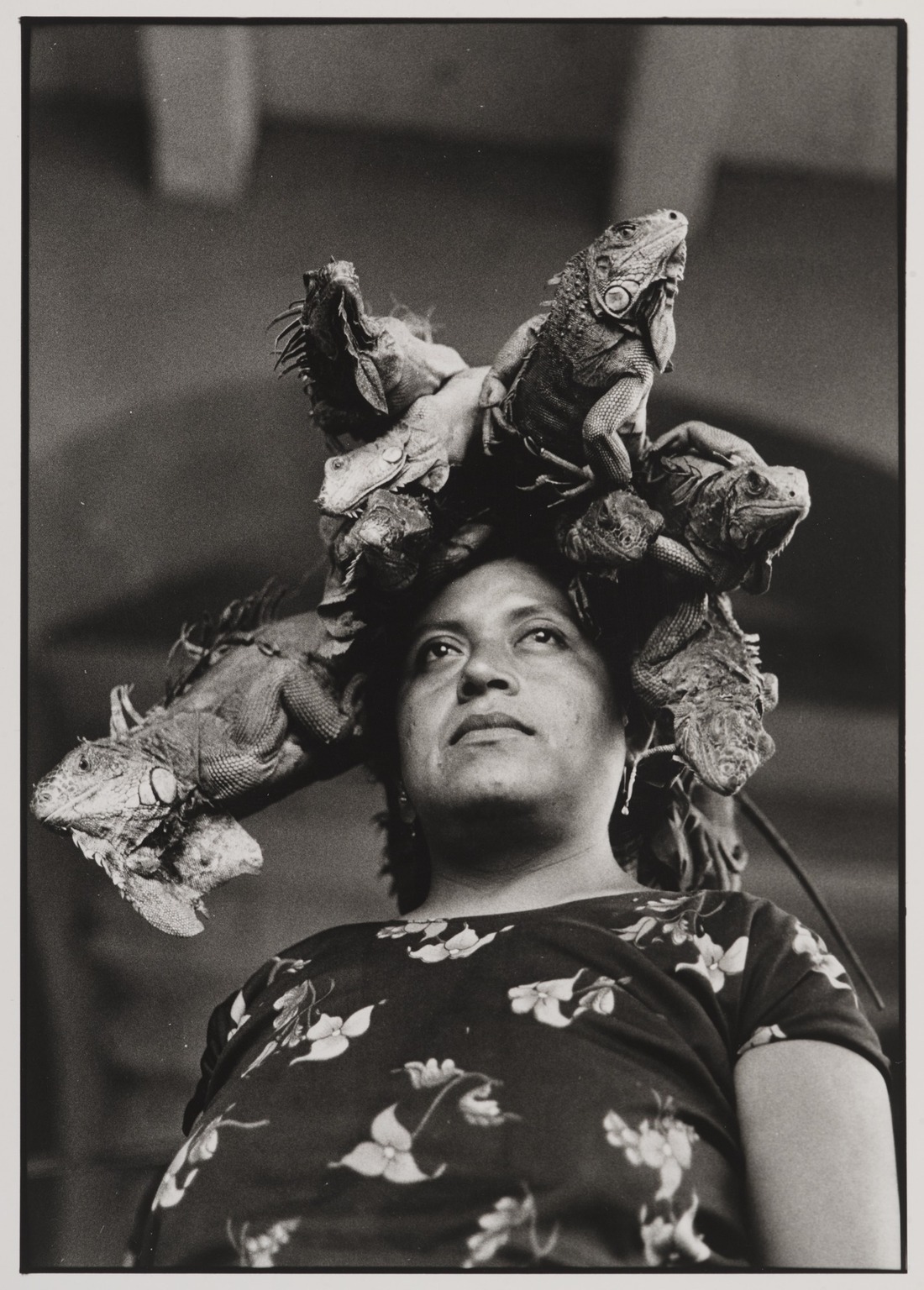
Image context: the cover is one real photographic artwork, not a generated visual or an analytical graphic. The Brooklyn Museum's image preserves the exact frame this essay examines: Zobeida Díaz, the iguanas she was carrying to market, and the crop that makes their temporary arrangement read as an enduring crown.[1][2]
The first word that arrives is usually crown.
In Graciela Iturbide's 1979 black-and-white photograph Nuestra Señora de las Iguanas (Our Lady of the Iguanas), several live iguanas gather above the head of Zobeida Díaz, a Zapotec market vendor in Juchitán, Oaxaca. Their snouts point outward like rays. Díaz's face rises beneath them, calm and monumental, while her patterned blouse spreads across the lower part of the frame. The Brooklyn Museum calls the animals a crown; the photograph's title supplies a saint.[1][2]
But neither crown nor saint was waiting at the market as a finished symbol. Díaz was carrying iguanas to sell. Iturbide asked to photograph her. The encounter produced a sequence in which Díaz adjusted the animals, greeted someone, and tried not to laugh. Only later, at the contact sheet, did one exposure become the famous print.[2][4]
That sequence changes how the photograph should be read. Its authority does not come from discovering a timeless emblem intact in everyday life. It comes from converting a moving, social, slightly comic market encounter into one fiercely economical frame—and from leaving just enough evidence of the encounter inside the icon to prevent the icon from closing.
A crown made of many directions
The composition is top-heavy by design. Díaz's shoulders and floral blouse build a broad base, her neck and face narrow the image at its center, and the iguanas expand again above her. The silhouette resembles a triangle balanced on a stem. That geometry gives the portrait stability even though its living headdress is anything but stable.
Each animal resists becoming mere ornament. One muzzle projects toward the left edge; another tilts upward; others turn across the picture plane or disappear into a knot of legs, tails, and scales. Their bodies mass together, but their heads establish separate vectors. A metal crown directs attention toward one sovereign face. This living crown disperses attention into several alert gazes before returning it to Díaz.
Her gaze does not meet the camera. Her chin is slightly raised and her eyes look above and beyond the viewer, introducing another direction into the photograph. The pose can read as devotional because the title has already placed “Our Lady” in the room. It can read as regal because the animals make a corona. Yet the averted eyes also keep the portrait from becoming an exchange in which a viewer looks, is looked at, and feels the encounter neatly completed. Díaz does not perform availability.
Black and white intensifies the difference between surfaces. Light crosses the smooth planes of her forehead, cheek, and nose; the iguanas break that light into scales, spines, claws, and overlapping shadows. Below, the blouse replaces reptile texture with a dense floral pattern. The photograph therefore moves through three kinds of visual information—skin, scales, cloth—without allowing any one of them to become a neutral background.[1][3]
This is why the image is more complex than a surreal juxtaposition between a woman and reptiles. Díaz is not a blank pedestal beneath an astonishing object. Her face is the composition's quietest surface and its strongest anchor. The animals make the outline spectacular; her stillness makes that spectacle legible.
The market is outside the frame
The photograph withholds almost everything that would explain what is happening. There is no stall, customer, price, street, or visible exchange. The close vertical crop gives the viewer little evidence of the Juchitán market where Iturbide encountered Díaz. What remains is body, blouse, animals, and a softened strip of surrounding space.
That removal is the image's decisive transformation. According to the Museum of Fine Arts, Boston, Díaz was taking the iguanas to market to sell them. The animals had both culinary and healing associations in Zapotec society.[2] In the uncropped situation, then, their place on her head belonged to work: they were a load being carried through a commercial space. In the finished photograph, their practical arrangement becomes a halo.
Calling that arrangement a crown is persuasive because the crop has done so much to make it persuasive. The radiating heads sit at the top edge, where Western portrait traditions teach viewers to look for an attribute of rank or sanctity. The title reinforces the conversion by borrowing the devotional address Nuestra Señora. Market labor has not disappeared, but a viewer needs context to recover it.
The recovery matters because “everyday” and “mythic” are not opposites here. The photograph does not reveal that Díaz was secretly a queen, nor does context debunk the image by proving that she was merely carrying merchandise. Its power lies in allowing a practical act to sustain an exalted form. The same animals can be inventory, weight, food, medicine, restless bodies, and crown. The camera does not have to choose only one, even though the frame makes one reading arrive first.
The contact sheet restores time
The final print appears inevitable because every element has settled into place. The contact sheet says otherwise.
For its 2019 Iturbide exhibition, the MFA displayed original contact sheets beside finished photographs. Its account of the Our Lady of the Iguanas sequence describes Díaz interacting with Iturbide while yellow grease-pencil marks record the photographer's selection and intended crop. Across nearby frames, Díaz adjusts the iguanas and breaks into laughter.[2] Christopher Alessandrini's review adds other small events: a handshake with a passerby, a suppressed smile, a shifted frame.[4]
Those variants do not expose the famous portrait as false. They show what photographic form costs. To make this image, motion had to become stillness; several expressions had to become one expression; market sociability had to be pressed beyond the edge. The final exposure is not the entire encounter. It is Iturbide's answer to the encounter.
Iturbide has described photography as having two decisive moments: first making an exposure, then discovering the photograph in the contact sheet.[3][4] Our Lady of the Iguanas demonstrates the distinction with unusual clarity. At the shutter, photographer and subject manage animals, balance, expression, passersby, and time. At the contact sheet, Iturbide recognizes the frame in which those contingencies briefly resemble an icon.
The sequence also puts a boundary around the easy language of spontaneity. This was not a stolen instant in which Díaz remained unaware of the camera. Iturbide asked; Díaz posed; the animals were adjusted; the exchange unfolded through multiple exposures.[2][3][4] Nor does that make the portrait a fully equal co-authorship whose power differences can simply be wished away. It means the picture arose from visible participation rather than from the fiction that a photographer extracted an untouched cultural essence.
Saint, Medusa, vendor
The photograph accumulated another name in Juchitán: the “Juchitán Medusa.” An academic reception history published by Mexico's National Institute of Anthropology and History records that local nickname, while the MFA and later criticism trace the image's broader circulation.[2][4][6] The two names—Our Lady and Medusa—pull the same cluster of animals in opposite directions.
“Our Lady” sanctifies. It turns the iguanas into a halo and Díaz into a vernacular Madonna. “Medusa” makes the animals uncanny hair and imports the danger of a gaze that petrifies. One metaphor elevates; the other makes strange. Both are visually available, and both can become shortcuts that replace a particular woman with an inherited type.
The photograph resists that replacement in small ways. Díaz's floral clothing belongs to the scene rather than to Greco-Roman myth. The iguanas are not one writhing special effect; their individual heads remain recognizable. Most importantly, the contact sheet keeps the final expression attached to a person who laughed, shifted, greeted someone, and endured the practical difficulty of balancing living animals.[2][4]
To call the image mythic is therefore only the beginning of interpretation. The harder task is to see how the photograph manufactures myth from social reality without exhausting that reality. Díaz can look monumental and still be a vendor. The animals can form a halo and still be going to market. The portrait can invite devotion and still preserve the friction of scales, weight, work, and choice.
The “matriarchy” shortcut
Accounts of Iturbide's Juchitán photographs often describe a matriarchal society. The shorthand seems to fit an image of a powerful woman crowned by living animals, and museum texts have emphasized women's economic, political, and ritual authority in the city.[1][2] Yet the label is not neutral. Alessandrini notes that many Juchitán women have rejected “matriarchy” as a description imposed on a more complicated social order.[4]
That dispute belongs inside a close reading because iconic photographs invite viewers to make one body prove too much. Díaz's portrait can document her presence, her work, the pose, Iturbide's framing, and the meanings later attached to the print. It cannot, by itself, settle the organization of gender and power across a whole Zapotec community.
Iturbide's wider practice offers a better scale for context. Invited to Juchitán by artist Francisco Toledo in 1979, she returned over years, photographed public and private life, and eventually published Juchitán de las Mujeres in 1989.[2] Her training with Manuel Álvarez Bravo and her sustained attention to Mexico's Indigenous traditions shaped a practice built around long-form photographic essays rather than isolated trophies.[5] Even so, duration does not make every interpretive label correct. It supplies relationships and a body of images through which claims can be tested.
Read at that scale, Our Lady of the Iguanas is not a certificate of matriarchy. It is a highly constructed portrait made within a longer relationship to a place. Its strength does not need the social fantasy of a city where women simply rule. The actual claim is sharper: a market worker can occupy the visual language of monumentality, and she can do so without surrendering all signs of labor, humor, or particularity.
When a portrait becomes civic property
The second decisive moment did not end at Iturbide's contact sheet. Once printed, the image entered another sequence.
The MFA records its reproduction on municipal buildings, highway signs, murals, and other local surfaces; critical accounts add posters, postcards, graffiti, film references, and a bronze statue in Juchitán.[2][4] A photograph made through one encounter became a repeatable public emblem. Cropped from the market, it returned to the city at architectural scale.
That afterlife complicates a simple accusation that the picture only exoticizes an Indigenous subject for outsiders. Local adoption matters. It shows that the image could be claimed inside Juchitán as well as consumed beyond it. But adoption does not freeze meaning or erase questions about who names, publishes, owns, and profits from an image. A symbol can be loved, contested, commercialized, and used for civic identity at the same time.
The photograph itself prepared for that mobility. Its narrow frame is easy to recognize from a distance. The silhouette survives changes of scale. The dark iguana heads remain legible above the lighter oval of Díaz's face. The image behaves almost like an emblem before anyone prints it on a sign. Formal economy becomes social portability.
Yet reproduction often drops the contact sheet, and with it the laughter and adjustment that keep monumentality attached to an encounter. The more familiar the icon becomes, the more important those discarded frames are. They remind viewers that the crowned figure was never simply found. She was photographed into visibility with another person, during a stretch of time, among other possible pictures.
The crown is real, and photography makes it
It would be easy to use the contact sheet to puncture the icon: look, the regal portrait was only one fraction of a laughing market sequence. That conclusion would miss Iturbide's achievement. Selection is not evidence against photography. Selection is photography.
The crown was physically present. Its iguanas had weight, claws, temperature, and commercial value. Díaz balanced them. Iturbide did not invent those facts. What she made was the relation among them: the tight vertical field, the radiant animal heads, the luminous face, the missing market, and the instant in which laughter has not yet broken the pose.[1][2][4]
That is why the contact sheet should sit conceptually beside the famous print. It does not reduce the final image to a lucky exposure. It lets us see the labor of becoming iconic. Díaz carries the animals; photographer and subject sustain the session; Iturbide chooses and crops; institutions title and display; Juchitán reproduces; viewers say crown, saint, Medusa.
The best reading keeps all of those acts visible. Our Lady of the Iguanas is monumental because it concentrates them, not because it escapes them. Its crown begins as a market load, coheres for a fraction of a second, and continues to be made wherever the photograph is framed as an emblem. The icon endures. The contact sheet keeps it human.
Sources
- Brooklyn Museum, “Nuestra Señora de las Iguanas (Our Lady of the Iguanas), Juchitán, Oaxaca” — official object record, exact 1979 print metadata, collection interpretation, and source page for the cover image.
- Museum of Fine Arts, Boston, “MFA Boston Presents First Major East Coast Exhibition of Photographs by Graciela Iturbide” — Zobeida Díaz's market journey, the iguanas' local uses, contact-sheet sequence, Juchitán project, and later civic circulation.
- National Museum of Women in the Arts, “In Focus: Graciela Iturbide” interview transcript — Iturbide's primary testimony on black-and-white abstraction, contact-sheet selection, composition, permission, and the “complicity” required when photographing a community.
- Christopher Alessandrini, “Graciela Iturbide, Visionary Ethnographer,” The New York Review of Books (March 30, 2019) — critical discussion of the Juchitán series, the contested “matriarchal” label, contact sheets, Díaz's session, and the photograph's afterlife.
- Hammer Museum, “Graciela Iturbide” — institutional artist biography covering Iturbide's film and photography training, work with Manuel Álvarez Bravo, and long engagement with Mexico's living Indigenous traditions.
- Abraham Nahón, “Nuestra Señora de las Iguanas y sus resonancias,” Con-temporánea, no. 13 (2021), Instituto Nacional de Antropología e Historia — academic reception history of Díaz's local economic and political agency, the “Medusa juchiteca” name, and the photograph's later reworkings.