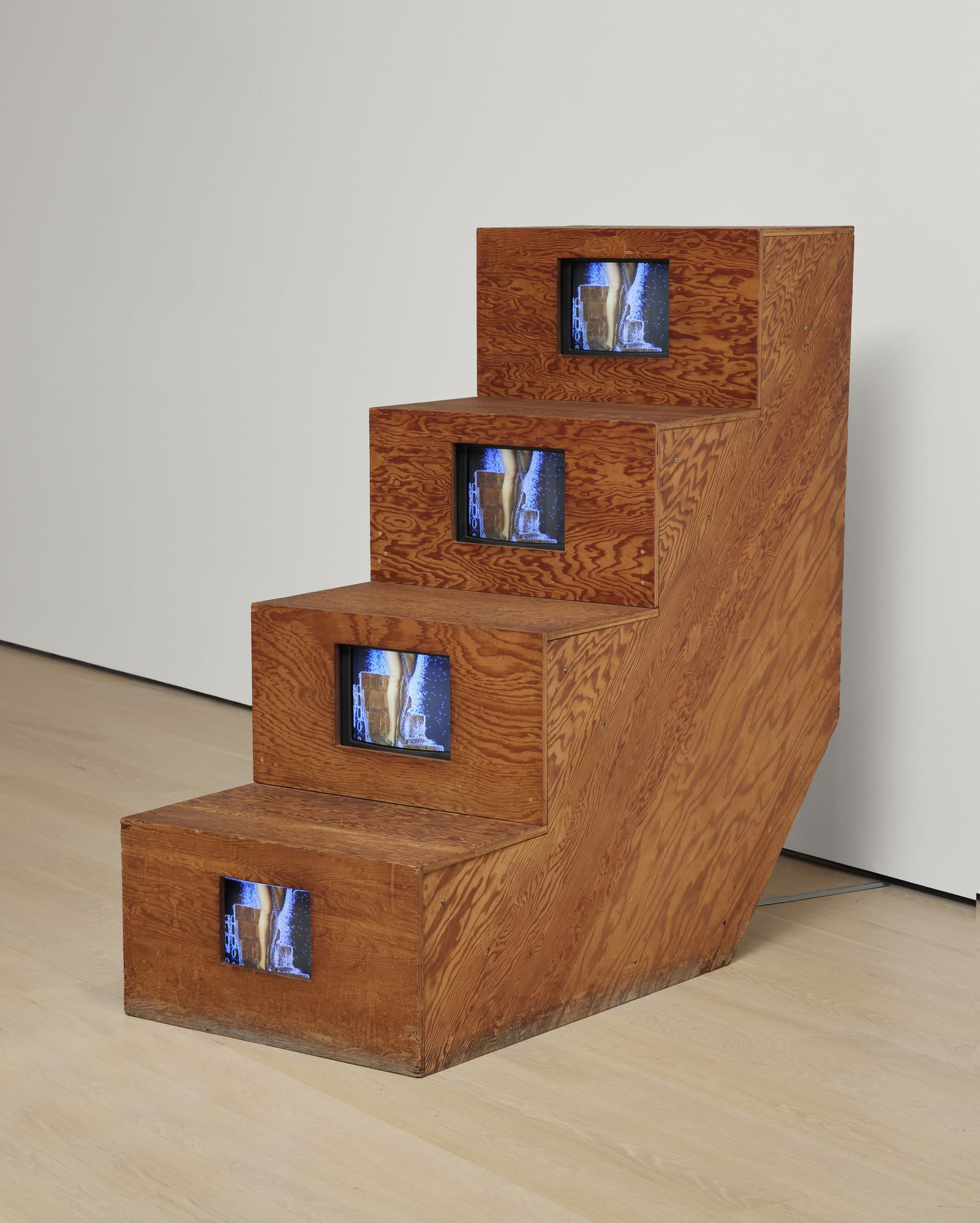
Image context: the cover is MoMA’s direct object photograph of the 1976 sculpture, not a reconstruction or a generic image of early video equipment. All four screens, their plywood housings, and the staircase profile appear together because none is merely a display support for the others.[1]
The screens are where steps should be. Four small rectangles of electronic light interrupt four broad plywood risers, each replaying a body in descent. The staircase appears sturdy enough to belong to a room, yet it leads nowhere and offers no landing. Its real traffic is time.
Shigeko Kubota built Duchampiana: Nude Descending a Staircase in 1976 from a silent, five-minute-and-twenty-one-second sequence, four cathode-ray tube monitors, and a plywood structure roughly the size of an adult body.[1] It is often described as a video homage to Marcel Duchamp’s notorious 1912 painting. That is accurate as genealogy and insufficient as description. Kubota did not simply animate an old canvas. She split motion between two incompatible systems: an image that can loop endlessly and an object that remains stubbornly still.
This is what makes the work more than an early screen sculpture with an art-historical title. Film, video, electronic synthesis, wooden construction, and the viewer’s own shifting angle each carry a different kind of duration. Kubota makes those clocks meet without allowing any one of them to disappear.
A painting about motion becomes a room-sized problem
Duchamp’s Nude Descending a Staircase (No. 2) renders one figure as a succession of fractured, ochre-brown forms. The Philadelphia Museum of Art describes the 1912 painting as an attempt to expand perception of a body in motion while stripping the academic nude of familiar carnality and even identifiable sex. Its mixture of a traditional subject, a staircase, and dynamic repetition helped provoke rejection in Paris and hostility at New York’s 1913 Armory Show.[7]
The painting asks the eye to manufacture movement from one fixed surface. Successive positions coexist, so the viewer mentally supplies the interval between them. By the 1970s, moving-image technology could deliver those intervals literally. Kubota’s sharper decision was not to let literal motion settle the question.
She filmed a real descent, then returned it to a staircase as light. The result reverses Duchamp without canceling him. His stationary painting compresses many moments into one field; her moving images occupy four separate fields inside one stationary volume. What had been depicted space becomes actual room space, while the painted body’s implied duration becomes a recorded loop.[1][2][3]
That change also alters the spectator. A canvas gathers its sequence inside a single upright rectangle. Kubota distributes hers from floor level upward, so the eye must climb and descend even while the sculpture stays put. The monitors are not four illustrations mounted beside an object. They are the risers that make the object read as stairs.
The descent was recorded twice
The body on the screens belongs to filmmaker Sheila McLaughlin. Kubota staged the recording in the lobby of Anthology Film Archives in lower Manhattan on a cold winter day, covering the glass so the session would remain private. MoMA’s audio account describes Kubota working in both film and video and using different frame rates; the original 1976 catalogue separately credits Stephen O’Donnell for the Super 8 imagery. McLaughlin moved down and back up the stairs while the work attended to the character of that movement rather than treating the body as anonymous raw input.[2][8]
The two capture systems did not see the same way. Super 8 divided action into exposed film frames that had to be developed and transferred. Standard-definition video turned light into an electronic signal. Kubota mixed and synthesized the material, altering speed and color until the repeated descent became less a record of one performance than a substance that could thin, flare, stall, and resume.[1][3]
This technical mixture matters because the work is sometimes reduced to a simple media equation: Duchamp froze movement; video made it move again. Kubota’s image does not offer the transparent continuity that equation implies. Frame-rate changes fracture the body in time. Electronic color pulls it away from natural appearance. Repetition denies the descent a final bottom. Each pass is recognizable as bodily movement and visibly processed as an image.
The four monitors add another complication. They present motion in parallel inside a form that normally organizes movement sequentially: first step, second step, third step, fourth. A conventional stair converts distance into ordered effort. Kubota’s stair converts one recorded action into simultaneous pulses. It is both a route and a stack, an instrument for going somewhere and a sculpture of recurrence.
Plywood turns the monitor into material
The wooden casing can look almost blunt beside the unstable color of the screens. That contrast was deliberate. In Kubota’s recollection, the boxes concealed the Sony brand names and set an organic material against the shining electronic image.[2] The gesture is practical, visual, and critical at once. A television enters a home as a branded appliance; inside Duchampiana, it loses its freestanding identity and becomes one luminous component in a larger body.
The plywood also gives video weight. A tape can be copied, transmitted, or shown on any compatible monitor. This particular footage does not become this particular artwork until its light is measured against the rise, depth, grain, and mass of the stair. MoMA’s 1978 announcement described the central contrast as continuous action held by a finite, unobtrusive structure.[5] That finitude is the sculpture’s discipline. The loop may have no endpoint, but its housing has edges everywhere.
Kubota did not fabricate that housing alone. MoMA’s records credit Al Robbins with constructing the staircase, and its later curatorial history identifies him as a collaborator on her earliest plywood video sculptures.[3][5] Naming that contribution improves the reading rather than weakening Kubota’s authorship. The work depends on translation between practices: McLaughlin performs the movement, cameras register it, electronic tools alter it, Robbins builds the volume, and Kubota determines the system in which those labors become inseparable.
That system resists the fantasy of immaterial media. The monitors occupy cavities. Cables and playback equipment have to work. Plywood corners wear; electronic standards age. Even before conservation becomes an institutional concern, the object insists that an image always arrives through something.
An homage can face two directions
Kubota’s admiration for Duchamp was real and sustained. Her Duchampiana series revisited his works through video sculpture, and her notebooks, travel, and archival activity repeatedly returned to his example.[3][4] Yet “homage” can become a polite word that places one artist permanently behind another. Kubota’s staircase is more argumentative than that.
In a 2009 oral-history interview, she connected the work not only to Duchamp but also to Mikio Naruse’s 1960 film When a Woman Ascends the Stairs. She also distinguished her conceptual practice sharply from Nam June Paik’s, calling him a comrade rather than a collaborator and rejecting the recurrent assumption that her video work merely followed his.[4] Those statements place Duchampiana inside several lineages at once: European modernism, Japanese cinema, New York Fluxus, personal diary, and emerging video art.
MoMA’s curators describe the series as moving among homage, critique, and reinvention. Kubota gave the relation its most compressed formulation in a journal: “Duchamp’s nude was dead. I let his nude alive again.”[3] The grammar is productively strange. Revival here does not mean restoring a lost original. It means letting the inherited image acquire another body, another author, and another technological condition.
There is a feminist pressure in that transfer, but it should not be simplified into a woman artist correcting a male predecessor. Duchamp had already disrupted the passive, erotic nude. Kubota changes the terms again by working with McLaughlin’s performed movement and by making electronic image occupy sculptural space—a domain then more readily granted institutional seriousness than portable video. The work claims room without pretending that influence must be escaped to be transformed.[3]
The acquisition exposed a category that had not settled
The work’s early exhibition history reads like a test of where video could belong. It debuted in Kubota’s three-installation Duchampiana exhibition at René Block Gallery in New York in 1976, appeared at Documenta 6 in Kassel in 1977, and entered MoMA’s Projects series in 1978.[4][5][8] MoMA acquired it in 1981 as the first work combining video and sculpture to enter the museum’s collection.[4] The current object record remains in the Department of Painting and Sculpture, not because the moving image is incidental, but because the work made the separation among those categories untenable.[1]
That institutional placement helps explain why the stairs mattered so much. A videotape could enter a screening program, a broadcast archive, or a media collection. A staircase demands floor space, storage, installation instructions, and a decision about how a viewer encounters it. Kubota did not make video acceptable by disguising it as conventional sculpture. She used sculpture to expose everything a supposedly weightless image needs in order to hold a room.
Later records also discourage the idea of one untouched machine surviving unchanged. MoMA dates its work to 1976. The National Museum of Art, Osaka’s 2021 retrospective listed a related Duchampiana: Nude Descending a Staircase as 1975–76/1983 and drew significantly on recently restored sculptures and archival material.[6] Those records do not specify every substituted component, so they should not be treated as a complete conservation history. They do establish that the work has more than one authorized material chronology.
That is an especially apt afterlife for Duchampiana. Film can be transferred; video standards can migrate; cathode-ray displays can become difficult to maintain; plywood remains visibly of its moment. Preserving the piece therefore cannot mean preserving movement alone or object alone. The essential relation is the tension between a repeatable signal and a bounded stair.
The screen never escapes the box
Early video art is often narrated as liberation: the camera becomes portable, the signal becomes immediate, the screen breaks painting’s monopoly on the wall. Kubota’s staircase offers a more tactile account. New technology does not free the image from matter. It gives the image new matter to negotiate.
That is why the work still feels alive after its once-novel monitors have become historical objects. The screens do not simply deliver content. They measure light against plywood, duration against volume, and a moving body against an architecture that will never move. Each replay descends; the sculpture stays. Neither half wins.
Kubota’s answer to Duchamp was not a faster nude. It was a place where recorded time could encounter weight. Every screen became a step, and every step made the image admit what it needed to glow.
Sources
- Museum of Modern Art, “Shigeko Kubota, Duchampiana: Nude Descending a Staircase, 1976” — exact work record, materials, running time, dimensions, department, acquisition data, and the museum photograph used as the cover.
- Museum of Modern Art, audio guide for Duchampiana: Nude Descending a Staircase — Kubota and curator Erica Papernik-Shimizu on filming Sheila McLaughlin, the two capture formats, frame-rate changes, the Anthology Film Archives location, and the plywood’s relation to the monitors.
- Erica Papernik-Shimizu and Veronika Molnar, “Everything Is Video: The Radical Imagination of Shigeko Kubota.” MoMA Magazine, August 19, 2021 — curatorial account of the Duchampiana series, mixed and synthesized imagery, Al Robbins’s collaboration, and homage as critique and reinvention.
- Miwako Tezuka, “Interview with Shigeko Kubota.” post at MoMA, oral history recorded October 11, 2009 — Kubota on Fluxus, Paik, Naruse, Documenta, the work’s acquisition, and her conceptual use of video and boxes.
- Museum of Modern Art, “Nude Descending a Staircase: Video Work by Shigeko Kubota at the Museum of Modern Art” (March 1978) — contemporary Projects announcement crediting Al Robbins and describing the synthesized image, plywood structure, and early exhibition context.
- National Museum of Art, Osaka, “Viva Video! The Art and Life of Shigeko Kubota” (2021) — institutional retrospective record covering restored sculptures, archival research, the Japanese exhibition tour, and the 1975–76/1983 version of Duchampiana.
- Philadelphia Museum of Art, “Marcel Duchamp, Nude Descending a Staircase (No. 2), 1912” — object record on the painting’s treatment of motion, its challenge to the academic nude, the Paris rejection, and its 1913 Armory Show reception.
- René Block Gallery, Shigeko Kubota: 3 Video Installations—Duchampiana (1976) — contemporary exhibition catalogue documenting the work’s first presentation and crediting Sheila McLaughlin, Stephen O’Donnell, Al Robbins, and production manager Bob Harris.