
Artist interviews often collapse into tasteful self-branding. A studio appears, the camera glides over tools, and the artist supplies a few polished convictions about creativity. Tate's short film William Kentridge - 'Art Must Defend the Uncertain' is more useful than that.[1] Kentridge begins by describing himself not through a market identity or a single medium, but through a chain of transformations: drawings become animated films, performers enter in front of them, then the work extends into theater and opera until drawing itself occupies space and time.[1] That opening already tells you why the clip matters. It presents Kentridge not as the custodian of a signature look, but as an artist testing how one unstable mark can survive migration into multiple forms.
The written record around his practice supports that reading. The Broad describes a studio language rooted in charcoal drawing, printmaking, theater, film, opera, and sculpture, all shaped by the political weather of South Africa and by Kentridge's long awareness of apartheid's aftermath.[2] Art21 pushes the point further: his charcoal animations preserve additions and erasures, avoid fixed storyboards, and convert public conflict into poetic allegory rather than slogans.[3] What the Tate video adds is the felt logic behind those facts. It lets you hear why uncertainty is not a vague philosophical preference for Kentridge. It is the working condition that keeps art from turning into certainty's servant.[1][2][3]
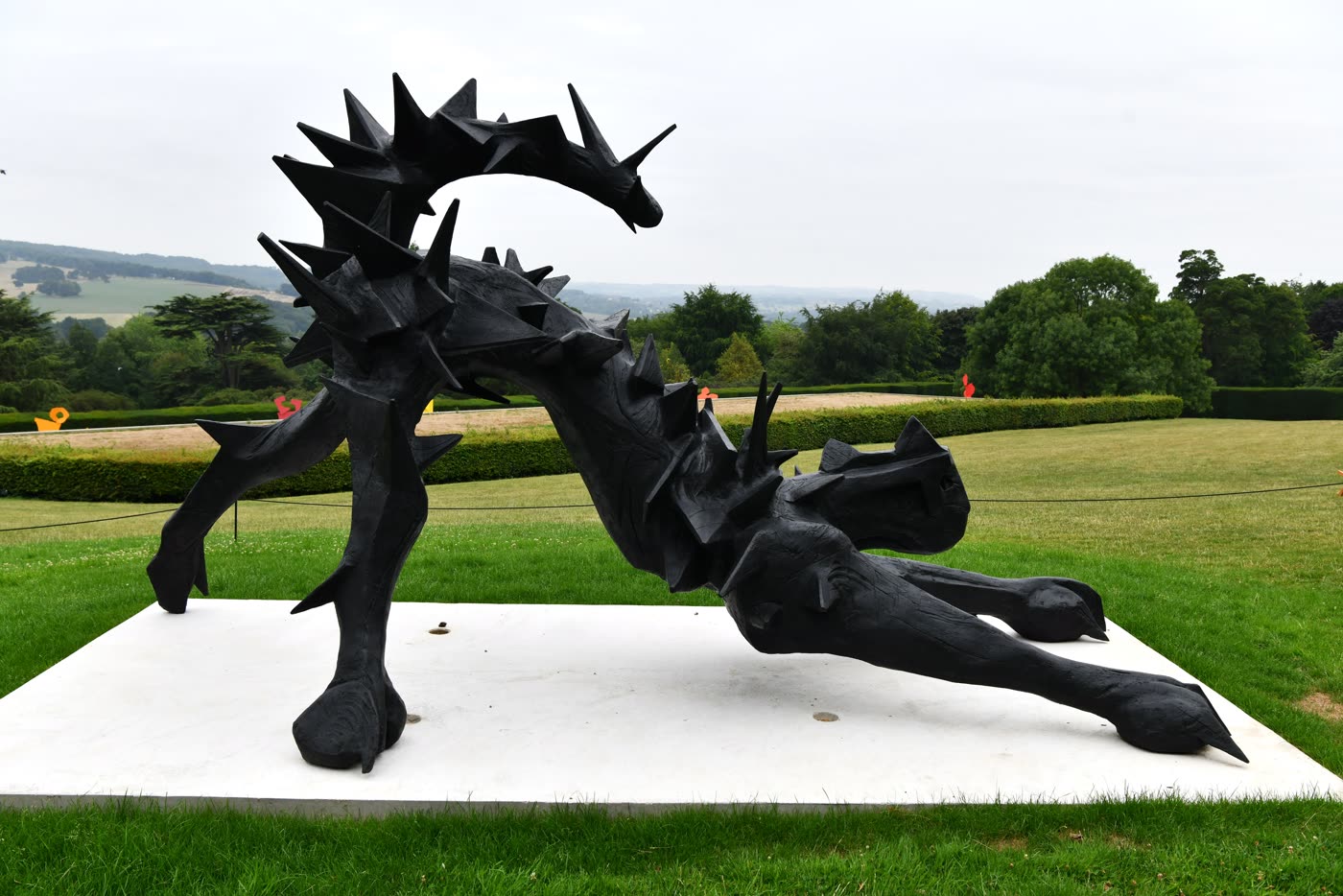
Image context: the cover uses a 2025 photograph of Kentridge's sculpture Stroke at Yorkshire Sculpture Park. It fits the article because the video starts with charcoal and paper, but its deeper argument is about how provisional marks travel outward: from page to film, from studio to rehearsal, and finally into public sculpture that still looks as if it could shift under pressure.[5]
Around 0:00 to 0:55, the studio becomes an externalized mind
The strongest idea arrives almost immediately.[1] Kentridge says the studio is a vital physical and psychic space, "a kind of expansion of one's head," where thought no longer travels a few centimeters between synapses but takes the eight-meter walk from one drawing to another.[1] That is a precise description of how his work resists clean conclusions. The studio is not simply a room where finished concepts get executed. It is the place where unfinished relations stay visible long enough to generate new ones.
This matters because Kentridge's work is often discussed through subject matter first: Johannesburg, mining capital, colonial violence, procession, archive, memory.[2][3] Those themes are real, but the video insists that the deeper engine is spatial and procedural. Sheets of paper, prior versions, ink, charcoal, and half-made images remain physically present around him, so thinking happens by pacing among residues rather than by protecting a single perfect idea.[1] The Broad's account of his multi-part practice and Art21's note that he works without a script or storyboard make more sense once you see the studio framed this way.[2][3] Revision is not an embarrassing stage to conceal. It is the condition of discovery.
Around 0:55 to 1:40, charcoal matters because it can change as quickly as thought
The video's second key move is material rather than abstract.[1] Kentridge says he likes charcoal because you can change it as quickly as you can change your mind, and he lingers on brushes that behave differently as they wear down.[1] This is more than studio charm. The medium lets him preserve the evidence of hesitation. Smudges, removals, overdrawn contours, and altered edges remain legible, which means the drawing can carry argument without pretending that argument arrived in one stroke.
Art21's artist page gives the broader consequence of that method: Kentridge photographs charcoal drawings and paper collages as they evolve, preserving every addition and erasure while plotting films without a fixed storyboard.[3] Tate's short interview compresses that whole practice into one tactile proposition.[1] If certainty depends on the illusion of seamless authority, then charcoal provides an alternative politics. It records thought as correction, not decree. In Kentridge's hands, erasure does not clean the image. It leaves a stain of prior judgment behind, which is exactly why the work can remain historical without becoming doctrinaire.[1][3]
Around 2:35 to 4:20, uncertainty becomes a political method rather than an alibi
The title phrase of the clip would be easy to sentimentalize, but Kentridge does not use it that way.[1] He situates himself as both inside and outside his own national story: a white, middle-class South African shaped by privilege, anti-apartheid struggle, and the contradictions of the democratic period that followed.[1][2] From there he argues that art has a polemical role in defending the uncertain and critiquing forms of certainty, whether those certainties come from authoritarian politics or from claims of total knowledge.[1]
That argument is sharper than a generic defense of ambiguity. The Broad notes his family background in anti-apartheid law and activism, and traces his early work through the Junction Avenue Theatre Company, where workshop methods were tied to resisting apartheid and retelling colonial history from the side of the colonized.[2] Art21 similarly stresses that he brings ambiguity and subtlety to subjects usually framed in narrow terms.[3] The video turns those biographical facts into a working ethic. Uncertainty here does not mean refusing judgment. It means refusing the dead language in which politics pretends to be finished, transparent, and immune to revision.[1][2][3]
Around 4:20 to the end, the page opens outward into theater, film, and sculpture
In the final stretch, Kentridge distinguishes the intimate garden studio from a larger studio in town where sculptures, workshops, filming, and rehearsals happen.[1] That distinction is easy to miss, but it explains why the interview is so valuable for reading his later public work. The private room is where images remain unstable enough to mutate; the larger studio is where those same unstable images are tested at scale.[1] Tate's earlier interview about his Teatro La Fenice project makes the same point from another angle: Kentridge describes wire-and-paper sculptures built for a camera's viewpoint, almost as an anti-stereoscope, where three-dimensional forms reveal themselves as legible silhouettes only through motion and rotation.[4]
That is why the photograph of Stroke works so well with this video.[5] The sculpture stands outdoors, fully public, yet it still reads like something that has passed through charcoal's grammar on the way there: cut edge, silhouette logic, a figure that looks both assembled and vulnerable.[5] The value of the Tate clip is that it prepares you to see public Kentridge work not as the end of a process, but as revision made durable enough to inhabit civic space. Theater, film, opera, and sculpture do not leave drawing behind. They keep its hesitation alive under new conditions.[1][4][5]
This short interview is worth returning to because it clarifies the real weight of Kentridge's art.[1] The work is political, but not because it delivers a finished lesson. It is political because it keeps showing how meaning gets made: through provisional marks, bodily movement, repeated adjustment, and a suspicion of any voice that claims too much certainty too quickly.[1][2][3] Charcoal becomes the right medium not because it is rough or expressive in a general sense, but because it lets thinking remain visible. The unfinished edge is the argument.
Sources
- Tate, "William Kentridge - 'Art Must Defend the Uncertain' | Artist Interview | TateShots," YouTube video.
- The Broad, "William Kentridge - Bio" - artist biography covering Johannesburg, anti-apartheid context, theater practice, and Drawings for Projection.
- Art21, "William Kentridge" - artist page on charcoal animation, erasure, and political allegory across media.
- Tate Etc., John Lloyd, "Interview: William Kentridge at Teatro La Fenice" - discussion of rotating sculptures, camera viewpoint, and anti-stereoscopic form.
- Geograph Britain and Ireland, Michael Garlick, "Yorkshire Sculpture Park: 'Stroke' by William Kentridge, 2023" - photographic source page for the sculpture image used here.