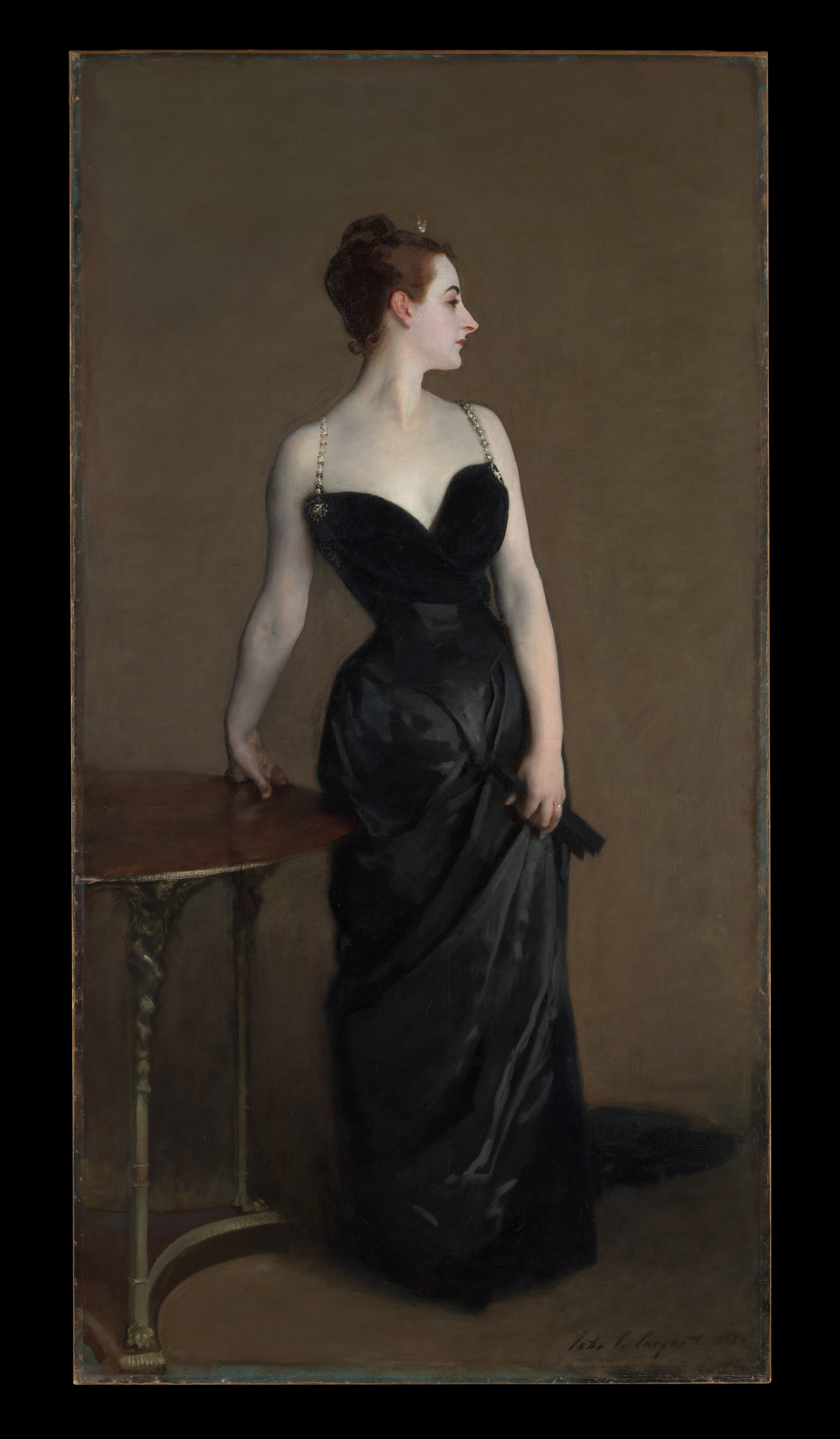
John Singer Sargent's Madame X is still introduced through its scandal, and the scandal is real enough.[1][2][5] When the portrait appeared at the Paris Salon in 1884, viewers recognized Virginie Amelie Avegno Gautreau, the New Orleans-born Parisian beauty whose right shoulder strap originally slipped down her arm.[1][2][5] Yet the painting lasts because the fallen strap is only the loudest sign of a deeper design. Sargent did not paint Gautreau as soft glamour. He painted her as a figure so sharpened by self-presentation that beauty starts to look rigid, almost electrically tense.[1][4][5]
That difference matters. Plenty of society portraits flatter their sitters by making luxury look natural.[4] Madame X does the opposite. The body is elongated into a near-vertical instrument, the skin is made strangely pale and cool against the black satin dress, and the head turns away from us as if the portrait's true subject were not intimacy but exposure under pressure.[1][2][3] Sargent wanted the picture to secure his reputation in Paris.[1][4] Instead he made a portrait so controlled that viewers felt the control itself.
Image context: the cover image uses the Met's public-domain reproduction of the painting itself. That exact match matters here because the article depends on the full vertical silhouette, the satin-black dress, and the severe profile relation between face, shoulder, and table edge. A cropped detail would weaken the argument before the close reading begins.[1]
The profile behaves like a cut
The first formal fact is that Gautreau is shown almost in profile, but not in a gentle Renaissance mode of ideal poise.[1][4] The head is turned so firmly that the bridge of the nose, the forehead, and the chin read as one continuous edge cutting into the brown background. The body, however, does not fully follow that turn. The torso opens outward through the low neckline, while the neck extends upward and back. That split is crucial. The portrait offers both display and refusal at once.
The result is why the picture can feel arrogant without becoming expansive. Gautreau does not meet the viewer's eye, yet she is not withdrawn.[1][5] She occupies the canvas too completely for that. Her right hand presses into the table, her left hand gathers the fan, and the body holds itself with a kind of trained inflexibility. Smarthistory notes that the portrait mixes a high-status Gilded Age portrait language with older classical cues, including the hairstyle and crescent ornament associated with Diana.[5] What Sargent takes from that classical register is not serenity. It is impersonality. He turns a fashionable woman into something closer to an emblem of cultivated surface.
Black satin and white skin create the real shock
The scandal is often reduced to the neckline or the strap, but the painting's stronger disturbance lies in its color structure.[1][2][5] Met conservation research describes Sargent's effort to capture Gautreau's exotic appearance and records his fascination with her unusually even lavender-toned skin.[2] That description is not a side anecdote. It explains why the flesh looks so stylized. The ear holds a warmer pink, but the face, shoulders, and arms are cooled and flattened into a deliberate pallor.[2] Against the dress, the skin stops reading as merely natural complexion and starts reading as an effect.
That effect is intensified by the dress's near-total darkness. From a distance the black shape looks simple, almost columnar.[1] Up close it is much more active. Conservation mapping found viridian green and other pigments working inside the supposed blackness, which helps explain why the fabric does not deaden into a flat void.[2] The dress absorbs light without losing internal life. Sargent uses it as a framing device around Gautreau's chest, arms, and head, so the pale flesh seems lit less by ambient room light than by a public spotlight of his own making.
This is where the picture becomes modern. The sitter does not appear naturally beautiful and then happen to wear an elegant dress. The portrait shows beauty as fabrication: powder, hair, posture, fabric, jewel, and calculated contrast locked together into one social machine.[2][5] That is what makes the image feel slightly cruel. Sargent admires the construction, but he also reveals how strenuous it is.
The famous strap matters because the whole pose is brittle
The right strap has received so much attention because it gives the scandal a convenient narrative.[1][2][5] Viewers can point to one visible transgression and call the case solved. The conservation record makes the story more interesting. X-radiography and infrared examination revealed not just the strap change but repeated adjustments to the profile, the ear, and the arms while Sargent worked toward the final composition.[2] This was not a casual likeness that accidentally offended. It was a heavily revised structure.
That helps explain why the repainting of the strap does not normalize the portrait. Even in its corrected state, the image remains precarious.[1][2] The body leans, but only just. The hand on the table supports the figure, yet it also advertises how much support is needed. The head lifts with hauteur, but the pose is too deliberate to read as ease. What scandalized the Salon was not simple nakedness. It was the sense that Sargent had made elite femininity look self-conscious, theatrical, and a little dangerous to itself.[2][4][5]
The background revisions point in the same direction. Met researchers found traces of a much brighter earlier color scheme along the edges and reconstructed shifts from cerulean and rose toward the more neutral brown field we see now.[2] That final restraint is important. The muted background strips away decorative atmosphere and leaves Gautreau with nowhere to hide. She stands in a field of judgment.
Reputation enters the picture as a formal pressure
Because Sargent painted Gautreau without commission, hoping the portrait would establish him, ambition is built into the image from the start.[1][4] The Met's Sargent chronology notes that Madame X drew on Velazquez, Titian, Manet, and Japanese prints while provoking criticism for its pose, modeling, and treatment of space.[4] Those references help clarify why the portrait feels so deliberate. Sargent is not just painting a fashionable woman. He is testing whether society portraiture can absorb avant-garde severity without breaking.
It partly breaks. The painting's fame now can make that outcome look inevitable, but the historical record says otherwise. The Salon reaction damaged Gautreau's reputation and pushed Sargent toward London rather than Paris.[2][4][5] Later, when he sold the picture to The Met in 1916, he still asked that it not be called by the sitter's full name because of the old quarrel surrounding it.[2][3] He nevertheless called it the best thing he had done.[2][3] The statement makes sense. Madame X is the place where his social brilliance stopped being merely flattering and became analytical.
Why the painting still holds
The lasting force of Madame X lies in how little it relaxes.[1][2][5] Every part of the composition participates in the same pressure system: the profile edge, the lifted chin, the almost metallic skin, the black dress, the bracing table, the emptied background. Beauty is present, but it has been tightened until it nearly stops being hospitable. That is why the portrait still feels contemporary. It understands glamour as a discipline before it understands glamour as pleasure.
Seen that way, the famous strap is not the whole meaning of the picture. It is the small visible crack that lets us notice the larger structure. Sargent built a portrait in which elegance, self-invention, and social exposure cannot quite be separated.[1][2][4][5] The painting's scandal was temporary. Its real subject, the brittleness of public beauty, has stayed current.
60-second viewing drill
- Start with the head and trace the profile as one sharp edge against the background.
- Drop to the neckline and notice how the black dress turns the chest and shoulders into a lit display zone.
- Look at the right hand on the table and ask whether the pose feels effortless or braced.
- Step back far enough to read the whole figure as one dark vertical column interrupted by pale skin.
- End with the corrected shoulder strap and ask why the portrait still feels precarious even after the visible scandal was repaired.[1][2]
Sources
- The Metropolitan Museum of Art, Madame X (Virginie Amelie Avegno Gautreau), collection entry with object data and curatorial overview.
- Dorothy Mahon and Silvia A. Centeno, "Revealing Madame X," The Metropolitan Museum of Art, on Sargent's revisions, pigments, and technical examination.
- Stephanie L. Herdrich, "From the Archives: How Madame X Came to The Met," The Metropolitan Museum of Art, on the 1916 acquisition and title history.
- H. Barbara Weinberg, "John Singer Sargent (1856-1925)," The Metropolitan Museum of Art Heilbrunn Timeline of Art History.
- Meg Floryan, "John Singer Sargent, Madame X (Madame Pierre Gautreau)," Smarthistory.