
Archival art films often pretend that installation is secondary. The object already exists, the camera implies, and museum staff merely help it arrive. The Met's Water Stone, 1987: Installing Isamu Noguchi's Iconic Sculpture shows the opposite.[1] Its real subject is not a peaceful finished fountain. Its subject is the amount of argument, calibration, and restraint required to make peace look natural inside a museum.
That difference matters because Water Stone is easy to romanticize. On the screen and in the gallery, it first appears as a dark, seven-sided stone with water sliding evenly from the top, surrounded by smaller rocks in The Met's Japanese galleries.[1][2][3] The opening narration already tells us that this is not a traditional basin but a modern sculpture cut from basalt, with polished faces and a rough outer skin.[1] Yet the film refuses to leave the work in that finished state. It immediately moves backward into the problem of how such calm gets made.
Noguchi's broader career makes that problem legible. The Noguchi Museum biography describes him as an artist who worked across sculpture, gardens, architecture, landscapes, furniture, stage design, and public works, while drawing on experience in Japan, Mexico, China, Italy, and New York.[4] Its public works overview is even more direct about the scale of his ambition: fountains, gardens, playgrounds, courtyards, and civic spaces all belong to the same field.[5] Water Stone sits squarely inside that larger project. It is a sculpture, but it is also a condensed site. The film matters because it shows Noguchi treating installation not as delivery logistics but as the final stage of form.
Image context: the cover uses The Noguchi Museum's reproduced installation photograph of Water Stone at The Met. That exact match matters here because the article's argument depends on the relation between the polished upper plane, the dark sides, the ring of surrounding stones, and the gallery floor. A generic portrait of Noguchi or a cropped close-up of the basin would lose the work's environmental logic before the reading begins.[2][3]
Historical context: Noguchi wanted sculpture to behave like place
By 1987, Noguchi was already an old master of cross-disciplinary form, not a younger sculptor still trying to prove that stone could be modern.[1][4] Born in 1904 and active across much of the twentieth century, he had spent decades collapsing borders between fine art, design, architecture, and landscape.[4] The biography page's list of materials is revealing on its own: marble, cast iron, balsa wood, bronze, sheet aluminum, basalt, granite, and water all appear in a single arc of practice.[4] That range helps explain why Water Stone should not be read as an eccentric late fountain. It is a late statement about medium itself. Stone and water are not additions to sculpture here. They are the terms through which sculpture becomes environment.
The public-works framing sharpens the point. The Noguchi Museum does not isolate his civic work as a side project; it treats fountains, gardens, and open-air commissions as central to understanding the oeuvre.[5] Seen in that light, Water Stone is not trying to imitate a Japanese garden from outside. It is trying to compress certain garden conditions, flow, stillness, edge, interval, and bodily orientation, into an indoor art object that still behaves like a place.[1][2][5]
That is why the installation footage is so valuable. A still photograph can show the final dignity of the object. The 1987 film shows that dignity being negotiated, often under pressure, in real time.[1] We watch Noguchi and the museum staff decide how much support can remain invisible, how level the upper plane must be, how the plumbing can disappear, and how much variation in the water's run should be tolerated before design becomes overcorrection.[1] What the archive preserves is not simply a work entering a gallery. It preserves the point where aesthetic calm is still a technical argument.
Video provenance
The embedded video is The Met's official upload from its From the Vaults series, published in 2020 from the museum's moving-image archive and documenting the 1987 installation of Water Stone while Noguchi was still present to direct decisions.[1] That provenance matters. This is not a retrospective reconstruction, and not a curator speaking over old stills. It is a record of the museum, the artist, and the work meeting each other at the moment when placement becomes meaning.
The first minutes make hidden infrastructure the real drama
The film opens with the finished sculpture in operation: water flowing outward from the dark top plane while rounded stones gather around the base.[1] Then, almost immediately, the narration shifts into problems. How will the water be contained? How high should the hidden tray sit? Can the plumbing disappear enough that the work still looks as though it belongs to nature rather than to a museum's mechanical systems?[1] Those questions are not side notes. They reveal what Noguchi is actually designing.
One of the strongest moments in the first two minutes comes when the discussion turns to visibility. Noguchi objects whenever a support element threatens to announce itself too clearly.[1] The transcript is rough, but the intent is unmistakable: if the catch basin or other hidden structure becomes legible, the sculpture loses the calm deception on which it depends.[1] The museum staff are not simply being asked to make the piece function. They are being asked to preserve an illusion of inevitability.
That is a crucial distinction for reading Water Stone. Many late-modern sculptures are content to display their supports and mechanical facts openly. Noguchi wants a different relation between fact and appearance. The work is engineered, but it should not look engineered in a heavy-handed way. The stone has been cut, polished, leveled, drilled, and plumbed; yet the final effect should feel closer to a discovered condition than to a demonstration of technique.[1][2][3] The archive therefore shows a modernist object refusing a fully industrial aesthetic. Its serenity depends on hidden labor.
Levelness is not fussiness; it is the form
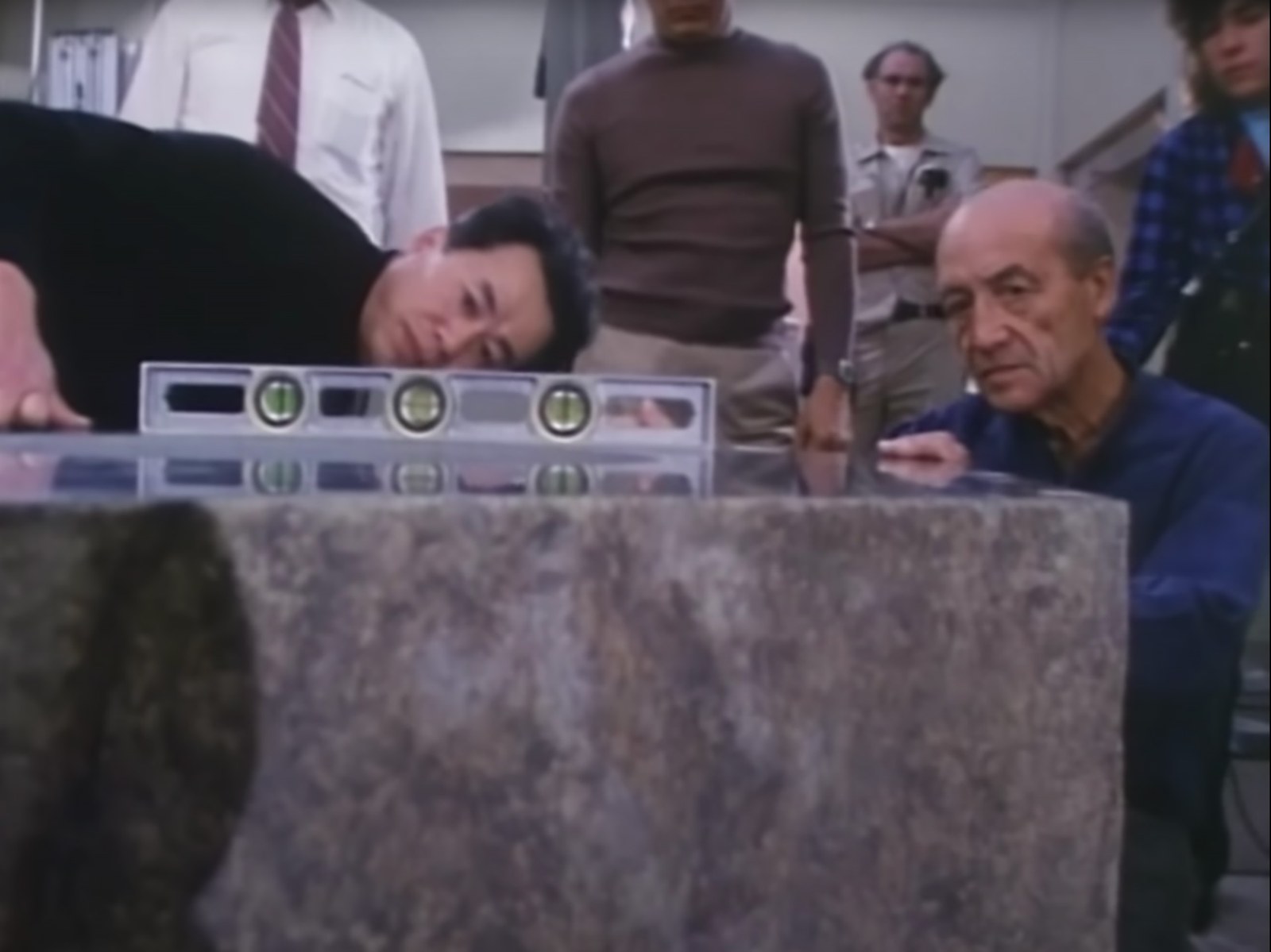
Around the middle of the film, the installation becomes a lesson in exactitude. The task, the narration tells us, is to set the stone so that its flat top is perfectly level "in relation to the center of the earth," and the placement takes seven hours.[1] That line could sound theatrical if the footage did not back it up. We see a crew working in close quarters, the heavy stone suspended and nudged into place, Noguchi crouching and looking, support stones adjusted and readjusted, and the work's great mass treated as if a few millimeters could change everything.[1]
They could. If the top plane tilts, the water does not read as a continuous skin. It betrays gravity too plainly on one side and starves another edge.[1] The film makes visible something viewers might otherwise miss in the gallery: the apparent simplicity of Water Stone is inseparable from precise leveling. This is not a sculpture to which water has been casually added. Water is the test that tells you whether the form has been installed correctly.
The supporting stones matter for the same reason. The film notes that the five support stones have been cut flat on top and bottom, with surfaces smooth like the bottom of the sculpture itself.[1] That detail is more than a craftsman's aside. It shows Noguchi refusing the fake-natural shortcut. The base may read as a rocky cluster, but the support system is carefully worked so that the stone above can hold both weight and stillness. Nature, in this indoor setting, has to be fabricated with rigor before it can appear unforced.
The turning point is Noguchi's defense of imperfection
The clip's best passage comes later, when the crew asks whether more water can be brought over one edge.[1] A lesser artist might have wanted the surface tuned toward total symmetry, every side flowing with equivalent force. Noguchi says no. Do not try to do too much, he says in effect; that heavier spill is an accident of nature, and the imperfection is important.[1] He even adds that, with time, the stone will grow browner. The finish is not supposed to freeze the work outside time.
That is the hinge on which the whole film turns. Up to this point, Water Stone can look like a perfectionist object, almost severe in its demands. The level has to be exact. The tray must disappear. The support stones must be cut properly. The void must hold the right depth of water. Then Noguchi reveals what all that control is for: not machine-perfect regularity, but a believable field in which variation can live.[1]
This is why the polished top and the rough outer skin need each other.[1][2][3] The object is neither raw stone nor pure industrial finish. It stages a negotiation between control and weather, cut and remainder, plan and drift. Once the film reaches that point, the smaller irregularities in the water's flow stop reading as flaws to be corrected. They become the proof that the sculpture has not been overdesigned into deadness.
The ending explains how Noguchi moves a garden indoors
The closing monologue gives the work its widest frame. The film speaks of the harmony of rock and water, of paintings of rocks and outward views bringing nature indoors, and of Japanese architecture as unimaginable without a relation to nature.[1] Then it turns to the center of the stone itself: the drilled void is deep, the water is stilled by that depth, and pressure sends the water outward in a horizontal sheet over the whole surface.[1] This is the most important explanatory stretch in the video because it shows that Water Stone is not merely symbolic nature. It is hydraulic nature reduced to a disciplined interior event.
That idea also clarifies why the object belongs in Noguchi's larger public and environmental practice.[4][5] He is not decorating a gallery with Japanese reference. He is building a pressure system that changes how a body stands in relation to floor, stone, sound, and surrounding space. The museum gallery does not turn into a full garden, of course. It becomes something tighter and stranger: a modern room in which a few carefully controlled conditions, rock, water, void, edge, can generate a garden-like concentration.
The film's final biographical note says Noguchi was eighty-two when the sculpture was installed.[1] That fact lands differently after nine minutes of watching him work. The archive does not show a ceremonial elder simply approving a finished idea. It shows an artist still calibrating, still worrying about pans, edges, levels, and how much imperfection a work needs in order to remain alive. That is why this footage deserves the term archival spotlight. It preserves not just a famous sculpture, but the exacting intelligence that kept the sculpture from becoming inert.
Why this archive matters now
The deepest value of Water Stone, 1987 is that it restores museum labor to the meaning of the object without reducing the object to labor alone.[1] We see rigging, support stones, plumbing, and patient adjustment. But the film does not end in backstage demystification. It ends by showing why such labor was necessary: Noguchi wanted a sculpture that could act like a compressed landscape, and compressed landscapes are unforgiving things. They fail if the mechanics dominate; they also fail if they are polished past variation.
Seen now, the film makes Water Stone feel less like a serene amenity and more like a difficult achievement.[1][2][3] Its quiet is built, tested, and defended. The museum setting does not cancel nature; it reveals how much artifice is needed to make nature thinkable indoors. That is the archival lesson worth keeping.
Sources
- The Met, "Water Stone, 1987—Installing Isamu Noguchi's Iconic Sculpture | From the Vaults," YouTube video.
- The Metropolitan Museum of Art, "Water Stone" - collection entry for Isamu Noguchi's 1986 sculpture on view in Gallery 229.
- The Noguchi Museum, "Water Stone" - artwork page with installation image and object record.
- The Noguchi Museum, "Biography" - overview of Noguchi's international practice across sculpture, gardens, architecture, and materials.
- The Noguchi Museum, "Public Works" - overview of Noguchi's fountains, gardens, playgrounds, courtyards, and civic environments.