The Washington Color School is one of those labels that sounds tidier than the art itself. It suggests a coherent local program, almost a syllabus, when the historical reality was looser and more alive. The Smithsonian Libraries and Archives notes that Gene Davis himself called it a "so-called school," because the artists gathered under that name did not set out to found a formal institution or obey one doctrine.[1] What they did share was a location, a period, and a problem: once Abstract Expressionism had made the heroic brushstroke feel inevitable, how could painting move forward without simply replaying New York drama at a lower volume?
Washington's answer was not to become colder in spirit. It was to move intensity into another place. Instead of asking gesture to carry meaning, these painters let pigment delivery, edge, absorbency, spacing, and scale do the work.[1][2] That is why the movement still matters. The Washington Color School did not only brighten postwar abstraction. It changed where pictorial pressure could live.
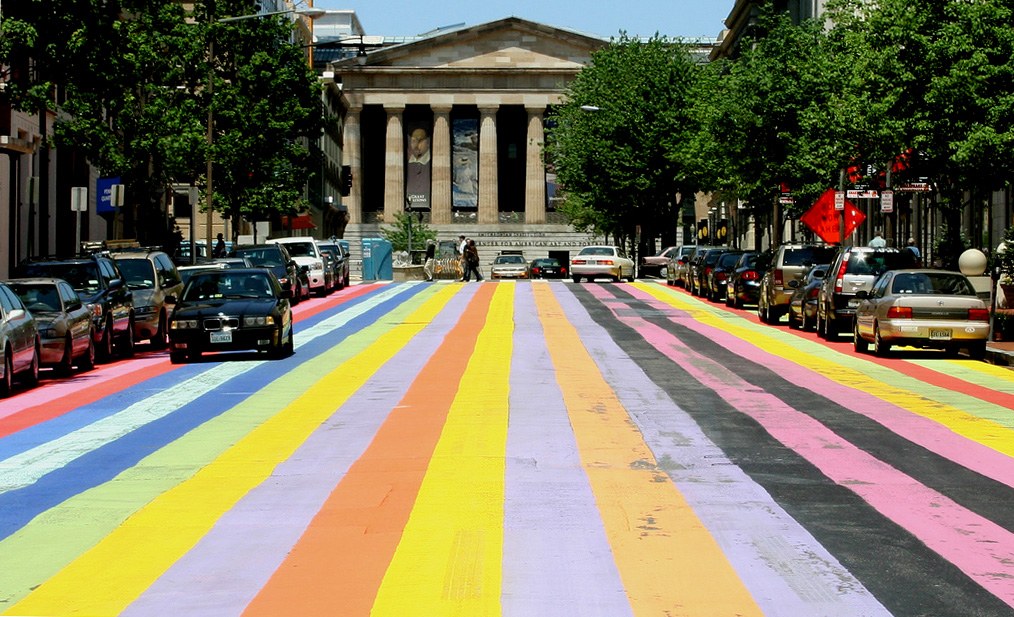
Image context: the lead image uses a real photograph of Gene Davis's Franklin's Footpath rather than a flat artwork reproduction. That choice keeps the visual grounded in Washington itself: the stripe becomes a public walking surface, so the movement's concern with interval, edge, and color sequence appears as something the city can physically cross.[7]
The name came late, and it never fit perfectly
The most useful starting point is to stop imagining the Washington Color School as a tightly unified bloc. The Smithsonian Libraries essay ties the label to the 1965 Washington Color Painters exhibition and stresses that the artists did not necessarily associate with one another as a self-conscious school, even if later history grouped them that way.[1] The term usually points to six painters: Morris Louis, Kenneth Noland, Gene Davis, Thomas Downing, Howard Mehring, and Paul Reed.[1] That list is real, but it is not the whole story.
The Smithsonian American Art Museum's Local Color exhibition makes the point even more sharply by looking beyond the label. Its Washington frame includes Leon Berkowitz, Sam Gilliam, Felrath Hines, Jacob Kainen, and Alma Thomas as well as the canonical names, treating the capital in the mid-1950s through mid-1970s as one of the country's most dynamic art communities rather than a neat club with fixed membership.[2] That broader lens matters because it shows the "school" less as a membership roll than as a local climate. Washington became a place where artists could test what color and form might do once subject matter was reduced and brush rhetoric cooled.
So the real unit here is not a manifesto. It is a shared reallocation of energy. Color stops decorating structure and starts becoming structure.
The medium became the argument
The Smithsonian Libraries piece is especially strong on this point. It describes the group as artists experimenting with pure color painting and emphasizes that the materials and the technique were themselves the message: staining, pouring, dripping, and dabbing on large surfaces mattered as much as any final composition.[1] That sentence gets to the heart of the movement better than the usual sound bite about "hard-edged, bright color." The Washington painters were not only choosing a new palette. They were changing the mechanics by which a painting came into being.
This is why unprimed canvas matters so much in the story. Kenneth Noland's Smithsonian biography says that after moving to Washington in 1949, he absorbed European painting at the Phillips Collection, discovered Abstract Expressionism, and began experimenting with unprimed canvases and unusual methods of applying paint.[3] The support was no longer a passive surface waiting to receive a finished image. It became an active participant. Thinned paint could soak, spread, or lock itself into the cloth in ways that made color feel fused with the ground rather than laid on top of it.
Noland's account also preserves the movement's social texture. He and Morris Louis held "jam sessions," painting together and testing ideas in real time.[3] That phrase matters because it keeps the school from hardening into a bloodless formal recipe. The paintings may look controlled, but their order often came out of experiment, chance, and speed. Noland's circles aimed for what he called a single expressive entity, and his "one shot" method shows how risk remained inside this cooler pictorial language.[3] Washington Color painting reduced visible struggle, but it did not reduce commitment. The gamble just moved from the brush flourish to the irreversible stain.
Gene Davis shows the movement's rhythmic side
If Noland and Louis clarify the soak-stain logic, Gene Davis clarifies something equally important: Washington color painting could become musical without becoming lyrical in the old, atmospheric sense. The Smithsonian's Davis biography presents him as a major figure who helped establish Washington as a center of contemporary art, and it notes that he turned to hard-edge stripe paintings in the late 1950s partly to minimize brushwork and let color relations stand exposed.[4] That shift is visible in Stripes from 1957, which the Smithsonian calls one of his earliest stripe experiments.[5]
That early canvas is useful precisely because it is not yet fully purified. The museum description says Davis applied bold strokes rapidly over a dark, roughly brushed ground, and the result still looks transitional: the verticals read as independent color events, but they have not yet lost all contact with painterly spontaneity.[5] In other words, Stripes shows the school's hinge. Gesture remains present, but it has been disciplined into serial order.
By the time Davis reaches Hot Beat, the structure is more exacting and more confident. The Smithsonian's label explains that the unexpected intervals between color bands are central to the painting's musical force and that Davis wanted viewers to enter through one color and follow what it does across the whole surface.[6] The museum adds that he worked with the vertical stripe for nearly thirty years because it gave him an endlessly productive way to test color's expressive and structural powers.[6] This is the Washington Color School at full maturity. Nothing needs to be represented. Nothing needs to explode. The painting pulses because interval itself has become event.
That explains why Davis remains so central to the movement's identity. He proved that repetition did not flatten painting. Under the right conditions, repetition could become the most sensitive way to register difference.
Washington offered an alternative, not an escape
The Washington Color School is sometimes misread as a retreat from emotional weight, as if these painters chose flatness to avoid the existential pressure that defined earlier abstraction. The sources suggest something more demanding. Gene Davis described the movement's hard-edged brightness as a breath of fresh air against the messier painting then dominant in New York, but freshness here did not mean superficiality.[1] It meant a different route to conviction.
The artists in Local Color demonstrate how wide that route could be. Some pursued stripes, some targets, some veils, some suspended chromatic fields, and later figures such as Sam Gilliam pushed the language beyond the stretcher while still advancing inventions associated with the Washington Color School.[2] That extension is crucial. It shows that the school's real legacy was not one fixed look. Its legacy was permission: a serious painting could be built from color decisions, from surface behavior, from the interval between bands, from the speed of a poured edge, from the way canvas drinks pigment and refuses revision.
Seen this way, the Washington Color School matters less as a regional footnote than as a structural correction inside American modernism. It told painters that the drama of abstraction did not have to arrive as anguish made visible. It could arrive as control, absorbency, timing, and chromatic pressure. Washington did not eliminate feeling. It taught feeling how to travel through color alone.[1][2][3][4][5][6]
Sources
- Anne Evenhaugen, "Hard-edged, Bright Color: The Washington Color School," Smithsonian Libraries and Archives / Unbound - overview of the label's looseness, the 1965 Washington Color Painters exhibition, the canonical six artists, and the movement's emphasis on pure color, staining, pouring, dripping, and dabbing.
- Smithsonian American Art Museum, "Local Color: Washington Painting at Midcentury" - exhibition page framing mid-century Washington as a dynamic art community and expanding the movement beyond a narrow canonical roster.
- Smithsonian American Art Museum, "Kenneth Noland" - artist biography on Black Mountain, the Phillips Collection, unprimed canvas, Morris Louis "jam sessions," and Noland's rapid one-shot method.
- Smithsonian American Art Museum, "Gene Davis" - artist biography on Davis's role in establishing Washington as a contemporary art center and his turn away from gestural painting toward stripe-based color structure.
- Smithsonian American Art Museum, "Stripes" - artwork page for Gene Davis's 1957 painting, including date, medium, and the museum's description of it as one of his earliest stripe experiments.
- Smithsonian American Art Museum, "Hot Beat" - artwork page on Davis's use of unexpected intervals, musical rhythm, and the stripe as a long-term device for testing color's expressive and structural qualities.
- Wikimedia Commons, "File:GeneDavisStreet.jpg" - source page for a real photograph of Gene Davis's Franklin's Footpath street painting in Washington, D.C.