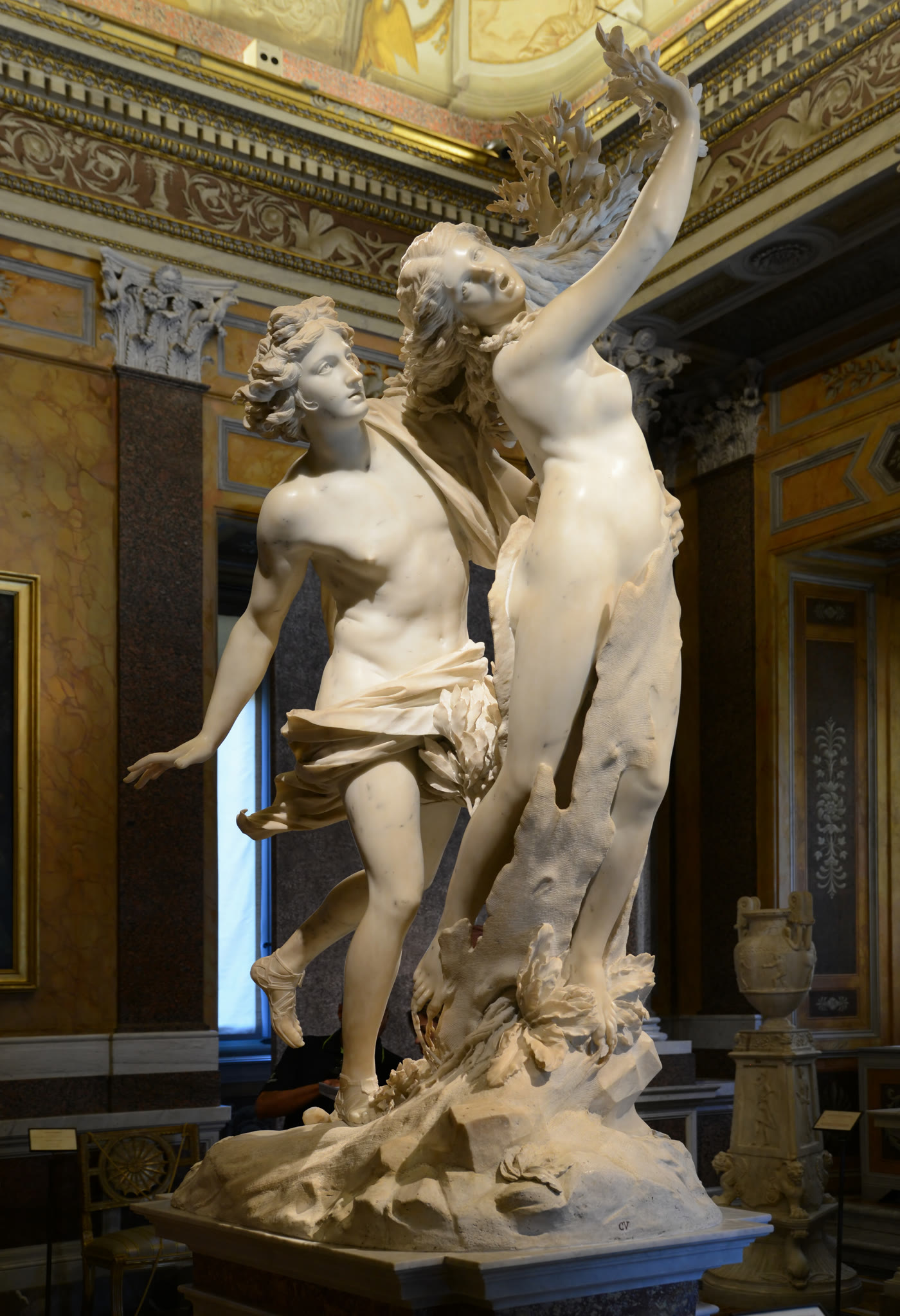
Bernini's Apollo and Daphne is usually praised for making marble look mobile, and that praise is deserved but incomplete.[1][3] Plenty of sculptures move. Bernini's sharper achievement is that he makes motion reverse its meaning at the exact second it reaches its goal. Apollo catches Daphne, wraps a hand around her torso, and discovers that victory has arrived one instant too late.[1][3] The sculpture is not simply a chase frozen in stone. It is a chase converted into loss at the moment of touch.
That reversal is why the work still feels faster than many later images of the same myth.[1][2] The official Borghese catalogue entry is especially useful because it insists that the group was not conceived as an all-purpose object to be admired from anywhere at random.[1] Bernini wanted it placed in front of the wall near the chapel and spiral staircase, with the observer's attention focused on Apollo's right side.[1] From that privileged approach, the viewer would not just see two beautiful bodies in motion. The viewer would watch Apollo's confidence collapse into amazement as Daphne's metamorphosis becomes legible.[1] The sculpture is therefore a sequence disguised as a single instant.
Image context: the lead photograph shows the sculpture from a view that makes the lunging diagonal, Daphne's raised arms, and the burst of leaves all read together at once. That is the right visual anchor for this article because the argument turns on staging: Bernini designed not only forms, but the order in which a viewer discovers what those forms are becoming.[1][5]
The sculpture is built as a turn
The myth comes from Ovid's Metamorphoses: Cupid punishes Apollo by striking him with desire and Daphne with refusal, so the pursuit is structurally unequal from the start.[1][3] The Borghese entry summarizes the dramatic climax with unusual precision. Apollo runs with his right foot grounded and left foot raised, the drapery on his shoulder and flank intensifying the forward thrust; Daphne twists back with her arms lifted even as her feet root, her hands leaf, and her hair breaks into laurel.[1] The point is not merely that transformation is happening. It is happening unevenly. Different parts of her body are changing at different speeds.
Smarthistory helps clarify why this matters aesthetically.[3] Harris and Zucker emphasize that Bernini chooses the exact point at which Apollo's hand touches only bark, even while the rest of Daphne still appears partly human.[3] That delay is the sculpture's emotional engine. If Daphne had already become a full tree, the scene would read as aftermath. If Apollo had not yet reached her, it would remain anticipation. Bernini wants the cruel middle state. Apollo arrives, but arrival produces no possession.
This is also why the sculpture needs bodily diagonals rather than stable classical balance.[1][3] Apollo's stride, the wind-whipped drapery, Daphne's recoil, and the spray of leaves all keep the composition from settling into symmetry.[3] The work behaves like a turn that has not finished turning. Baroque drama here does not mean noise. It means that form remains under pressure.
Marble changes texture before it changes meaning
The technical miracle is not only that Bernini narrates metamorphosis, but that he makes different materials seem to occupy the same body at once.[1][3] On the Borghese page, the catalogue writer lingers over precisely this: fingers and toes becoming leaves and roots, hair swept backward, bark delicately chiseled, garments finished differently from skin.[1] Those surface distinctions are not ornamental extras. They let the viewer feel the moment as a sequence of collisions. Flesh meets bark. movement meets rooting. Pursuit meets stoppage.
Smarthistory's transcript adds a useful reminder about material risk.[3] The laurel leaves between the two bodies look almost implausibly fragile for marble, and that fragility is part of the work's charge.[3] Bernini is not only illustrating Daphne's escape; he is testing how far stone can be thinned, pierced, and animated before it starts to feel impossible. The Borghese catalogue notes that 1997 restoration analysis found he temporarily protected the thinnest elements with plaster cushions during successive working stages.[1] That detail matters because it pulls the sculpture out of legend and back into workshop intelligence. The work looks miraculous because it was also meticulously engineered.
One of the most revealing curatorial details concerns what Bernini did not finish.[1] The Borghese entry notes that some unpolished areas remain because Bernini did not believe they would be visible from the intended placement.[1] In other words, the sculpture's famous "in the round" vitality is partly a later condition. Its original logic was directional. The work was made to produce a privileged encounter, not total democratic visibility from every angle.
The room was part of the sculpture
That original staging becomes clearer when the museum's room page is read alongside the catalogue entry.[1][2] The Apollo and Daphne room was redecorated in the late eighteenth century, and by then the group had been moved so the furnishings and ceiling program could complement it.[2] The room is now named for the sculpture, and the ceiling even retells the myth in painted form.[2] Yet the same institutional record also preserves the fact that this was not Bernini's initial setup.[1][2] The later display canonized the sculpture as a centerpiece. Bernini had conceived it more theatrically, with a lower pedestal and a side placement that increased the observer's emotional involvement.[1]
That difference changes how one reads Apollo's face. Seen frontally today, the sculpture can look like a general spectacle of virtuosity. Seen through the original viewing logic described by the Borghese catalogue, his expression becomes narrative timing.[1] The moment is not "Apollo chases Daphne." It is "Apollo realizes that the thing he has reached is already gone." Bernini does not separate theatricality from psychology. He uses staging to make psychology visible.
Even the base once pushed viewers toward interpretation.[1] The Borghese entry records Cardinal Maffeo Barberini's moralizing couplet about the bitter berries gathered by anyone who pursues fugitive beauty.[1] That inscription matters because it keeps the sculpture from drifting into pure decorative myth. The group offers sensual abundance, but it also punishes appetite. The more irresistibly alive Daphne looks, the more absolute Apollo's failure becomes.
Why Apollo and Daphne still feels immediate
The sculpture's enduring force comes from that double structure: seduction at the level of surface, refusal at the level of story.[1][3] We first register speed, anatomy, drapery, leaves, polish, and risk. Then the work closes. Apollo's hand lands, but the body he wants has already crossed into another state.[1][3] Bernini makes the viewer experience the gap between contact and possession as something almost physical.
That is why later writers kept returning to Daphne's bark and leaves as the place where the sculpture seems to exceed ordinary carving.[1][4] The Met's page on Giuliano Finelli notes how strongly contemporaries associated the assistant's virtuosity with the leaves, tendrils, and bark of Daphne's metamorphosis, while the Borghese catalogue says modern scholars largely reject another hand in the finished group.[1][4] The disagreement is revealing in itself. It shows where viewers locate the sculpture's extremity. They keep being drawn to the exact surfaces where living body and inhuman matter trade places.
Bernini's real triumph, then, is not that he makes stone look soft. It is that he makes marble understand timing. Apollo and Daphne works because it withholds the single thing Apollo believes he has secured. The sculpture turns a grasp into a miss without relaxing the beauty of the form for a second. That is why the work still feels less like a static masterpiece than like an event that has not quite stopped happening.[1][3]
Sources
- Galleria Borghese, "Apollo and Daphne" - official catalogue entry with date, medium, original placement, intended right-side view, inscription, restoration notes, and discussion of finishing and attribution.
- Galleria Borghese, "Apollo and Daphne Room" - museum room page on the late eighteenth-century display context and the sculpture's later repositioning within Room 3.
- Smarthistory, "Gian Lorenzo Bernini, Apollo and Daphne" - art-historical walkthrough of the Ovidian story, the instant of transformation, and the sculpture's Baroque motion.
- The Metropolitan Museum of Art, "Cardinal Scipione Borghese (1577-1633)" by Giuliano Finelli - collection essay used here for patronage context and the later association of Finelli's virtuosity with Daphne's leaves, tendrils, and bark.
- Wikimedia Commons, "File:Apollo & Daphne September 2a.jpg" - source page for the documentary photograph used as the article image.