Giovanni Battista Piranesi is often introduced as the great engraver of Roman ruins, which is accurate as far as it goes.[1][2][4] It does not go far enough. Piranesi's real achievement was that he made paper behave architecturally. A plate, drawing sheet, or bound volume became a place where Rome could be stretched, argued over, merchandised, and emotionally intensified all at once. His views of antique remains did not simply record stones that still stood. They taught viewers how grandeur should feel.
That is why Piranesi still reads as more than a gifted topographer of the Grand Tour. He handled etching as a system for building depth, scale, and persuasion. The famous ruins, prisons, title pages, and archaeological books all come out of one pressure point: he wanted architecture to exceed immediate sight. The city on paper had to arrive larger, darker, and more charged than the city a traveler first encountered in person.[1][2][4]
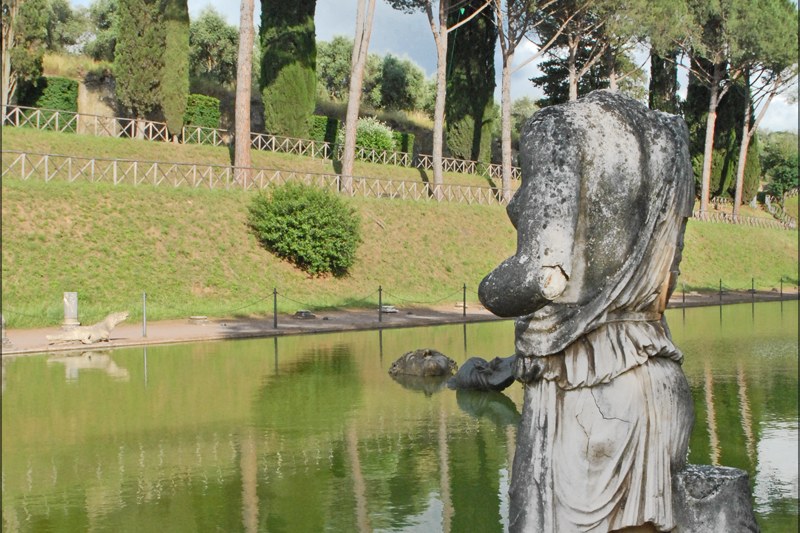
Image context: the lead image now shows the Canopus at Hadrian's Villa as a lived ruin rather than a diagram or reproduction. That physical site helps make Piranesi's method visible in reverse: real depth, water, statues, and fragments become the raw architecture that his paper view could stretch into theatrical Roman magnitude.[2]
He trained like an architect and printed like a dramatist
The Metropolitan Museum's essay gives the indispensable biographical base. Piranesi was born in 1720, the son of a stonemason and builder, learned structural and hydraulic engineering through family connections, absorbed enthusiasm for ancient Rome from his brother, and also received training in perspective construction and stage design.[1] That combination matters more than the standard biography line about an engraver who loved ruins. It means his imagination was formed by building, by infrastructure, and by theatrical space before it was stabilized by print.
The same Met essay notes that soon after arriving in Rome in 1740, Piranesi briefly apprenticed himself to Giuseppe Vasi, whose etched views supplied pilgrims, scholars, artists, and tourists with souvenirs of the city.[1] Piranesi learned the commercial reality immediately: prints were portable architecture. They were how Rome circulated. Yet the point was never mere souvenir traffic. Once he mastered etching, he used it to hold together several ambitions at once: documenting ancient systems, inventing impossible structures, and turning perspective into a kind of emotional mechanism.[1]
That is where the artist profile really begins. Piranesi did not fail at architecture and then retreat into print. He moved his architecture onto paper, where commissions could be replaced by editions, copper plates, and books. The medium let him design without waiting for a patron to build. It also let him enlarge his audience far beyond one site or one client.[1][4]
He sold Rome by making scale feel unstable
The Getty's exhibition page frames Piranesi as a lifelong champion of Rome who published more than a thousand etchings of the city and its monuments.[4] It also states the essential commercial fact: these publications were acquired as fine works of art and as surrogate images for collectors' libraries and print cabinets.[4] That second function is crucial. Piranesi did not only picture Rome for people who had seen it. He taught distant viewers what Rome was supposed to look like before they arrived.
The National Gallery of Art's text on The Canopus of the Villa Adriana at Tivoli makes this mechanism visible with unusual precision. It says Goethe found Rome disappointing in person after knowing Piranesi's views, and it explains why: Piranesi enhanced scale by diminishing the figures, pushed the space much deeper by showing the building from an angle learned from baroque stage design, and still remained notably accurate in the number and arrangement of architectural features.[2] That mix of fidelity and enlargement is the whole game. Piranesi never needed literal falsification. He needed calibrated excess.
This is why his views feel so modern. They are documents that already understand mediation. A drawing or print is not a transparent window onto the site. It is an instrument that organizes the viewer's response in advance. Piranesi makes antiquity legible through inflation of feeling: more plunge, more shadow, more mass, smaller human bodies, greater pressure from arch and void.[2][4]
The Carceri turned architecture into dread
If the Roman views made scale saleable, the Carceri d'invenzione made architecture psychic. The Met's object page for The Well gives the material facts: the print belongs to the Imaginary Prisons series, dates to about 1749-50, and is built through etching, engraving, scratching, burnishing, and lavis.[3] Even that list of processes helps explain the image's force. The plate is not satisfied with a clean linear notation of structure. It thickens, revises, scratches, and darkens itself into an environment.
Getty describes the Carceri as a world of pillars and arches twisting with muscular energy.[4] That phrasing is apt because these sheets do not merely depict confinement. They make architecture feel alive enough to threaten thought. Staircases fail to settle into clear route systems. Platforms hang in suspense. Mechanical fragments and chains imply labor without completing any readable task. Scale expands while orientation weakens. The result is not a prison one can map, but a prison one can inhabit emotionally.[3][4]
Piranesi's importance lies in what this move did to the idea of ruins. In the Roman views, antiquity could still operate as prestige, archaeology, and tourist desire. In the Carceri, architecture grows inward and starts behaving like memory, dread, and obsession. Paper becomes a site where engineering and nightmare share the same depth system. That reach helps explain why later writers and artists kept returning to him. He showed that buildings on a page could carry as much psychological voltage as any painted myth.[1][3][4]
He argued for Rome as well as pictured it
Piranesi also wanted Rome to win an intellectual fight. The Met's page for Della Magnificenza e d'Architettura de' Romani places the book squarely inside the mid-eighteenth-century debate over whether Greek art and architecture were superior to Roman art and architecture.[5] When Julien-David Le Roy's Greek monuments shifted elite taste toward Greece, Piranesi answered with visual comparison, textual argument, and later a direct rebuttal to Pierre-Jean Mariette's insistence that Roman art derived from Greek origins.[5]
This polemical side is easy to underrate if one remembers only the ruins and prisons. Yet it belongs at the center of the profile. Piranesi did not see antiquity as neutral evidence lying about in fragments. He saw it as a live design argument. Rome, for him, was not merely older material to be cataloged. It was a claim about invention, ornament, engineering, and historical magnificence that still had consequences for the present.[1][2][5]
That helps clarify why his output ranges so widely from views to archaeological books to decorative inventions. The same artist who deepened Roman space for tourists also produced arguments for Roman originality and designed ornamental systems that pushed antique fragments toward contemporary interiors.[1][4][5] Piranesi's career holds together because every branch of it asks how the authority of the past can be made active now.
Why he still feels oversized
Piranesi's afterlife comes from that double command over evidence and theater. The NGA page calls him the most influential Italian artist of the eighteenth century and traces his effect into Washington's classical grandeur.[2] Getty emphasizes his monumental prints and his ability to make the city on paper more overwhelming than the city itself.[4] Those judgments sound large because the work remains large. Even when the subject is a ruin, a stair, or a title page, the real medium is magnitude.
He matters now because he understood a durable truth about representation: people do not inherit places directly. They inherit mediated versions first. Piranesi made those versions powerful enough to shape taste, memory, and design before the viewer ever touched the stone. Rome became bigger on paper, and once that happened, architecture could no longer be only what stood in front of the eye.[1][2][4][5]
Sources
- The Metropolitan Museum of Art, "Giovanni Battista Piranesi (1720-1778)" - essay on his architectural self-conception, engineering and stage-design training, Roman arrival in 1740, brief apprenticeship with Giuseppe Vasi, and turn to etching as a vehicle for fantasies and antiquarian reconstruction.
- National Gallery of Art, "The Canopus of the Villa Adriana at Tivoli" - object page on Piranesi's influence, Goethe's reaction to his Roman views, his enlargement of scale through tiny figures and stage-design angles, and the balance of accuracy with theatrical depth.
- The Metropolitan Museum of Art, "The Well, from Carceri d'invenzione (Imaginary Prisons)" - object page listing the series, date, publisher, and layered printmaking methods used in one of the key prison plates.
- Getty Villa, "The Magnificent Piranesi" - exhibition page on his more than one thousand Roman etchings, the use of publications as collectible surrogate images, and the muscular energy of the Carceri suite.
- The Metropolitan Museum of Art, "Della Magnificenza e d'Architettura de' Romani" - object page on Piranesi's intervention in the Greek-versus-Roman debate and his defense of Roman architectural originality against Le Roy and Mariette.