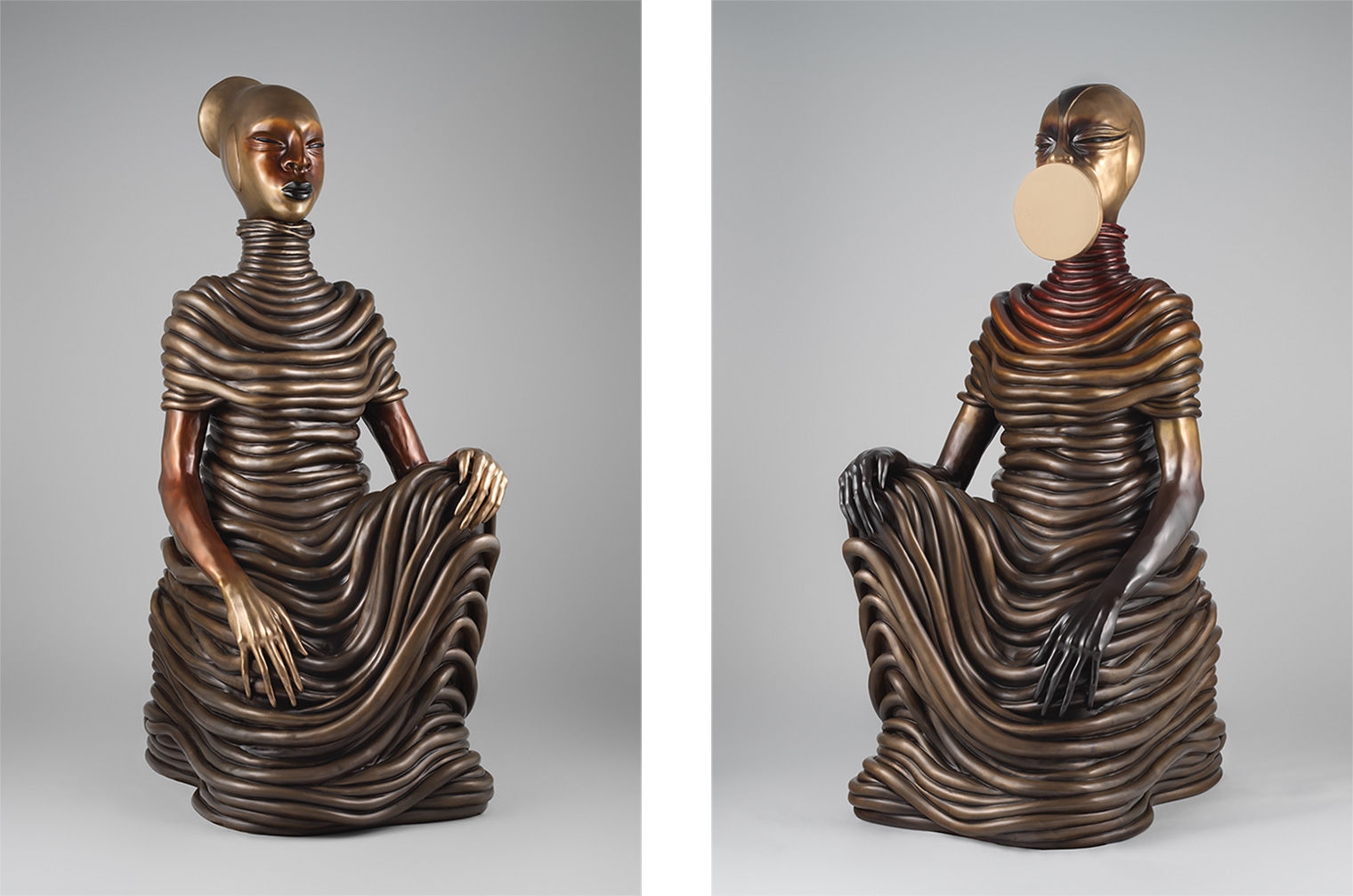


Image context: the cover is an official museum photograph of the exact sculptures discussed here, not an illustration of their ideas. Seen without The Met's facade around them, the figures make an important point especially clear: their upright authority does not depend on pretending to hold up a building. Coils gather around shoulders, torsos, and raised knees like clothing with its own gravity, while the polished facial disc on the figure at right redirects attention back toward the viewer.[3][5]
A carved woman attached to architecture often receives her assignment before she receives an identity: support the roof, display the patron's wealth, turn a body into a structural promise. Wangechi Mutu begins with that old job description and refuses it. Her four bronzes for The Metropolitan Museum of Art's facade occupied niches left empty since the building was completed in 1902, but the figures were not columns drafted into late service. They sat or knelt in front of the stone, commanding the threshold while carrying none of it.[3]
The first film in this collection follows that intervention, The NewOnes, will free Us (2019), through Mutu's own account. The second moves to MamaRay (2020), a sixteen-foot-wide bronze hybrid of woman and manta ray, and gives the act of interpretation to filmmaker DaeQuan Alexander Collier.[1][2][4] They are not two versions of one artwork. Together, however, they trace a compelling change in the monumental female figure: first she is relieved of an inherited burden; then she becomes a guardian whose power comes from crossing categories rather than standing in for one fixed ideal.
This is also a collection about viewpoints. The Met's film begins at an institutional entrance, where architecture decides who appears authoritative before a visitor even crosses the door.[1][3] MoMA's film begins with a viewer responding through Super 8 footage, home movies, and diasporic memory.[2] One asks how a new figure can enter the public face of a museum. The other asks what that figure enables someone else to imagine.
Film 1: occupying the niche without accepting its job
The Met's short film is best watched with the facade in mind. The four recessed bays selected for the commission look like invitations, but they also impose a grammar: sculpture is expected to complete the architecture. Mutu answers by placing four figures there while withholding the familiar visual bargain between female body and supported structure. The sculptures belong to the site without becoming its obedient parts.[1][3]
Mutu's point of departure is the caryatid, a human figure used as architectural or symbolic support. The Met places her response within more than one history: women carved as columns in Greek architecture and female figures supporting prestige stools made for male rulers in parts of Africa.[3][5] That comparison should not flatten distinct traditions into a single universal symbol. Its usefulness here is narrower. Across both examples, the represented woman is assigned the work of upholding someone else's structure or status.
The Seated I, II, III, and IV keep the recognizable dignity and vertical presence of monumental sculpture, then separate dignity from service. Nothing rests on their heads or shoulders. Their arms settle on their own legs. A bent knee makes the seated pose active rather than recessive. The horizontal coils that cover the bodies register as both garment and armor, following musculature instead of concealing it, while polished discs catch light and sometimes return a visitor's reflection.[3][5]
That last detail changes the power relation at the museum door. A conventional facade sculpture can be looked at as part of a completed architectural statement. A reflective disc prevents the encounter from remaining safely one-way. The visitor appears inside the figure's surface, briefly becoming part of a work that is already looking outward. The sculpture does not support the institution; it makes the institution's public examine its own position.
The film's account of inspiration and making matters because liberation here is not represented by weightlessness. These are large bronzes with palpable mass, elaborate surfaces, and the bodily composure of figures prepared to remain. Mutu does not escape the monument by making it dematerialize. She keeps its durability and scale, then changes whom those properties serve. Authority is no longer the reward for carrying a roof or a ruler. It is visible in a body allowed to possess its own weight.[1][3]
Film 2: a guardian made from crossings
MamaRay begins from a different silhouette. The bronze extends laterally into the broad wings of a manta ray and tapers toward a long aquatic body. MoMA describes the figure as a female guardian deity whose human and animal forms hold ancient history, science fiction, oceanic life, and Afrofuturist imagination together.[4][6] Where the facade commission alters an existing architectural type, this work invents a being whose authority depends on refusing a stable type at all.
The second video also changes narrators. Collier does not deliver a neutral museum explanation of MamaRay. He responds to it through his own filmmaking, folding Super 8 and family footage into a meditation on African diaspora, lives lost in the Atlantic, memory, and the possibility of a protector.[2] That subjective structure is not incidental. It demonstrates that Mutu's hybrid can receive another person's history without becoming a closed emblem of it.
Watch how the film refuses to keep sculpture and memory in separate compartments. The museum object supplies neither a tidy historical illustration nor a complete answer. Instead, its winged body gives Collier a form through which personal archives can approach a history too large to picture directly.[2] The movement is important: MamaRay does not impersonate the people lost to the transatlantic slave trade, and the film does not claim that one bronze can repair that loss. It asks what kind of figure might face such history without repeating the spectacle of Black suffering.
Protection is the video's answer, but not protection as withdrawal. The manta form makes the ocean both habitat and historical passage. Mutu has described the ocean as a portal from which living beings first arrived, while MoMA places MamaRay in an Afrofuturist lineage that imagines submerged life after the violence of the Middle Passage.[4][6] Those references let the sculpture hold catastrophe and origin at once. The figure's power comes not from mastering the sea but from belonging to it differently.
That distinction keeps MamaRay from becoming a generic superhero enlarged in bronze. A superhero is usually exceptional because ordinary categories intensify around one body: stronger, faster, more invulnerable. Mutu's guardian is exceptional because the categories themselves become porous. Woman, animal, ancestor, divinity, and imagined future do not line up as separate attributes. They meet in one continuous anatomy.
Collier's home-movie language gives that anatomy an afterlife beyond the gallery. Family footage is intimate, contingent, and visibly carried forward from another moment; bronze conventionally promises public permanence. Bringing them together prevents either medium from having the final word. The sculpture can enter a private archive, and the archive can interrupt the monument's claim to speak for everyone.[2]
From released burden to usable power
Placed side by side, the films reveal more than a recurring interest in hybrid female figures. They show a two-step sculptural argument. The NewOnes, will free Us clears an inherited obligation from the body: no roof, no royal seat, no secondary status. MamaRay then asks what the newly available monument might do. It can become a guardian, a portal, and a prompt for somebody else's act of remembrance.[1][2][3][4]
This progression grows from Mutu's earlier collage practice. In works on paper, she cut apart fashion, ethnographic, medical, pornographic, botanical, and other published images whose conventions had packaged Black and female bodies for external use. Recombination gave those fragments new agency and made contradiction part of the figure rather than a flaw to resolve.[6] The bronzes carry that collage logic into mass and space. Coils, ceremonial references, animal anatomies, mirrors, and speculative beings meet without submitting to a single source culture or chronological period.
Monuments often stabilize: this person, this event, this authorized memory. Mutu uses monumentality to make identity more permeable while keeping presence firm. That is the productive tension the videos share. The figures are not uncertain about whether they belong. They are certain without becoming singular.
The collection's two voices complete the point. In the first film, Mutu explains how a body can face an encyclopedic museum without serving its old architecture.[1] In the second, Collier shows what happens when a viewer treats another Mutu sculpture not as a finished message but as permission to think with personal and collective memory.[2] Freedom, in these works, is not an empty niche. It is the ability to occupy public space without inheriting its assigned burden—and to make that unburdened presence useful to imaginations beyond one's own.
Sources
- The Metropolitan Museum of Art, “Meet the Artist—Wangechi Mutu: The NewOnes, will free Us” — official YouTube film on the inspiration, making, and meaning of the 2019 facade commission.
- The Museum of Modern Art, “Afrofuturism in sculpture: How Wangechi Mutu addresses African diaspora” — official YouTube ArtSpeaks film by DaeQuan Alexander Collier responding to MamaRay through Super 8, home movies, protection, and diasporic memory.
- Max Hollein, “With Wangechi Mutu's The NewOnes, will free Us, The Met Facade Is Now on View.” The Metropolitan Museum of Art, 2019 — commission history, caryatid context, facade chronology, and source page for the official cover photograph.
- The Museum of Modern Art, “Wangechi Mutu: MamaRay, 2020” — official collection record, dimensions, medium, installation history, and work-specific interpretive context.
- The Metropolitan Museum of Art, “Wangechi Mutu: The Seated I, 2019” — official collection record on posture, coils, ornament, reflective disc, caryatid history, and the figure's release from load-bearing duty.
- The Museum of Modern Art, “Wangechi Mutu” — institutional artist overview connecting Mutu's collage method, hybrid figures, diasporic identity, Afrofuturism, and the guardian imagery of MamaRay.