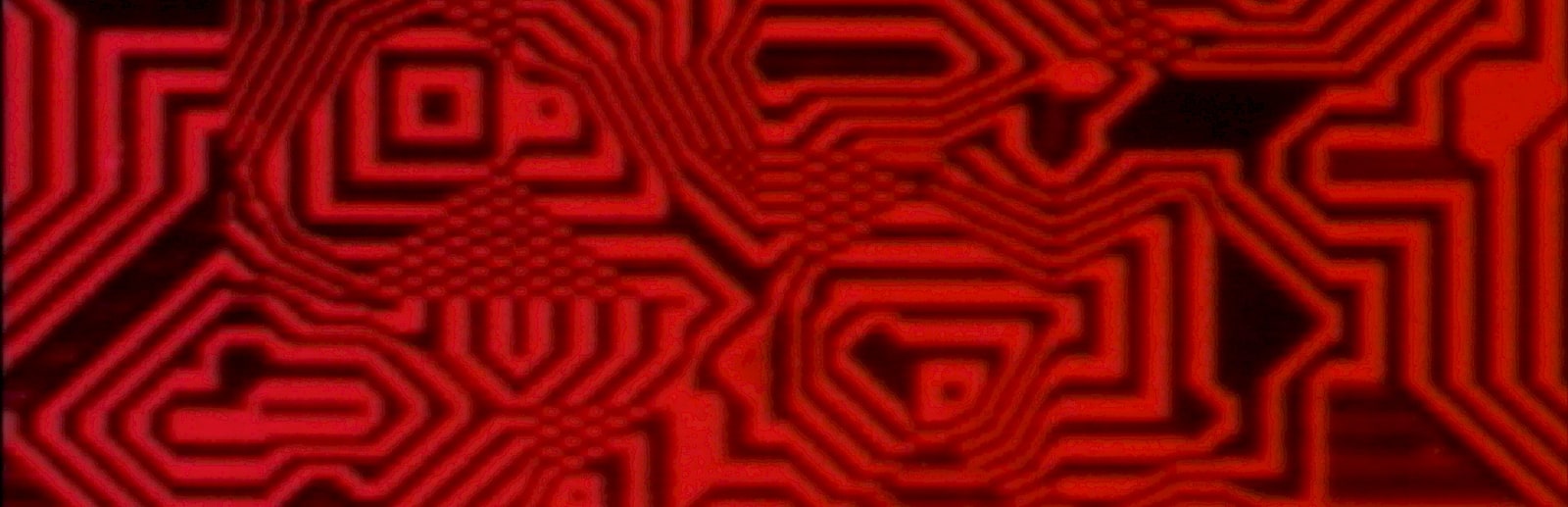
Image context: the cover is an official still from the film itself, not a later visualization of early computer art. Its glowing red paths preserve the block-based vocabulary of the computer footage—the same vocabulary Schwartz taught her hand-painted passages to imitate. A still can show that visual grammar; the film's edit is what makes its different materials hard to sort.[1][2][4]
One moment in Lillian Schwartz's Pixillation locks glowing red pathways into nested rectangles. Elsewhere, hot pink presses into orange, blue slips toward black, and crisp-edged blocks give way to forms that seem to bloom, clot, or swim. The larger surprise is that the computer could not have produced the whole thing. In 1970, it could barely supply enough moving image to begin.
That shortage is the film's real engine. Schwartz had access to an IBM mainframe and a microfilm printer at Bell Laboratories, an extraordinary privilege for an artist at the time. But access did not mean abundance. The computer yielded brief strips of black-and-white imagery, while a film needed sustained motion, color, rhythm, and sound. Schwartz answered by building a production chain that ran through code, paint on glass, microscope footage, an optical bench, film laboratories, a basement editing room, and electronic music.[3][4][6]
Pixillation is often introduced as a pioneering computer-generated film. That description is historically understandable and materially incomplete. Its more durable invention was to make the boundary between computer-generated and handmade images stop being useful. The machine supplied a new visual pressure; editing turned that pressure into a medium.
Eighty-five frames are not yet a film
The digital part of Pixillation began with severe limits. A contemporary technical note in the August 1970 issue of Computers and Automation describes each original 35 mm frame as a 240-by-340 array of dots and blanks, output by a Stromberg-Datagraphics 4060 microfilm printer controlled by an IBM 360/50. The system could apply global and local operations to a two-dimensional array, then render black, white, or randomly varied dots frame by frame.[3]
Those specifications sound capacious until they are translated into screen time. Describing her early film workflow in a 2013 oral history, Schwartz recalled that one magnetic tape held about 85 frames. At 24 frames per second, that represented only a few seconds of motion. The output also arrived as black-and-white 35 mm microfilm, not as a finished color work ready for projection.[4]
Ken Knowlton's EXPLOR language gave Schwartz a way to alter rectangles, overlap, frequency, and random behavior by changing numerical instructions. It made variation programmable. It did not abolish the physical bottleneck downstream. Producing another second meant more calculation, more tape, more output, and more film handling. The computer was not a frictionless image fountain. It was one constrained station in a long apparatus.[3][4]
This is where a triumphalist history of digital art can misread the work. Scarcity did not merely slow Schwartz down on the way to a purer computer film. It changed what she made. She stopped treating limited output as a defect to conceal and began designing analog footage that could converse with it.
Paint learns the rectangle
Schwartz mounted a 16 mm Bolex camera above an animation stand, poured colored paint onto glass, and exposed the changing surface one frame at a time. She deliberately drew square-like forms so that the handmade passages would rhyme with the computer's rectangular vocabulary. She also made more fluid images and incorporated microscopic footage of growing crystals.[4][6]
These additions were not neutral filler. If Schwartz had inserted unrelated painted animation simply to reach a target length, the film would have divided into obvious zones: machine here, hand there. Instead, she translated one process into the visual habits of another. Paint imitated the computer's blocks. Computer rectangles, enlarged and colored, began to behave like pigment. Crystal growth introduced patterned change that looked simultaneously organic and rule-bound.[4][6]
The result unsettles authorship in both directions. The handmade frames do not arrive as warm, expressive relief from a cold machine. They become more procedural: dripped, smeared, squared, photographed at intervals. The computer frames do not remain raw evidence of calculation. They are recolored, resized, layered, repeated, and placed in sequences whose pacing belongs to cinematic judgment.[4][5]
This is why the cover image matters. Its fields of color may look painterly, but a still cannot disclose which operations made them. That is not a failure of documentation. It is proof that the edit has done its work.
The optical bench was the interface
Calling Pixillation a collaboration between artist and computer skips over the equipment that made their outputs meet. Schwartz's microfilm first had to be copied from 35 mm black and white to 16 mm color. At the optical bench of filmmakers Bruce and Katharine Cornwell, footage could be rephotographed through color filters, enlarged, reduced, layered, frozen, or repeated. Schwartz arrived with detailed shot lists; the optical work converted a few machine-made frames into many possible cinematic events.[4]
Then came another stage of assembly. Schwartz recalled returning with the new footage to edit and synchronize image with sound in her basement studio. A, B, and sometimes C rolls went back to a film laboratory for an answer print, the first single strand on which picture, color, transitions, and soundtrack could be judged together.[4]
The geography of the work is revealing. Computation happened at Bell Labs in Murray Hill. Optical processing took place on specialized equipment away from the mainframe. Film copying and answer prints required commercial laboratories. Final editing happened at home. No single device contained the artwork, and no single location deserves to be called its studio.
Seen this way, the optical bench was not post-production in the dismissive sense of polishing a computer's authentic result. It was an interface between incompatible image systems. It let microfilm become color film, a static frame become duration, a tiny array become a field of light. The handmade and computed elements could share a screen because optical printing gave them a common material body.
The soundtrack changes what counts as an edition
The film's sound history makes its hybridity even clearer. The version most often described by museums has a Gershon Kingsley score performed on a Moog synthesizer. The Arkansas Museum of Fine Arts notes that its rising tempo intensifies the accelerating alternation between digital and analog passages.[1] The electronic sound does more than announce futurity. It makes unlike pictures feel driven by one nervous system.
But Pixillation did not have only one score. The Computer History Museum reports that Schwartz made four editions: one with music by F. Richard Moore, one with conventional instruments, and two with Kingsley scores made on the Moog. Moore's version used GROOVE, the computer-controlled music system he developed with Max Mathews to direct analog synthesizer equipment through real-time controls.[5]
Four scores mean four timing relationships. Even when the picture edit remains substantially shared, a pulse can make a cut feel anticipated or abrupt; a sustained tone can bind two image sources; a faster attack can expose their difference. The work's identity therefore resides not in one master digital file but in a family of synchronized assemblies. Film, computer graphics, optical color, and sound meet differently each time.
That variability also sharpens Schwartz's role. Knowlton's code and Bell Labs' hardware were indispensable, as were the composers and optical technicians. Yet the artwork takes shape through her decisions about substitution, resemblance, duration, sequence, and fit. Collaboration disperses production without dissolving artistic judgment.
A “computer-generated” label with an analog underside
In 1970, Computers and Automation awarded first prize in its computer art contest to Schwartz and Knowlton's Tapestry I, a frame from Pixillation. The magazine emphasized the IBM computer, the microfilm printer, the array, and the programming system.[3] That framing makes sense: a still extracted from the work offered striking proof that computers could participate in image-making.
Schwartz's later account shifts the emphasis. She remembered that the rectangular computer images were not interesting enough by themselves, and that traditional animation, coloring, reshooting, editing, and synchronization supplied the needed variety.[4] The two accounts do not cancel each other. Together they show how a new medium acquires a public identity. The contest isolated the digital output as the newsworthy object; the finished film made that output inseparable from older crafts.
The distinction still matters. “Made with a computer” can describe provenance, marketing, technique, or appearance, and those meanings are not identical. Pixillation was computational at its point of generation, photographic at its point of output, painterly in its added frames, optical in its compositing, and cinematic in its final organization. Calling it hybrid is not a compromise category. It is the most exact description of its system.
Preservation returns the film to matter
The afterlife of Pixillation has likewise depended on institutions handling physical and digital versions rather than preserving an abstract algorithm alone. The Henry Ford now holds the film within the Lillian F. Schwartz and Laurens R. Schwartz Collection, while the National Film Preservation Foundation lists Pixillation among Schwartz works preserved through its Avant-Garde Masters program at Ohio State University.[2][7] Recent museum presentations continue to screen and reproduce the work for new audiences.[1][5]
That history completes the argument embedded in the film. A computer image survives because somebody kept the film reel, identified an edition, maintained color and sound relationships, and transferred a fragile object into another viewing system. Digital origin never removed material dependence.
Pixillation became a landmark of computer art because Schwartz refused to wait for the computer to become sufficient. She let shortage determine form, then made every workaround visible as energy: paint copying pixels, pixels acquiring color, crystal growth entering the edit, electronic music tightening the cuts. The film does not predict a future in which machines replace the studio. It discovers a studio large enough to include the machine—and restless enough to keep moving beyond it.
Sources
- Arkansas Museum of Fine Arts, “Lillian Schwartz: Pixillation” — official 2024 exhibition page, film still used for the cover, work metadata, account of the hand-colored and computer-generated passages, and discussion of the Gershon Kingsley score.
- The Henry Ford, “Pixillation by Lillian F. Schwartz, 1970” — official collection record for the motion picture, object ID, creator, date, collection provenance, and film imagery.
- Computers and Automation, August 1970 — contemporary account of the Pixillation frames, first-prize notice for Schwartz and Ken Knowlton, and specifications for the IBM 360/50, 240-by-340 array, and microfilm output process.
- Computer History Museum, “Schwartz, Lillian F. oral history,” interviewed by Christopher Garcia with Jon Plutte, 2013 — official catalogue record and transcript access for Schwartz's first-person account of EXPLOR, frame scarcity, paint-on-glass animation, optical printing, film rolls, editing, and Bell Labs collaboration.
- Computer History Museum, “Music-Film-Computers” — institutional exhibition history of Pixillation, its combination of computer animation with drawing and painting, the four scored editions, and the GROOVE system used for F. Richard Moore's version.
- Kristen Gallerneaux, “Remembering Lillian Schwartz.” The Henry Ford, 2024 — collection-based account of the Bell Labs grant, limited footage, painted glass, crystal-growth photography, optical-bench work, and Moog-scored edition.
- National Film Preservation Foundation, “Avant-Garde Masters Grants: Preserved Films” — preservation register listing Pixillation and four other Schwartz films with Ohio State University.