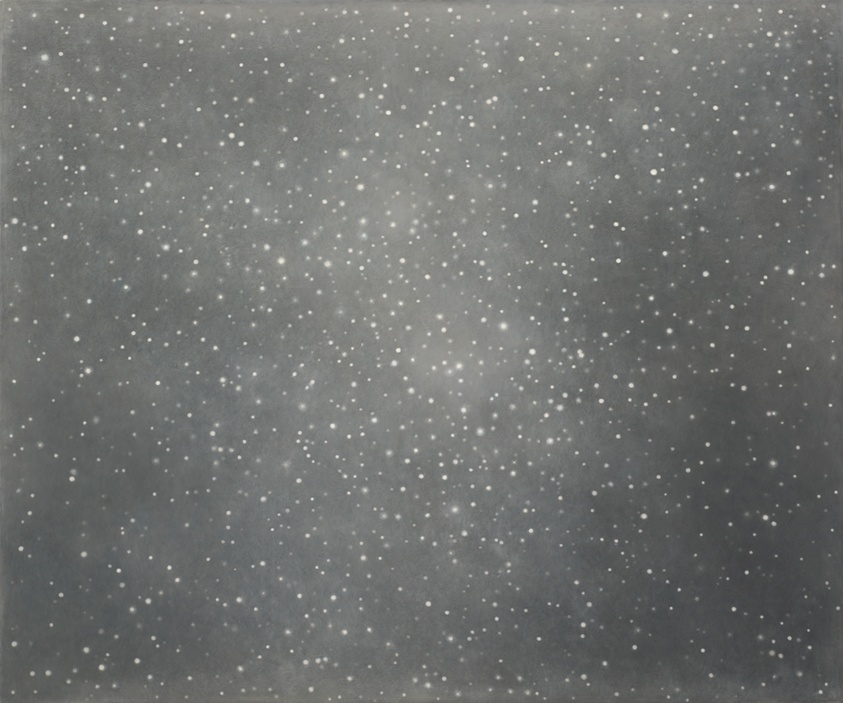
Vija Celmins's Night Sky #2 first appears to offer something expansive and almost impersonal: stars, darkness, distance, a view too large for ordinary scale.[1] But the painting gets sharper once it stops reading as a cosmic postcard. Its real force lies in a reversal. Celmins takes a subject associated with limitless depth and rebuilds it as a small, frontal, hand-worked surface. What should feel like open space starts to behave like a wall of marks held very close to the eye.[1][2]
That reversal is why the painting stays tense. The Art Institute of Chicago notes that Night Sky #2 is derived from satellite photographs and that the work withholds a horizon, a human reference point, and any recognizable landmark.[1] Those absences matter more than the subject label alone. Celmins is not using the night sky to deliver easy sublimity. She is making a viewer confront distance without the usual navigational aids. The image opens outward in subject, then closes inward in experience.
Image context: the lead image uses the Art Institute's photograph because this article's claim depends on the entire field rather than on one star cluster. The scale is modest, the surface is dark and velvety, and nothing in the picture lets the eye settle into a stable foreground or background.[1]
Vastness arrives with no horizon
The Art Institute's description of the painting is unusually direct about what goes wrong for the viewer in a productive way.[1] Because the image lacks a horizon line, a familiar landmark, or any object proportioned to human life, the museum notes that viewers may struggle to determine their relationship to it.[1] That sentence is the right starting point for a close reading. Most pictures of space or landscape help orient us even while they enlarge our sense of scale. Celmins removes that aid. We do not stand before a scene and then enter it imaginatively. We remain suspended at the picture plane, unable to convert the stars into a mapped distance.
The painting's size intensifies the effect. At under two feet wide, it is physically smaller than the subject it names would ever lead us to expect.[1] The result is not miniaturized grandeur. It is concentration. A night sky has been compressed into an object that demands near attention, and that near attention refuses to become comfortable because the image never relaxes into a stable depth system. The stars do not recede toward a horizon. They stay distributed across a surface that remains insistently flat even while it suggests immeasurable distance.
This is why the work feels both romantic and unsettling, exactly the pairing the Art Institute uses for it.[1] The romance comes from the old attraction of star fields and astronomical scale. The unsettling part comes from Celmins's refusal to stage that scale theatrically. She does not give us a silhouetted observer, a telescope, a mountain edge, or a dramatic atmospheric gradient. She gives us a field that is all relation and no anchor.
The surface is built, not captured
Celmins's night skies matter because they never pretend to be immediate transcriptions of vision. The Art Institute explains that since the early 1970s she has made exacting depictions of deserts, oceans, lunar surfaces, and night skies from photographic sources, and that her interest lies in image making itself rather than in media spectacle or mass culture.[1] That distinction is crucial. Night Sky #2 is not a spontaneous glimpse upward. It is a rebuilt image, translated from an already mediated source and then slowed down into painting.
The labor behind that translation keeps the painting from becoming decorative. The Art Institute notes that Celmins often applies multiple layers of pigment and sands them down before adding the next, modulating the field through blacks, whites, and silvery grays.[1] SFMOMA's retrospective material makes the same point even more materially for the later night skies: in Night Sky #16, more than twenty layers were reworked, and stars were developed through a process involving tiny drops of liquid rubber sanded away as the surface accumulated.[2] That description is about another painting in the series, but it clarifies the larger logic. Celmins does not sprinkle stars onto a neutral ground. She builds darkness as a worked substance, then forces light to emerge through abrasion, subtraction, and repeated adjustment.[2]
Seen that way, Night Sky #2 stops looking smooth in any casual sense. Its velvety finish is the record of pressure. Darkness here is layered, tuned, and revised. The stars feel detached from expressive brushwork not because the hand has disappeared, but because the hand has submitted itself to a disciplined, nearly anti-gestural process.[1][2] The painting does not ask us to admire virtuosity as flourish. It asks us to feel how much work it takes to make an image of vastness stay this withheld.
Light behaves like a negative mark
That withheld quality becomes even clearer when the night-sky series moves into drawing. The National Galleries of Scotland's page on Night Sky #19 describes charcoal rubbed into paper and then opened back up with an eraser so that starlight arrives as a kind of negative drawing.[3] The medium is different from Night Sky #2, but the conceptual move is closely related. Celmins repeatedly makes light appear by working through darkness rather than laying bright marks onto an empty field. Stars are not ornaments dropped on top. They are apertures, interruptions, recoveries.
The National Galleries text also emphasizes that the night-sky image in Celmins's work is frontal rather than horizon-based.[3] That observation helps explain why Night Sky #2 resists scenic reading so stubbornly. A conventional night landscape lets distance unfold from near to far. Celmins instead chooses an image type that sits squarely against the picture plane. Even when the subject is astronomically deep, the experience of looking remains surface-bound. The eye travels, but it does not arrive anywhere.
This is one reason the painting feels intimate despite its cosmic scale. Intimacy here does not come from narrative or domestic detail. It comes from the nearness of the surface. The viewer is held close to a field that never opens into habitable space. That closeness gives the stars their peculiar doubleness. They read as remote, but they also read as marks whose spacing, intensity, and edge softness have been minutely judged.
The image survives translation because the structure is strict
Celmins's print practice shows that this is not an isolated effect tied only to one painting. The Whitney's Untitled (Night sky) records the motif in mezzotint, while the Hammer Museum's Night Sky 3 records it again through photogravure, aquatint, and drypoint.[4][5] Those medium shifts matter because they show how stable the structure of the image is beneath the specific support. Celmins can move the night sky across painting and print without giving up its central terms: frontal field, disciplined tonality, and a refusal to offer easy spatial orientation.
That serial translation is part of what makes Night Sky #2 feel so exact. The painting does not depend on one dramatic compositional trick that would vanish outside oil and alkyd. It belongs to a longer investigation into how an image can be re-described without becoming expressive theater.[1][4][5] The night sky remains the same subject only in the broadest sense. Each medium changes the pressure slightly, but the governing restraint remains intact.
Why Night Sky #2 holds
What lasts in Night Sky #2 is the way Celmins makes scale misbehave. The subject promises infinity, but the canvas insists on objecthood. The stars suggest recession, but the surface keeps turning them frontal. The image looks cool and impersonal, but every inch of it implies slow, exacting labor.[1][2][3] Celmins does not solve those contradictions. She stabilizes them.
That is why the painting keeps its grip. It does not give us the night as escape, transcendence, or illustration of scientific wonder alone. It gives us a star field rebuilt until distance becomes tactile and orientation becomes uncertain. A small canvas holds a huge subject, then refuses to let that subject become either spectacle or comfort. Night Sky #2 turns depth into a worked surface, and that surface keeps the viewer looking longer than a mere view ever could.[1][2][3][4][5]
Sources
- The Art Institute of Chicago, "Night Sky #2" - official object page with metadata, the museum's description of the painting's photographic source, layered dark tonality, absent horizon, and disorienting small scale.
- SFMOMA, "SFMOMA Announces Highlights of First Major Vija Celmins Retrospective in More Than 25 Years" - retrospective press material on Celmins's night-sky paintings, including layered paint, sanding, liquid-rubber star construction, and the 1990s return to the motif.
- National Galleries of Scotland, "Night Sky #19" - object page on Celmins's night-sky drawings, charcoal ground, eraser-built stars, and the frontal, horizonless structure of the image.
- Whitney Museum of American Art, "Untitled (Night sky)" - collection page documenting Celmins's translation of the motif into mezzotint and its place within The View print series.
- Hammer Museum, "Night Sky 3" - collection page documenting Celmins's use of photogravure, aquatint, and drypoint for another night-sky variant.