Romare Bearden is often introduced through medium first. He is the great American collagist, the artist of cut paper, photomontage, jazz scenes, Harlem streets, and southern memory.[1][2][3] The description is accurate, but it can make the work sound looser than it is. Bearden's decisive achievement was not simply that he pasted fragments together. It was that he made fragments hold like painting. Migration, neighborhood life, music, family memory, and myth do not remain scattered in his pictures. They become rooms, stages, and blocks with enough internal order to carry a whole social world.[1][3]
That is why Bearden still feels larger than the category of collage usually allows. The National Gallery of Art places his childhood move from North Carolina to New York inside the Great Migration and notes that his mature collages and photomontages returned repeatedly to Black experience, including migration, jazz, blues, domestic life, and family.[1] The Whitney sharpens the formal turn by stressing that after a long period of experiment in abstract idioms, he returned to figuration in the early 1960s and made intricate collage his primary medium for the rest of his career.[2] The Smithsonian then adds the crucial correction: Bearden insisted that these works were paintings, because he used collage materials to build rhythms, surfaces, tones, and moods rather than scrapbook effects.[3] That insistence is the right place to begin.
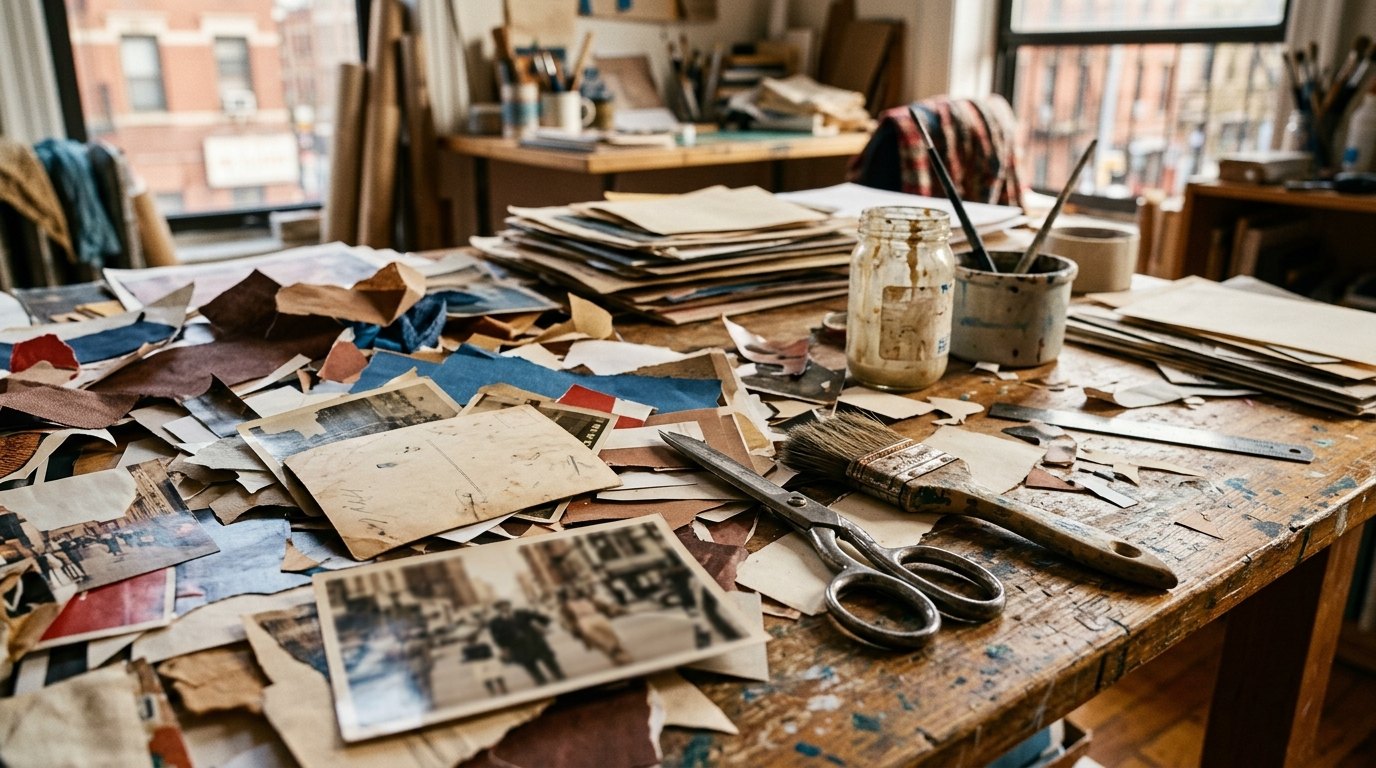
Image context: the hero image now uses an immersive studio-table photograph rather than a collage reproduction. The close-reading reference remains Eastern Barn, where the seated figures, fruit, and barn planes do not read like one witnessed scene; they read like lived experience rebuilt out of separate visual pieces until it regains social weight.[2]
He turned collage into structure
The strongest short definition of Bearden is that he treated collage as a way to organize experience rather than to advertise fragmentation. Whitney's artist page describes Eastern Barn as a work made from photograph and magazine cutouts combined with colored and textured paper, and it links the scene to Bearden's recurring focus on the rural South and to memories of North Carolina carried into late-1960s work.[2] That matters because the surface is visibly composite, yet the image does not dissolve into miscellany. Three figures hold the space. Color planes make the barn feel stable. Conversation seems to happen inside a deliberately rebuilt environment.
This is the point at which Bearden separates himself from a simpler modernist story about rupture. Fragmentation in his hands is not the end state. It is the method by which a scene becomes legible again after distance, migration, and historical pressure have broken it apart.[1][2] The Smithsonian's biography is especially useful here because it describes his archetypal figures, his use of oil paint alongside collage materials, and his view that the medium should still carry the tonal and atmospheric authority of painting.[3] Bearden does not glorify the tear. He makes the tear answer to composition.
Migration gave him more than one visual home
The migration story is not background detail. It is the engine of Bearden's pictorial intelligence. The National Gallery notes that he moved north as a child while his mother worked as an activist and newspaper editor in New York, and that his collages later portrayed the Great Migration alongside domestic life and music.[1] The result is that Bearden rarely paints a single place as if it could explain him completely. Harlem and the South keep crossing inside the work. Urban windows and church fronts sit beside remembered porches, fields, musicians, kitchens, and family rituals. His pictures feel doubled because his life was doubled.
Whitney's account of the 1960s collages makes that doubling more precise. Memories of North Carolina and later travel in the South fed works that were made in New York, at the same time that Bearden was a central figure in a city-based Black artistic world shaped by civil-rights urgency.[2] The point is not nostalgia for origins left behind. The point is that Bearden learned to treat memory as a second location one could build from, test, and revise. The collaged surface becomes the right medium for that task because it can keep different times and places adjacent without forcing them into one seamless fiction.
Harlem became a cutaway city
No single work proves that better than The Block.[4][5] The Metropolitan Museum of Art describes the 1971 collage as a tribute to Harlem and explains that each of its six panels presents an aspect of neighborhood life, from the Evangelical church and barbershop to the corner grocery store and the private lives visible through windows and cutaway walls.[4] That language is essential. Bearden is not painting one anecdote on one street. He is building a whole social section view. Public and private, sacred and ordinary, mourning and play all sit on the same urban strip.
The effect is mural-like without becoming monumental in the dead sense. The Met records the work at forty-eight inches high and eighteen feet wide, large enough that walking along it becomes part of reading it.[4] Its scale matters because Bearden wants collage to stop behaving like something intimate and desktop-sized. He wants it to carry the density of a neighborhood. A city block becomes readable as a stack of simultaneous lives.
The 2024 Met essay on the work's soundtrack makes the point even harder. It shows that The Block originally circulated with taped street sounds, church music, jazz, voices, children at play, and even television reports on war and fire, turning the collage into something close to an urban sensorium.[5] Even if one finally agrees with Bearden's later view that the painting needed no accompaniment, the historical fact is revealing. His art already invited that extension because the visual field was built to hold many registers of Black public life at once: ritual, noise, grief, humor, faith, labor, and pressure.[4][5]
Music kept the fragments moving
Music is therefore not a side theme in Bearden. It is part of how the pictures find tempo. The National Gallery includes jazz and blues among the recurring subjects of his mature work, while the Met's soundtrack history for The Block shows how strongly curators and audiences felt the pull of sound around his imagery.[1][5] This does not mean that the collages illustrate songs. It means Bearden composes the way music organizes recurrence: through repetition with change, syncopation, breaks, returns, and layered voices.
That is one reason his images stay alive instead of stiffening into cultural emblems. A Bearden room rarely settles into one frozen instant. Figures look assembled, but the composition keeps them in motion. Surfaces switch from photograph to flat color to torn paper edge and back again. The eye has to travel across the image as if following a score made of interruptions and recoveries. Bearden's gift was to make that movement feel human rather than merely formal.[1][3][5]
Why Bearden still enlarges the room
What survives most strongly in Bearden is scale of accommodation. He could take materials that usually imply incompleteness and make them hold history, migration, and ordinary life without flattening any of them into slogan.[1][2][3] The Great Migration is there, but so are the local room, the corner store, the church service, the basket of fruit, the jazz set, the remembered South, and the actual street. He made Black life visible as something architecturally full.
That is why the label "collagist" remains too small unless it is used with care. Bearden did not just cut and combine. He rebuilt pictorial space so that fractured modern experience could recover density. Harlem could be shown as both real neighborhood and symbolic stage. Southern memory could arrive without becoming pastoral haze. Music could enter visual form without turning into mere decoration. Romare Bearden made collage carry two homes at once, and then made the result feel solid enough to walk into.[1][2][3][4][5]
Sources
- National Gallery of Art, "Romare Bearden" - artist page on his Great Migration childhood, political-cartoon work, Spiral and Cinque leadership, and the way his mature collages portrayed migration, jazz, blues, domestic life, and family.
- Whitney Museum of American Art, "Romare Bearden" - artist page on his shift from abstraction back to figuration in the early 1960s and its description of Eastern Barn as a collage built from photograph and magazine cutouts, colored paper, and memories of the rural South.
- Smithsonian American Art Museum, "Romare Bearden" - artist biography emphasizing his archetypal figures, his use of collage materials with painting values, and his insistence that the works should be read as paintings rather than scrapbook assemblages.
- The Metropolitan Museum of Art, "The Block" - object page on the 1971 six-panel collage, its Harlem institutions and interior cutaways, medium, dimensions, and neighborhood tribute.
- Lauren Rosati, "The Sounds of The Block," The Metropolitan Museum of Art - essay on the original 1971 soundtrack, Lenox Avenue field sounds, church music, jazz, and how audio widened the work's social reading.