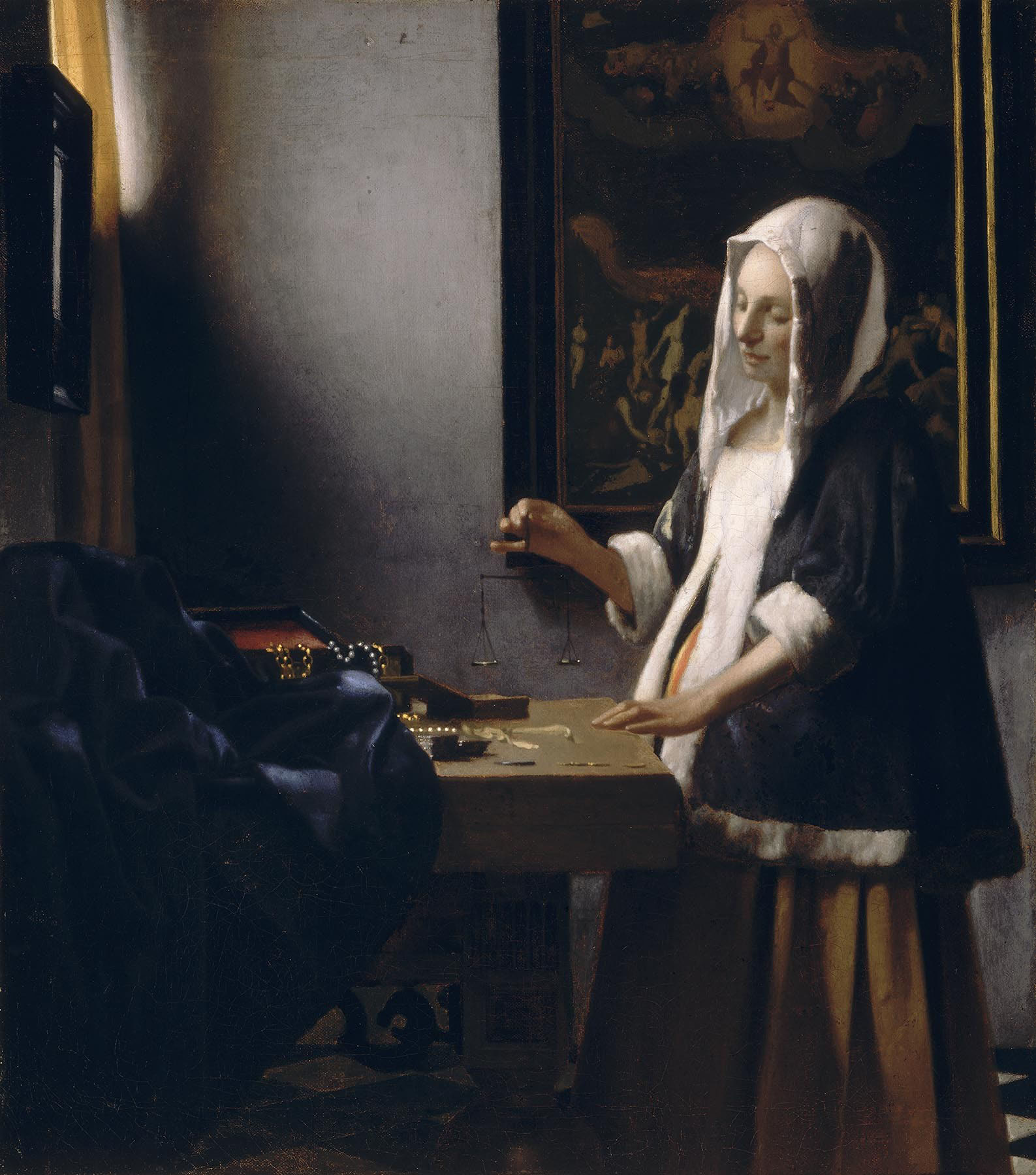
Some paintings about judgment arrive like sermons. They crowd the eye with warning signs, skulls, storms, collapsing bodies, or overt allegories of vice and punishment. Johannes Vermeer's Woman Holding a Balance does something harder. It makes judgment look quiet. A woman stands in a corner of a room, holds a tiny scale in one hand, rests the other on a table scattered with pearls and gold, and pauses long enough for the room's stillness to become the subject.[1][2] Behind her hangs a painting of the Last Judgment. Beside her, near the window, a small mirror waits in shadow.[2] Nothing in the scene moves quickly, yet everything in it is about measure.
That is why the picture has never stayed content as a simple domestic interior. The National Gallery of Art's object page calls it an example of Vermeer's sense of stability and rhythm, and the scholarly catalogue goes further: the scales are held in equilibrium, the woman stands transfixed in a moment of balance, and the painting behind her acts as an iconographic foil to the life-sized pause in front of it.[1][2] The deeper force of the image comes from how Vermeer compresses wealth, self-knowledge, and final reckoning into one modest corner. Judgment is not staged as future catastrophe. It is staged as present composure.
Image context: the lead image uses the full painting rather than a crop because the argument depends on relation, not icon alone. The balance matters differently when the pearls remain below it, the Last Judgment remains behind it, and the mirror remains off to the side as a second instrument of measure.[1][2][5]
The scales are empty, which changes everything
The most important fact about the painting is also the one that took art history time to settle. Earlier viewers often assumed the woman was weighing pearls or gold and named the picture accordingly.[2][4] The National Gallery's scholarly entry argues against that older reading with technical precision: microscopic examination indicates that the bright points in the pans are not painted like the pearls on the table, but register as reflections of light instead.[2] In other words, the balance is empty.
That emptiness matters because it shifts the painting away from transaction. If the woman were literally pricing or sorting her jewelry, the scene would belong more fully to commerce. Once the pans are read as empty, the act changes. She is not measuring a pile of goods. She is testing equilibrium itself.[2][4] The gold chain, open caskets, and pearl strands still matter, but they now work as the temporal riches of the room, not as the immediate content of the scale.[2] The gesture becomes less economic than ethical.
Vermeer builds the room around that conversion. The woman's hand floats at the perspective system's symbolic center, and the tiny instrument becomes the quiet hinge on which the entire image turns.[2] What looks at first like a genre picture of upper-class domestic life becomes a meditation on how one holds material abundance without letting it command the soul.
The Last Judgment does not thunder; it steadies the room
The painting on the wall behind the woman is not mere background decoration. The National Gallery's catalogue entry describes it as a compositional and iconographic foil whose proportions echo the overall picture, placing the woman directly before a scene of divine judgment.[2] Her head aligns with the central axis of the background painting, while her hand holding the balance falls near the perspective focus.[2] Vermeer is not being coy. He wants earthly pause and eternal reckoning in the same frame.
But the effect is remarkably unlike fear. The woman does not recoil from the image behind her. She does not clutch the jewelry or hurry to hide it. The scholarly entry insists on the psychological tone: conflict is not what the picture projects; instead the woman's attitude is one of inner peace and serenity.[2] That point is decisive. Vermeer is not offering a simple vanitas warning in which worldly goods and salvation stand in crude opposition. He is offering a more demanding proposition. One must live among temporal things and still learn balanced judgment.
Essential Vermeer sharpens that reading by tracing the interpretive debate around the work. Pearls may carry associations ranging from purity to vanity, the woman may or may not be pregnant, and some scholars have explored Marian or Catholic resonances, yet the strongest surviving consensus remains close to Arthur Wheelock's formulation: the scales are empty, and the act is balancing rather than weighing.[4] That distinction explains the room's unusual calm. Judgment has been internalized. The drama is not whether punishment will come, but whether self-command can already be practiced now.
Pearls and gold stay on the table, where time can touch them
Vermeer's room is quiet, but it is not ascetic. The blue cloth glows richly. Jewelry boxes sit open. Pearls spill and loop. A gold chain catches the light.[1][2] These objects are sensuous enough that the painting cannot be mistaken for a renunciation tract. Their function is more exacting than that. They keep the room inside the world.
Smarthistory notes the upper merchant-class context of the woman and the way Vermeer grants everyday scenes broader meaning.[3] The point is not only social classification. It is that worldly goods have already been made intimate. They are not displayed in a market stall or treasury. They are present in the room where private thought happens. That intimacy is what makes the painting so enduring. Moral life does not begin elsewhere, after wealth has been removed from sight. It begins beside the casket, the chain, and the strand of pearls one could touch at any moment.
This is also why the painting feels stronger than a simple moral binary. Vermeer does not demonize material beauty. He paints it exquisitely. He allows blue cloth, polished surfaces, and soft light to remain fully seductive.[1][2] The test is not whether beauty can be denied. The test is whether it can be held in proportion.
The mirror turns judgment back toward the self
Near the light source sits a small mirror, easy to miss beside the brighter symbolic machinery of the scale and the Last Judgment.[2] Yet the National Gallery's catalogue gives it a crucial role, noting that mirrors were commonly associated with self-knowledge and citing emblematic traditions in which a true glass represents the face without flattery.[2] The mirror changes the picture's moral direction. Judgment is not only descending from the painting on the wall. It is also being turned inward.
That inward turn is one reason the composition feels so modern. Nothing in the room depends on public performance. No one else is present to witness her act. There is no confessor, merchant, husband, or crowd. The woman stands alone in a private interval of self-measure. Even the Last Judgment, so often used in art as a spectacular collective scene, has here been domesticated into a backdrop for inward balance.[2][3]
The result is a vision of conscience that is neither panicked nor complacent. One can understand why later viewers kept wanting more story from the picture: is she pregnant, Marian, vain, pious, or allegorical?[4] Vermeer resists that appetite. He paints a person who has stepped into a pause dense enough to contain all those possibilities without collapsing into any one of them.
Why this room still feels difficult
Woman Holding a Balance remains one of Vermeer's hardest paintings because it refuses both theatrical guilt and decorative neutrality. The room is too morally charged to be only beautiful, and too beautiful to read as a bare warning.[1][2][3][4] Everything depends on proportion: empty scales against heavy meanings, intimate jewelry against cosmic judgment, reflective mirror against painted apocalypse, still body against radiating moral pressure.
That balance is what makes the work feel inexhaustible. Vermeer shows that judgment does not always arrive as an event that breaks into life from outside. Sometimes it takes the form of a woman standing still in a room full of light and objects, learning how not to let possession outrun measure. The picture's serenity is not innocence. It is discipline. And that may be why this small interior remains one of the most searching religious paintings ever made without ever looking like one at first glance.[1][2][3][4]
Sources
- National Gallery of Art, "Woman Holding a Balance" - official object page on the room's objects, the equilibrium of the scales, and Vermeer's balance of stability and rhythm.
- Arthur K. Wheelock Jr., "Dutch Paintings of the Seventeenth Century: Woman Holding a Balance, c. 1664," National Gallery of Art - scholarly catalogue entry on the empty scales, the Last Judgment, the mirror, compositional geometry, and the painting's theme of temperance and balanced judgment.
- Dr. Steven Zucker and Dr. Beth Harris, "Johannes Vermeer, Woman Holding a Balance," Smarthistory - discussion of the painting's quiet domestic setting, upper-merchant context, and enlarged field of meaning.
- Essential Vermeer, "What is the Meaning of Woman Holding a Balance?" - critical assessment page on the work's iconography, empty scales debate, and interpretive history.
- Wikimedia Commons, "File:Woman Holding a Balance (Vermeer).jpg" - file page for the faithful photographic reproduction used as the article image.