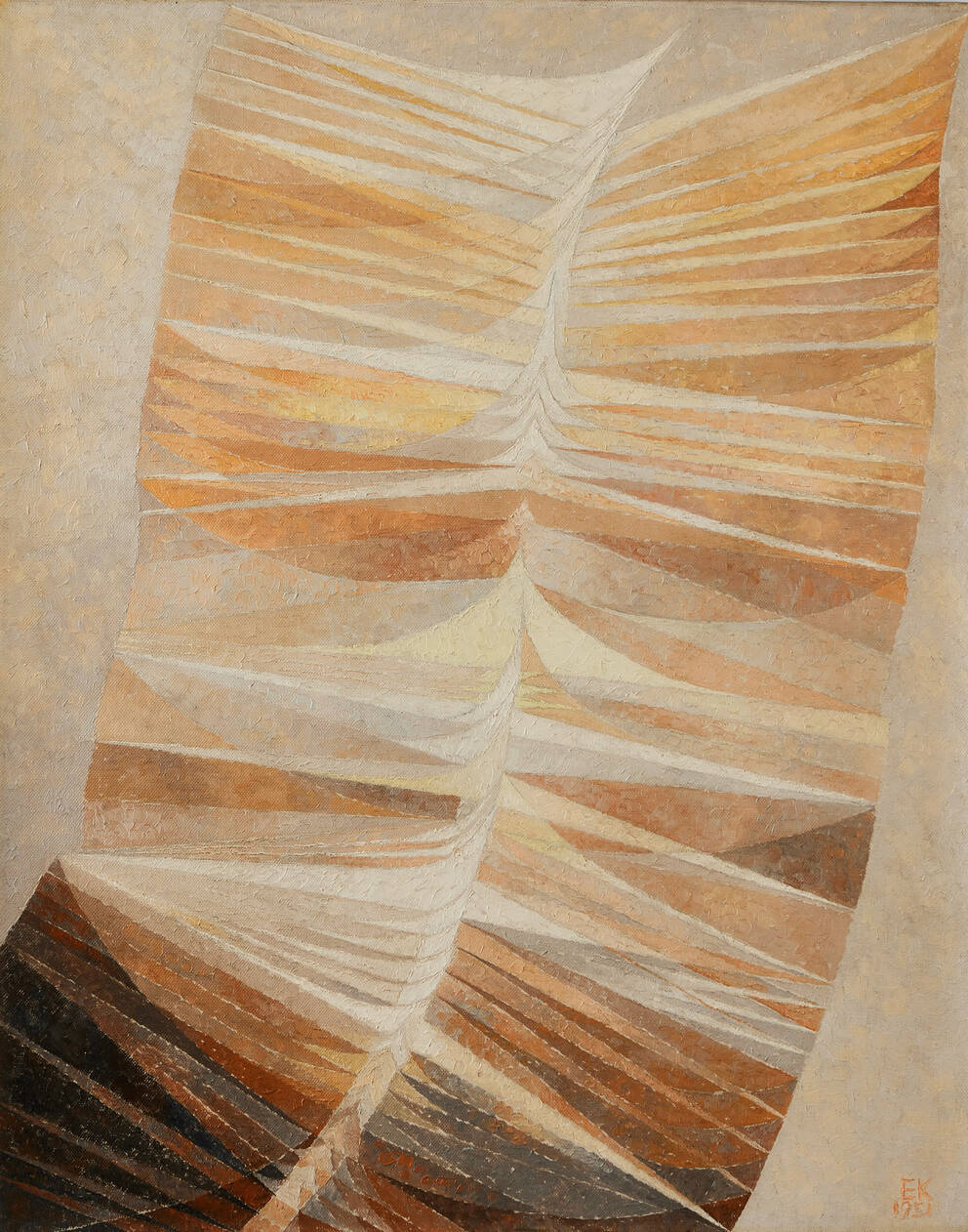
Image context: this is the Leopold Museum's real photograph of Erika Giovanna Klien's 1951 painting Flight of birds, not a generated image or an analytical graphic. Although made decades after Viennese Kineticism's brief classroom peak, the painting keeps its central problem in view: how can a still surface make repeated motion register as a pattern of perception?[4]
Most avant-gardes enter history noisily. They acquire a manifesto, a quarrel, a café, a scandal, and a compact roster of names that can be printed beneath a group photograph. Viennese Kineticism entered through a course catalogue. Around 1920, in Franz Čižek's class for Ornamental Morphology at Vienna's School of Arts and Crafts, students began turning movement, sensation, and emotion into rhythmic geometries.[2]
That origin helps explain both the movement's strangeness and its later obscurity. Kineticism was not simply Vienna's local imitation of Futurism, nor was it kinetic art in the later sense of objects that physically move. Its pictures remained still. What moved was the viewer's attention: across repeated contours, compressed bodies, rotating machines, expanding ornament, and patterns that seem to continue beyond the sheet.
The work was radical, but it was produced in an introductory applied-arts course, often by young women whose access to study was structurally limited. Modernism has usually been narrated through autonomous masterpieces and self-declared groups. Kineticism developed instead as an exercise, a teaching method, and a portable visual grammar. The classroom was not merely where the movement happened. It determined what kind of movement it could become.
Ornament stopped behaving like a border
Čižek's adult course prepared students to design things that would enter everyday life: fabrics, carpets, fashion, books, and other useful objects. “Ornament” therefore did not mean a decorative strip added after the important decisions had been made. It was a way of organizing energy across a surface—finding a visual structure for heat, grief, noise, dance, a crowd, or a machine.[2]
The method grew beside Čižek's better-known work in children's art education, but the two classes should not be collapsed into one. His Youth Art Class encouraged children to work from their own experience through drawing, modeling, wood, paper, and other materials. The Ornamental Morphology course enrolled adult art students. What they shared was a reform-pedagogical belief that making could be discovery rather than the obedient reproduction of a model.[2][7]
That belief changed the status of an assignment. A study of “mourning” or “greed” was not rehearsal for a future, more serious painting. The study was already a complete attempt to give an internal state a public form. A textile design could hold an argument about modern perception as forcefully as a canvas. The hierarchy between exercise and artwork, or applied and fine art, became less stable.
It also explains the movement's recurring rhythms. Ornament can extend. A motif returns with a difference; one unit accelerates the next; an edge implies continuation. The Leopold Museum describes Kineticism as an experiment in dynamic perception formed from Expressionist feeling, Cubist relations between object and space, and Futurist movement.[4] Those ingredients were not pasted together as recognizable styles. They became tools for asking how the eye experiences change while the page itself stays still.
The class borrowed speed without worshipping it
Vienna in the early 1920s had not developed the same established relationship to Cubism or Italian and Russian Futurism as Paris or Berlin. For a short interval, Čižek's room became a point where those currents converged. Students encountered recent art, science, aesthetics, and cultural history, then translated that material into a new geometric language.[3]
Translation mattered more than allegiance. From Expressionism came the permission to treat feeling as a formal pressure. Cubism offered a way to break the stable agreement between object and surrounding space. Futurism supplied vectors, simultaneity, and the attraction of the machine. Constructivist composition became increasingly visible after 1923, when students moved toward abstract elements in both two- and three-dimensional work.[2]
Yet Kineticism's idea of motion was wider than mechanical speed. Course works addressed dancing figures and urban masses, but also mourning, greed, cold, heat, smell, and religious agitation. The motion could be bodily, optical, emotional, or sensory. A feeling did not sit behind the image waiting to be decoded; it became the image's rhythm.
That distinction places a useful limit on comparisons with Italian Futurism. Museion's 2022 exhibition around Klien described Kineticism as a humanistic avant-garde: one that located change in education and human experience rather than in Futurism's aggressive mythology of speed.[6] The contrast should not turn the Viennese group into gentle innocents—Čižek's circle actively received Futurist ideas, and Filippo Tommaso Marinetti visited the course's orbit in 1924.[2] But the borrowed diagonal did different work. It could register a bird's flight or a dancer's turn without making force itself into a political virtue.
Women made the movement visible, then inherited its smaller label
Erika Giovanna Klien, Elisabeth Karlinsky, and My Ullmann became the movement's best-known figures. The Wien Museum's history emphasizes that the experimental group consisted especially of enthusiastic young women, while many later remained confined by the dismissive identity of Kunstgewerblerinnen—women practitioners of arts and crafts.[1]
That outcome was not an accident of taste. The University of Applied Arts' archive notes that women's study in the early 1920s was restricted to the School's “General Department,” which included Čižek's course.[2] The same institutional boundary that gathered women into Kineticism also made their work easier to classify as preparatory, pedagogical, or applied. They could be central inside the classroom and peripheral in a history organized around male painters' studios.
Klien's work shows why that hierarchy fails. She trained as an actor as well as an artist; theater and dance entered her set designs, drawings, and Kinetic Puppet Theater of about 1925. After moving to New York in 1929, she studied bridges, machines, workers, crowds, and the pace of city life while supporting herself largely through teaching and graphic work.[5] None of those activities sits outside the movement's logic. Performing, teaching, observing, and designing were ways of testing how motion could pass from experience into form.
Karlinsky likewise carried Čižek's pedagogy into American schools. Klien taught at institutions including the New School for Social Research, the Dalton School, the Spence School, and later Walt Whitman School; Karlinsky taught at the Walden School, among others.[2][5] Their teaching was not merely the day job that interrupted “real” art. It was one of the principal routes by which the movement traveled.
A brief classroom acquired an international radius
Kineticism's concentrated phase was short. The Wien Museum places its high point in 1924, when leading students completed their studies and the course was dissolved as a distinct program.[1] A movement tied to one teacher, one class, and a recurring population of students did not have the institutional machinery to reproduce itself indefinitely.
But short does not mean sealed off. Čižek's circle met an unusually dense network of modernists and intermediaries. The archive records contacts with Lajos Kassák, Béla Uitz, Theo van Doesburg, Wassily Kandinsky, Herwarth Walden, Marinetti, and others. The class showed work in Paris in 1925, and Katherine Dreier's Société Anonyme sought works by Klien, Karlinsky, Eduard Föderl, and Alfred Schömer for its International Exhibition of Modern Art at the Brooklyn Museum. Klien ultimately represented the “Cizek method” there as the Austrian contribution.[2]
That phrase is revealing. Abroad, a heterogeneous body of work could travel under the teacher's method more easily than under the students' movement. Pedagogy provided access and recognition; it also kept authorship attached to Čižek. The historical task is not to erase the teacher, whose course genuinely created the conditions for experiment, but to see that students converted those conditions into styles, subjects, and careers he did not own.
Klien's Flight of birds makes the afterlife visible. Painted in 1951, it falls well beyond the early-1920s formation and belongs to her later return to subjects she had pursued before.[4][5] It should not be used as a diagram of every Kineticist device. Its value here is temporal: a method developed for interpreting motion in a Vienna classroom still organized how one artist looked after migration, employment, and three decades of historical change.
Rediscovery had to rebuild the room
The movement faded quickly from view. The Wien Museum dates sustained renewed interest to the 1970s, especially through Klien, and used Čižek's large surviving estate to reconstruct the field for its 2006 exhibition.[1] Later exhibitions at the Belvedere and Museion placed the work beside European Cubism, Futurism, Constructivism, light art, and kinetic art, making comparison possible without reducing Kineticism to any one of them.[3][6]
That recovery continues. A Belvedere exhibition devoted to Klien is scheduled to open on September 18, 2026, drawing on the museum, the University of Applied Arts' collection and archive, and new research into her work as painter, designer, performer, and educator.[5] The institutional return is welcome, but it also clarifies why the movement once disappeared. To recover Kineticism, museums have had to recover assignments, teaching records, applied designs, photographs, and women's professional routes—not only paintings that fit a familiar canon.
Seen this way, the movement's modest scale becomes intellectually large. It asks what art history misses when it looks only for declarations rather than lessons, finished schools rather than temporary rooms, and singular breakthroughs rather than methods passed between people.
Viennese Kineticism did not make a still picture move. It made stillness feel provisional. A bird, a dancer, a bridge, a sensation, or a crowd could be broken into pressures and returned as rhythm. Its most modern claim was not that everything had become faster. It was that perception could be taught to notice motion before motion settled into a name.
Sources
- Wien Museum, “Kinetismus: Wien entdeckt die Avantgarde” (2006) — exhibition archive on the movement's classroom origins, leading women artists, 1924 peak, disappearance, and later recovery.
- University of Applied Arts Vienna, Collection and Archive, Lill Tschudi – Franz Čižek (2026) — institutional research on Ornamental Morphology, pedagogy, applied-art contexts, international networks, gendered study limits, and the “Cizek method.”
- Belvedere, “DYNAMICS! Cubism / Futurism / KINETICISM” (2011) — museum account of abstraction in Vienna from 1919 to 1929 and Čižek's classroom as a convergence point for European avant-garde ideas.
- Leopold Museum, “Erika Giovanna Klien, Flight of birds, 1951” — official object record, movement context, dimensions, medium, and source page for the museum photograph used as the cover.
- Belvedere, “Erika Giovanna Klien: All Is Movement” (2026–27) — exhibition and biographical account of Klien's theater, teaching, migration, urban subjects, and later career.
- Museion, “Bird Flight” (2022) — exhibition framing of Kineticism's educational, humanistic model of change and Klien's place within later histories of light and movement.
- Elke Wikidal, “Die Jugendkunstklasse des Franz Čižek,” Wien Museum Magazine (2020) — museum history of Čižek's youth-art pedagogy and its relationship to activity-based educational reform in Vienna.