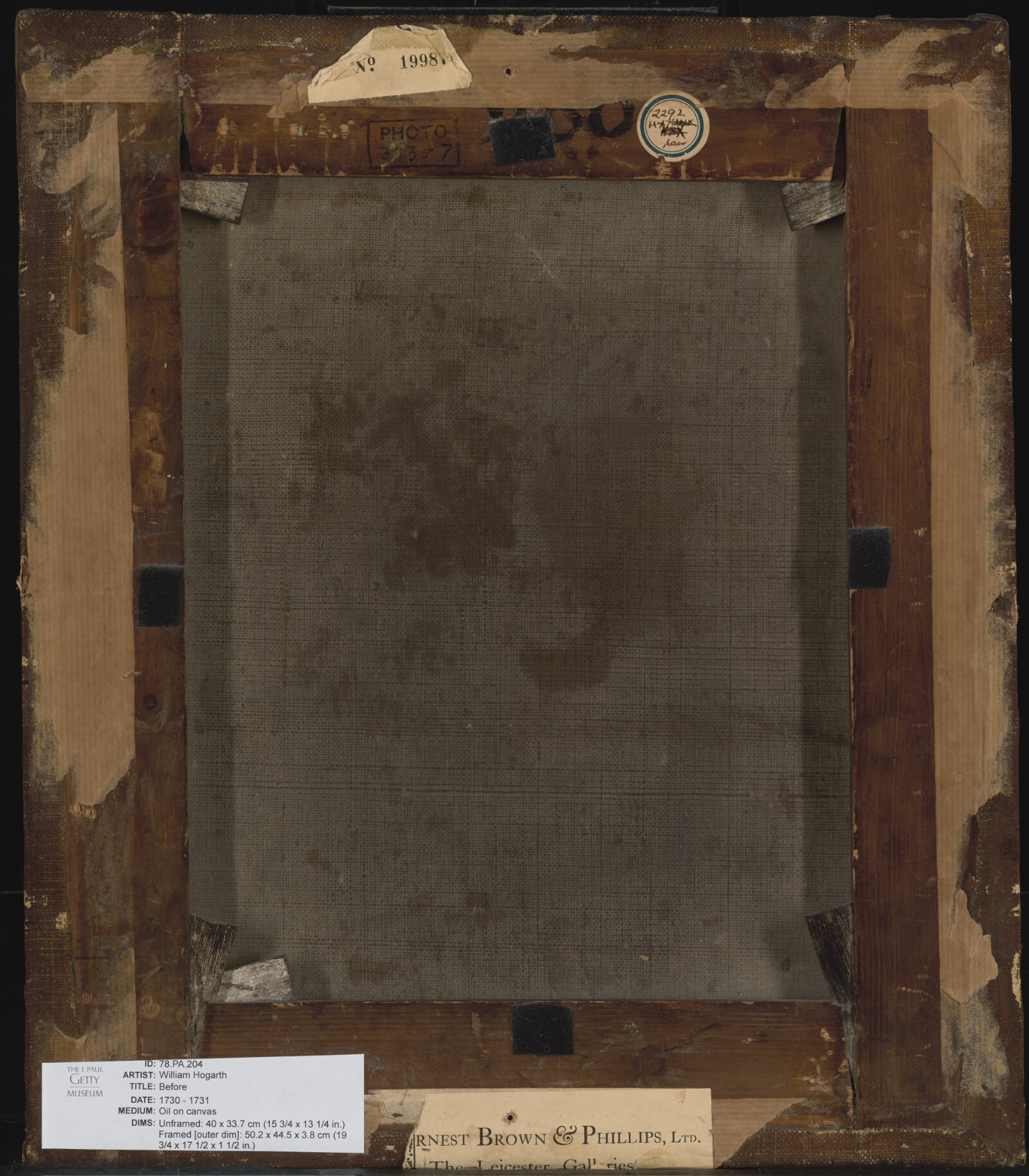
Image context: this is a real museum photograph of the reverse of William Hogarth's Before, not a generated image or an analytical graphic. The front shows the scene Hogarth offered to viewers; the photographed back shows the object that dealers, collectors, handlers, and museum staff actually moved through the world.[1]
A museum wall performs a small act of disappearance. It offers a painted surface and hides almost everything that keeps the surface upright: canvas, panel, stretcher, frame joints, nails, keys, patches, seals, labels, inventory numbers, and the abrasion of repeated handling. The picture appears to have arrived in the gallery without luggage.
Turn it around and time returns. The reverse, or verso, is rarely a secret second masterpiece. More often it is brown cloth and dusty wood interrupted by scraps of paper. Yet those ordinary materials can record a life that the image alone cannot show—where the work traveled, who sold it, which exhibition borrowed it, how it was repaired, and which histories later owners tried to clarify or conceal.
The front asks, “What does this image mean?” The back asks a different question: “What happened to this thing?” Looking at both does not diminish the art. It releases the artwork from the fiction that making was its final event.
The front holds a moment; the back keeps adding time
A painter normally completes the face first. The verso remains available to the future. A dealer adds a stock label. An export office applies a stamp. A collector writes a number. A museum fixes its accession mark. A conservator records a treatment. Each inscription belongs to a different moment, so the back develops less like a composition than like a crowded passport whose entries were never designed to look good together.
Getty's survey of painting versos makes the range tangible. One photographed back bears a French customs stamp; another carries the number 3382, which the museum identifies with an inventory of art confiscated for Hitler's planned museum.[1] These marks are visually minor but historically heavy. They do not alter a brushstroke on the face. They alter the field of questions around the object: When did it cross a border? Under whose authority? Was the movement voluntary, commercial, forced, or still unresolved?
The cover photograph offers a quieter case. William Hogarth's Before was painted in 1730–1731, but its back continued to gather paper, hardware, handwriting, and wear long after the painted encounter on the front had stopped changing.[1] Nothing on the verso competes with Hogarth as an image-maker. Its value comes from succession. The back lets several later histories occupy one plane without pretending they occurred at once.
A label is a lead, not a verdict
Old paper can feel authoritative simply because it is attached to an old object. Provenance research requires more discipline. The Rijksmuseum describes a process that begins with the object—including its rear and underside—then moves outward through inventory cards, catalogues, annual reports, archives, literature, and databases.[2] The physical mark starts the search; other records have to make it legible.
The National Gallery of Art's Battle Scene by Philips Wouwerman shows why. Two old labels on the panel's verso preserve a former title and a Swedish collection reference. The museum places those clues beside historical sale records and recorded dimensions, proposing a possible link to a 1770 Hague auction while keeping the earlier provenance uncertain.[3] The labels narrow the path. They do not close the case.
That distinction protects against two opposite mistakes. Ignoring the back throws away first-hand evidence. Trusting every mark at face value turns residue into proof. Frames can be replaced, labels can be transferred, handwriting can be misread, and an inventory number means little until it meets the ledger that generated it. A good provenance is therefore not a romantic deciphering of scars. It is an agreement among object, archive, chronology, and comparison.
Separate paintings can meet on the same dealer's desk
The most evocative discovery on a back may be not a famous name but a repeated number. Getty curator Nicole Block found matching Ernest Brown & Phillips dealer labels on Sebastiano Ricci's Diana and Her Dog and Hogarth's paired Before and After. The dealer's stockbooks then established that all three had been sold to Swedish publisher and collector Thorsten Laurin in January 1936.[1]
That connection was invisible on the fronts. A mythological nude and a satirical pair share no obvious subject, scale, or painted world. Their labels reveal that they once shared a commercial and domestic one. They passed across the same desk, entered the same collection, and later reached Getty through sales separated by years.[1]
This is where the verso changes art history's unit of attention. A front encourages study by artist, school, iconography, and style. A back can regroup works by shipment, dealer, collector, exhibition, confiscation, storage room, or conservation campaign. It exposes networks that cut across the categories displayed in galleries.
Getty's Provenance Index expands that principle beyond individual objects. Its linked records reconstruct transfers among artists, dealers, collectors, auctions, and museums, treating ownership history as a social system rather than a decorative list after the catalogue entry.[6] A label on one stretcher may be the local address of a much larger network.
Conservation also leaves a history
The verso is evidence, but it is not untouched evidence. Canvas paintings have been lined, patched, restretched, backed, flattened, and reinforced for centuries. Every intervention can preserve one part of an object while covering or changing another.
Conservator Mary H. Gridley includes stretchers, inscriptions, old tack holes, studio handling marks, labels, and provenance among the normally unseen elements that can contribute to a modern painting's authenticity.[5] Her account of structural treatment also explains why many conservators came to favor local, retreatable repairs over comprehensive lining when the condition permits. A global treatment may stabilize a weak canvas, but it can also obscure the original verso, change edges, or leave a conspicuous new backing.[5]
This does not make restoration an act of vandalism, nor does it make every stain sacred. It makes treatment a negotiation among structural safety, visible appearance, reversibility, and documentary loss. The back is where that negotiation often becomes clearest. A neat new support may be excellent engineering and poor historical transparency unless the displaced evidence has been carefully recorded.
The reverse therefore carries two kinds of time at once. Labels and stamps track circulation. Patches, linings, extra tack holes, and replacement stretchers track care. One tells us where a painting has been; the other tells us what people believed the painting needed in order to survive.
Publishing the back turns storage into a research room
For most viewers, versos were once accessible only when a work left the wall or a catalogue happened to reproduce one. Digitization changes that asymmetry. In 2021, Getty reported adding verso photographs for more than 320 paintings to its online collection records.[1] The Mauritshuis likewise says that almost all of its painting backs were photographed for its Image Bank Project and posted online, explicitly inviting additional information when labels or inscriptions might help fill provenance gaps.[4]
This is more than a bonus image in a carousel. A high-resolution verso gives researchers outside the storeroom a chance to compare typefaces, dealer labels, seals, handwriting, frame construction, and numbering systems across collections. It also preserves a state of the object before the next loan, treatment, or reframing changes it.
Public access does not remove the need for curators, conservators, and archival expertise. It widens the pool of possible recognition. A faded label that means nothing in Los Angeles may be familiar to a dealer archive in London; an unexplained number in The Hague may match a photograph in another museum. The back becomes not just evidence but an interface between institutions.
The hidden side changes the visible one
Once the verso has been seen, the front no longer looks quite self-sufficient. A painting with export stamps is also a traveler. A painting with several exhibition labels has repeatedly entered new arguments. A work with confiscation numbers may carry a history of coercion that present ownership labels cannot neutralize. A heavily lined canvas has survived partly through decisions that altered its material body.
None of this tells a viewer what to feel about the painted image. It changes the conditions under which interpretation takes place. Style belongs to an object that circulated. Meaning belongs to an object that was priced, packed, inherited, seized, repaired, stored, researched, and displayed.
Museum walls will keep hiding the hardware; paintings need to hang. Digital records can nevertheless undo the deeper disappearance. They let the front remain a picture without pretending it is only a picture.
The back is not more truthful than the face. It is truthful about something else. The face records an artist's acts of selection. The verso records everyone who came afterward—and shows that an artwork's biography is not written in a line, but accumulated in layers.
Sources
- Nicole Block, “What You Can Find on the Back of a Painting,” Getty (2021) — museum overview of verso marks, the Hogarth and Ricci dealer-label discovery, and source page for the archival photograph used as the cover.
- Rijksmuseum, “Provenance Research in Practice” — official account of beginning with the object's rear and underside, then testing physical clues against museum and external records.
- National Gallery of Art, “Philips Wouwerman, Battle Scene” — collection record showing how verso labels, sale records, dimensions, and stated uncertainty work together in provenance research.
- Mauritshuis, “Ongoing Research” — museum account of digitizing almost all painting backs and using labels and inscriptions to investigate provenance gaps.
- Mary H. Gridley, “The Structural Treatment of Modern and Contemporary Canvas Paintings,” Getty Conservation Institute, in Conserving Canvas — study of lining, local repair, retreatability, and the evidentiary value of normally hidden material features.
- Getty Research Institute, “Tracing Art” — introduction to the Getty Provenance Index and the social networks of ownership, exchange, collecting, and museum formation that provenance records reveal.