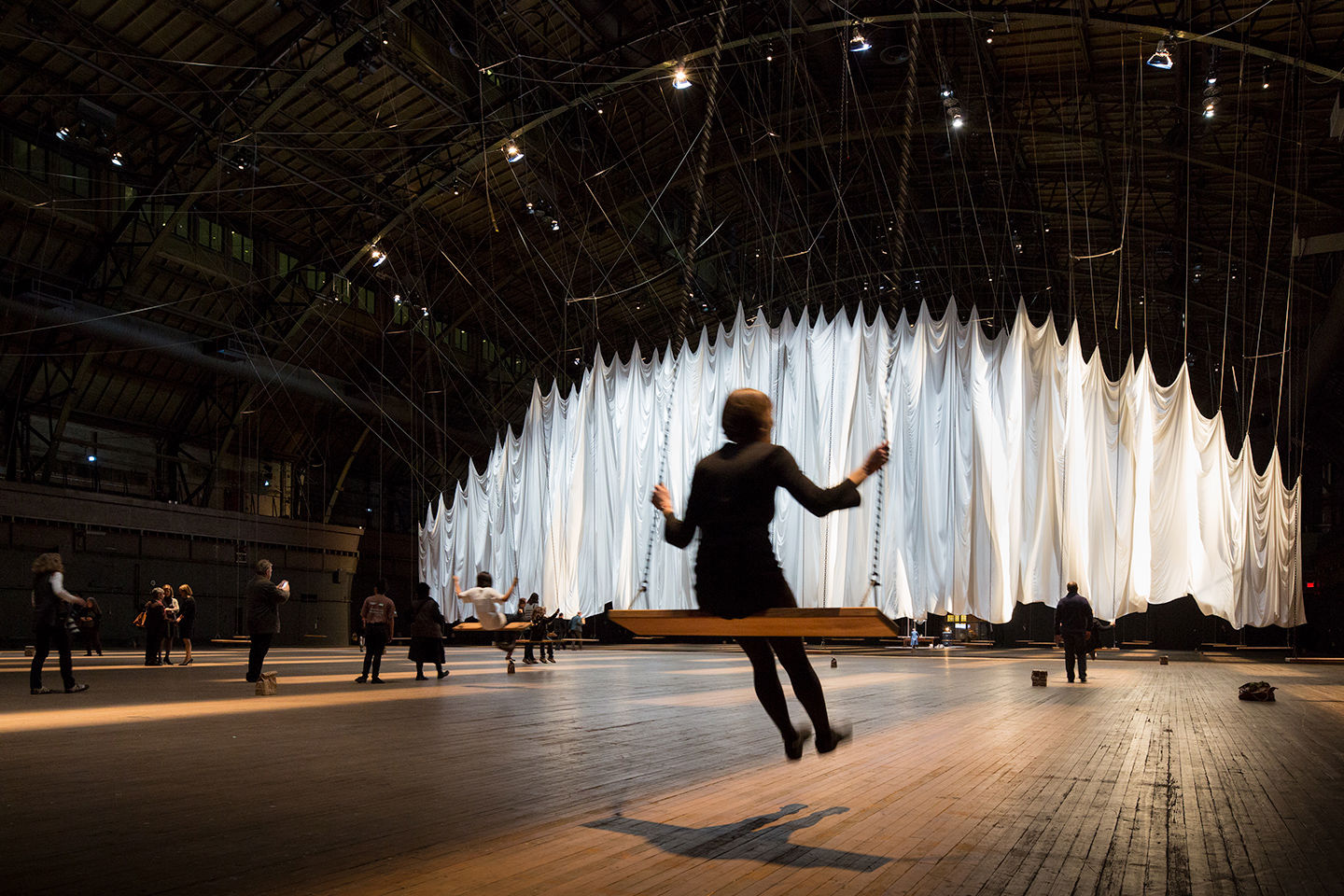

A playground swing usually encloses a private circuit: effort, ascent, suspended instant, return. Ann Hamilton's the event of a thread extended that circuit until one person's movement arrived in everybody else's view. A field of swings hung from the Park Avenue Armory's iron trusses, their ropes and pulleys connected to an immense white silk cloth. Riders did not command separate patches of fabric. Their different speeds and arcs accumulated in one rising, falling surface.[4][5]
The installation occupied the Wade Thompson Drill Hall from December 7, 2012, through January 6, 2013. The cloth was more than twice the hall's width, nearly as tall, and suspended beneath trusses 70 feet overhead.[4][5] Those measurements establish spectacle, but not the work's real achievement. Hamilton made an individual action remain pleasurable and legible while denying it an individual result.
Art21's four-minute, 57-second film is an unusually good record of that proposition because moving images can keep cause and consequence in time: a body swings, ropes tighten, silk lifts, another body crosses the floor. Hamilton, who stayed at the Armory throughout the run, narrates what surprised her as visitors learned to inhabit the work.[1][2] Watch once for the exuberance. Then replay these moments to notice how the film turns participation into a study of transmission.
0:15 — Begin with a bag, not the spectacle
The first sustained close-up is not a swing or the monumental cloth. At 0:15, a tied brown paper bag sits on the worn floor while static and a woman's voice leak from inside. Another disembodied voice follows. The shot is deliberately unhelpful if all we want is a quick explanation of the installation, but exact if the subject is how an action travels after it leaves its source.[1]
Each bag concealed a radio transmitting a live reader's voice from the Drill Hall entrance. Two readers sat at a table with caged pigeons and read concordance texts assembled from authors including Aristotle, Darwin, William James, and Emerson. Fragments met at recurring “spinal words,” so reading became a new path through existing language rather than the delivery of a stable passage.[3] Visitors could pick up and carry the bags. A voice therefore crossed the room without its body, intimate at the ear and anonymous in the crowd.
Only at 0:54 does Hamilton supply the conceptual seam, describing her first hand as a sewing and weaving hand and joining text to textile.[1] The film has already made that connection sensorially. A voice threaded through a bag is not an explanation pasted onto the moving silk; it is another material crossing.
1:19 — The cloth is a consequence
At 1:19, the camera isolates the silk's high points and plunging folds. Hamilton explains that the cloth rises and lowers with the swings, then says that everyone's presence registers in its materials.[1] The phrasing matters. The cloth is neither a screen showing data nor a puppet that one rider controls. It is a consequence—continuous, physical, and impossible to divide into neat shares.
Hamilton's project statement describes the silk as registering the swings' combined velocities and accelerations, its “weather” generated through collective action.[5] That mechanism gives a familiar social metaphor unusual precision. We often call a community a fabric while leaving the threads abstract. Here, the crossing lines are load-bearing. A hard push changes the common cloth, but so do a gentle arc, a pause, and the counter-motion of strangers.
The film's editing reinforces that lack of a single author. It cuts between chains, bodies, overhead ropes, and folds rather than tracing one rider's input to one visible output. The viewer learns the system by relation. No privileged angle can isolate the movement that “belongs” to a particular person, because the material itself has already combined it.
2:07 — Pleasure is the entry, not the endpoint
At 2:07, Hamilton recalls wondering whether visitors would swing at all. Seconds later she speaks about the pleasure of giving oneself over to the motion; the camera lets riders streak through the Drill Hall rather than reducing them to instructional examples.[1] Play is not bait concealing a more serious artwork. It is the bodily knowledge that makes interdependence available without a diagram.
The installation also refuses the fantasy that collectivity requires synchronized behavior. At 2:43, a wide view places riders at different phases of their arcs around the long, twisting cloth. Hamilton describes the work's simultaneous intimacy and anonymity: solitude inside a congregation.[1][2] A person can feel an individual rhythm without exiting the common mechanism. Difference is what animates the field.
That distinction separates participation from voting or pushing a button. Visitors are not choosing among outcomes designed in advance. They enter a set of constraints—gravity, seat, rope, neighboring bodies—and discover an outcome that remains responsive but cannot be fully predicted. Agency survives; sovereignty does not.
3:08 — Stillness also enters the weave
The film next tests its own emphasis on motion. At 3:08, the camera faces a table beneath the turbulent cloth. By 3:19, visitors are lying flat on the floor, watching the silk pass overhead. Hamilton says she expected people to stand there but had not anticipated that they would stay horizontal for so long.[1] The work's public did not merely activate a script. It found postures the artist had left possible without specifying.
This stillness is not withdrawal. Bodies on the floor alter how others circulate, gather along the cloth's edge, and understand its scale. Meanwhile, movement continues to arrive from the swings. The installation permits activity and receptivity to coexist: some people generate force, some watch its passage, and the roles can change.
The parts that Art21's short film only glimpses expand this temporal weave. Readers sent voices into portable radios. At each day's end, a vocalist sang as the pigeons were released; the song was cut live on a record lathe and played back the following day. Successive discs accumulated into a chorus.[4][5] The silk combined actions almost immediately, radio displaced a voice across space, and vinyl returned yesterday's voice to today. “Together” did not have to mean simultaneous.
4:00 — “Wild and safe” names the balance
At 4:00, as the image holds riders and rows of reclining visitors in the same frame, Hamilton recalls a girl's description of feeling “wild and safe” at once.[1] The phrase names the installation's productive tension. Swinging offers speed, height, and surrender, while the engineered apparatus and the presence of others hold that release inside a dependable structure.
Near 4:11, Hamilton states the ethical limit of her authorship: she wants to make an opportunity for experience without determining what that experience must be.[1] The film then closes not with a thesis card but with children swinging and an audible “Whoa!” The exclamation is evidence of encounter, not proof that every visitor felt the same thing.
An online film cannot reproduce the tug in the chains, the air displaced by the silk, a radio voice against the hall's echo, or the awareness that one's own weight is entering the system. Its loss is tactile and architectural. Its advantage is editorial: it can move from bag to hand, swing to cloth, solitude to crowd, and show that these are not separate attractions.
The event of a thread made a social fabric without picturing one. Every rider left a visible effect, but nobody received a private result. Every voice came from somewhere, but not always from the body beside it. Hamilton's weave was therefore less an object than a condition: one's motion remains one's own precisely while becoming part of what moves everyone.
Sources
- Art21, “Ann Hamilton: ‘the event of a thread’ | Art21 ‘Extended Play’” — official YouTube film, published April 19, 2013.
- Art21, “Ann Hamilton: ‘the event of a thread’ (SHORT)” — official film page with runtime, production credits, installation context, and Hamilton's account of solitude within a group.
- Ian Forster, “Exclusive | Ann Hamilton: ‘the event of a thread,’” Art21 Magazine, April 19, 2013 — the radio bags, readers, pigeons, and concordance texts.
- Park Avenue Armory, “The event of a thread” — official exhibition record, installation dates, daily song-and-record cycle, and James Ewing photographs.
- Ann Hamilton Studio, “the event of a thread” project description — artist's statement on the swing mechanism, cloth dimensions, transmissions, and accumulated recordings.