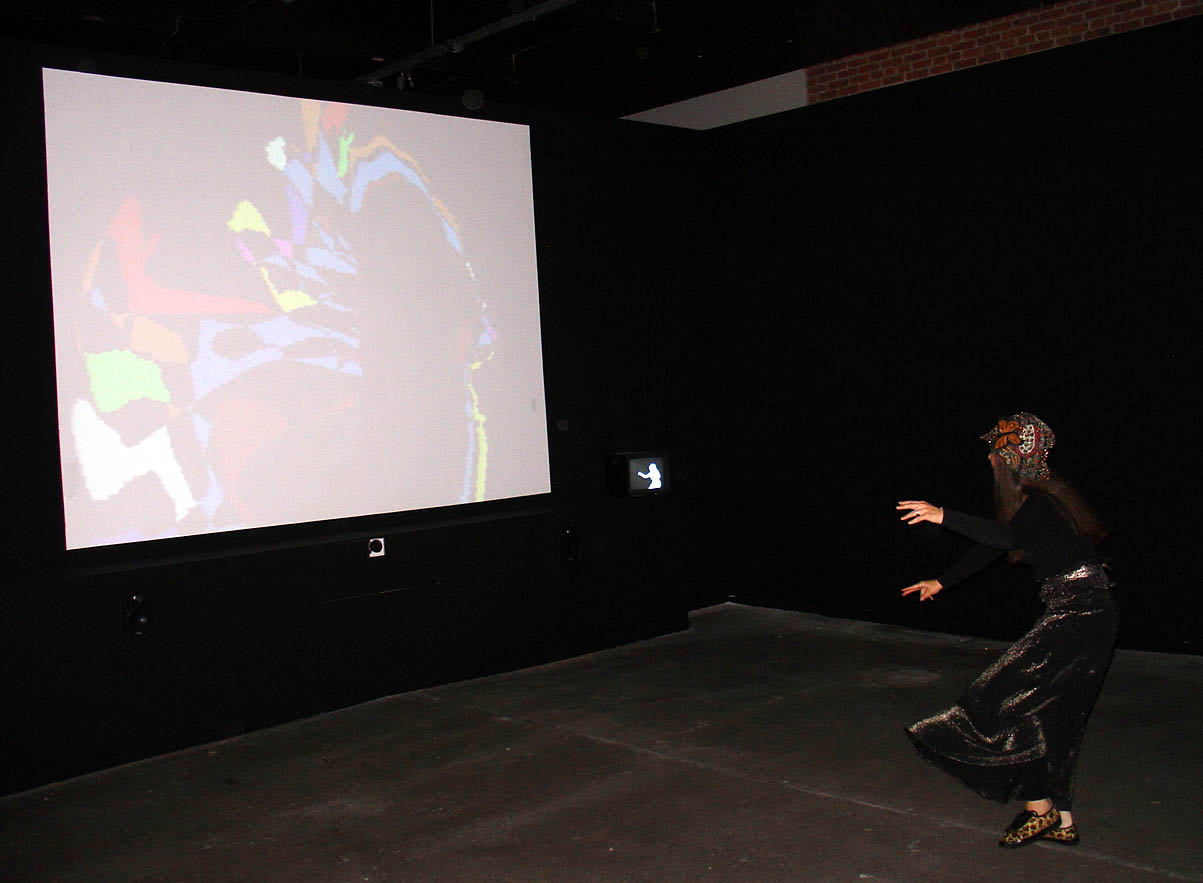
In a 2004 gallery photograph, Galen Brandt crouches and reaches toward a wide projection. Her body remains fully visible in the dark room while the screen blooms with overlapping silhouettes: blue, green, red, white, a hand repeated into a fan. The apparatus has not disappeared. A small monitor glows beneath the projection, a camera faces the working space, and the bare floor preserves the distance Brandt must cross with a gesture. This is not an illustration of interactivity. It is a photograph of interaction becoming form.[1]
The surprise of Myron Krueger's VIDEOPLACE is not that 1970s computer graphics looked rough. It is that Krueger treated their roughness as an artistic instrument. Instead of asking a participant to enter a convincing three-dimensional world, the system asked a more basic question: what if a room could notice what you did and answer immediately?
That question put VIDEOPLACE on a different path from headset-centered virtual reality. There was no visor to seal off the participant's sight, no glove to translate the hand, and no controller whose buttons had to be learned. A camera watched a person moving against a bright field. Processing hardware extracted a silhouette. A projector returned that body as a colored image mixed with other people, lines, sounds, and graphic creatures. The room itself became the interface—and the relationship between action and reply became the artwork.[2][3]
A room that learns to answer
VIDEOPLACE did not arrive as a single invention. It condensed lessons from a sequence of environments built around the University of Wisconsin. In 1969, Krueger worked with Dan Sandin, Jerry Erdman, and Richard Venezky on GLOWFLOW, a dark room of glowing tubes and synthesized sound. Pressure pads let the installation respond to footsteps, but delays deliberately obscured cause and effect. Krueger later judged that ambiguity to be a weakness: if the audience could not tell that the room was responding, interaction remained an engineering feature rather than an expressive relationship.[2]
He reversed that logic in METAPLAY in 1970. A participant in a gallery saw a live video image overlaid with marks drawn by an operator in another building. When a participant moved a hand and the remote line followed it, the screen became less like a picture than a negotiated surface. PSYCHIC SPACE followed in 1971, using a pressure-sensitive floor, sound, and a projected maze whose boundaries shifted when a visitor tried to solve it. Each project tightened the loop: sense a body, establish a rule, let the participant discover it, then change the rule before discovery hardens into routine.[2]
Krueger began developing VIDEOPLACE in the mid-1970s. A preliminary version ran for six weeks at the Milwaukee Art Center beginning in October 1975. In his 1977 account, each participant entered a darkened room and faced an eight-by-ten-foot rear-projection screen. The screen showed a life-size self-image together with the image of someone in another room. Both people saw the same composite field. Physical distance remained, but the shared image created a place in which gestures could meet.[2]
The distinction matters because later versions became much more computationally elaborate. VIDEOPLACE is best understood as an evolving medium, not a frozen 1975 machine. Krueger's own 1993 retrospective separates the realized multi-room work from a far larger satellite-linked version he proposed but never built.[4] Its history is a chain of prototypes, exhibitions, programs, and rebuilt processors—not a clean product launch.
The silhouette was the bargain
The silhouette looks playful, but it also reveals the system's central bargain. Backlighting made the participant dark against a neutral field. The camera signal could then be digitized and thresholded into a binary image: person here, background there. Dedicated processors traced outer edges and searched for usable features such as head, hands, and fingers. Software mapped those findings to visible or audible responses.[3]
This was not full visual understanding. It was a deliberately reduced body made legible enough for real-time action. A face, fabric, or expression might disappear, while an elbow, fingertip, or highest point on the outline could become operationally important. The reduction gave VIDEOPLACE speed. It also gave the work its look: a human presence at once unmistakable and anonymous.
The mature 1984–85 configuration archived by ACM SIGGRAPH makes the amount of engineering behind that apparent simplicity clear. It used a National 16000 computer controlling six microcoded processors, with custom software written in C and LISP. The archive also names Katrin Hinrichsen, John Rinaldi, Bruce Shay, and Tom Gionfriddo as collaborators.[5] Krueger supplied the originating artistic theory, but the responsive room was not a lone-genius object. It depended on a team turning perception into hardware fast enough that a raised hand still felt connected to what happened next.
That speed was the aesthetic threshold. If the reply lagged too long, the green line would read as playback. If the system reacted promptly, it could feel like conduct: the room had noticed not merely that someone was present, but that this particular movement had occurred.
A work made of possible encounters
Krueger argued in 1977 that "response is the medium."[2] The phrase remains useful because it relocates authorship. The artist does not compose a fixed sequence for a passive viewer. Nor does the participant become completely free. The work lies in the prepared relationships between possible actions and possible consequences.
One program might let an outline draw. Another could change scale, color, or orientation. Two silhouettes could overlap and produce a sound, erase their intersection, or open a window into another image. In the well-known Critter interaction, a small graphic creature sought a perch on the participant's outline and climbed toward its highest point. The participant learned the creature's apparent desire by moving, then began inventing poses that might help or frustrate it.[3][6]
The crucial artistic move was to keep instructions out of the foreground. A button tells the user what kind of command it expects. VIDEOPLACE offered a mirror that behaved strangely. The participant had to infer the system through gesture. That made curiosity visible: a tentative hand, a repeated motion, a sudden effort to outwit the rule. The visual output could be simple because the encounter was not.
This is also why the work should not be reduced to an ancestor of motion-controlled games or today's camera filters. Those are valid technical descendants, but they can make history sound inevitable. VIDEOPLACE was making a cultural proposal. Computing did not have to meet the public as a terminal, a form, or a headset. It could become an environment in which people tested cause and effect with their whole bodies—and sometimes encountered another person inside the same artificial field.[2][4]
What the room could not see
The same silhouette that liberated the participant from wearables imposed a strict visual discipline. The body had to stay available to the camera. Lighting and background were part of the interface. Complex identity became a contour. "Touch" meant that images met and the system produced a consequence; it did not mean pressure on skin. Depth could be suggested through scale and overlap, but the participant still faced a screen rather than inhabiting a volumetric world.[2][3]
More importantly, the room's apparent intelligence was authored. Its processors detected selected features; its programs tested selected relations. It did not understand intention in the broad sense, and it did not learn new social rules on its own. Ars Electronica's technical record describes the system analyzing binary "shadow people" in parallel and responding in real time, but every feat of responsiveness depended on a carefully bounded perceptual problem.[6]
That limit does not diminish the work. It sharpens it. VIDEOPLACE made the politics of any interactive system unusually easy to see: the machine can answer only what it has been built to notice. A participant experiences freedom inside somebody else's vocabulary of detectable actions.
The more interesting inheritance
In 1990, VIDEOPLACE received the first Golden Nica in the Prix Ars Electronica category for Interactive Art.[6] By then, the project had been evolving for well over a decade. Its achievement was not lifelike graphics or invisible machinery. The 2004 gallery photograph keeps the machinery, viewing distance, and bodily effort visibly present. Its achievement was to make responsiveness feel like material: as distinct as light, clay, or sound, yet produced between a body and a rule.
That remains the more interesting inheritance. Camera-based interfaces now promise to disappear into convenience. VIDEOPLACE asks us to look at the exchange they usually hide. What does the system notice? Which gestures become meaningful? Who sets the consequences? The orange silhouettes seem simple because so much of the person has been removed. They remain compelling because, in the instant the green line answers, removal becomes relation.
Sources
- Galen Brandt, "Galen interacting with Videoplace" — photographic documentation of Myron Krueger's installation at Eyebeam, New York, May 25, 2004.
- Myron W. Krueger, "Responsive Environments," Proceedings of the National Computer Conference, 1977 — primary account of the precursor works, 1975 presentation, VIDEOPLACE concept, and responsive aesthetic.
- Myron W. Krueger, Katrin Hinrichsen, and Thomas S. Gionfriddo, US Patent 4,843,568, "Real time perception of and response to the actions of an unencumbered participant/user" — primary technical description of backlighting, binary silhouettes, feature extraction, and real-time response.
- Myron W. Krueger, "The Artistic Origins of Virtual Reality," ACM SIGGRAPH Visual Proceedings, 1993 — the artist's retrospective distinction between VIDEOPLACE's realized history and an unbuilt worldwide proposal.
- ACM SIGGRAPH History Archives, "Myron W. Krueger: Videoplace" — 1984–85 artwork record with collaborators, medium, hardware, and software.
- Ars Electronica Archive, "Videoplace" — 1990 Golden Nica project record describing the camera, backlight, specialized processors, interactive repertoire, and real-time silhouette analysis.