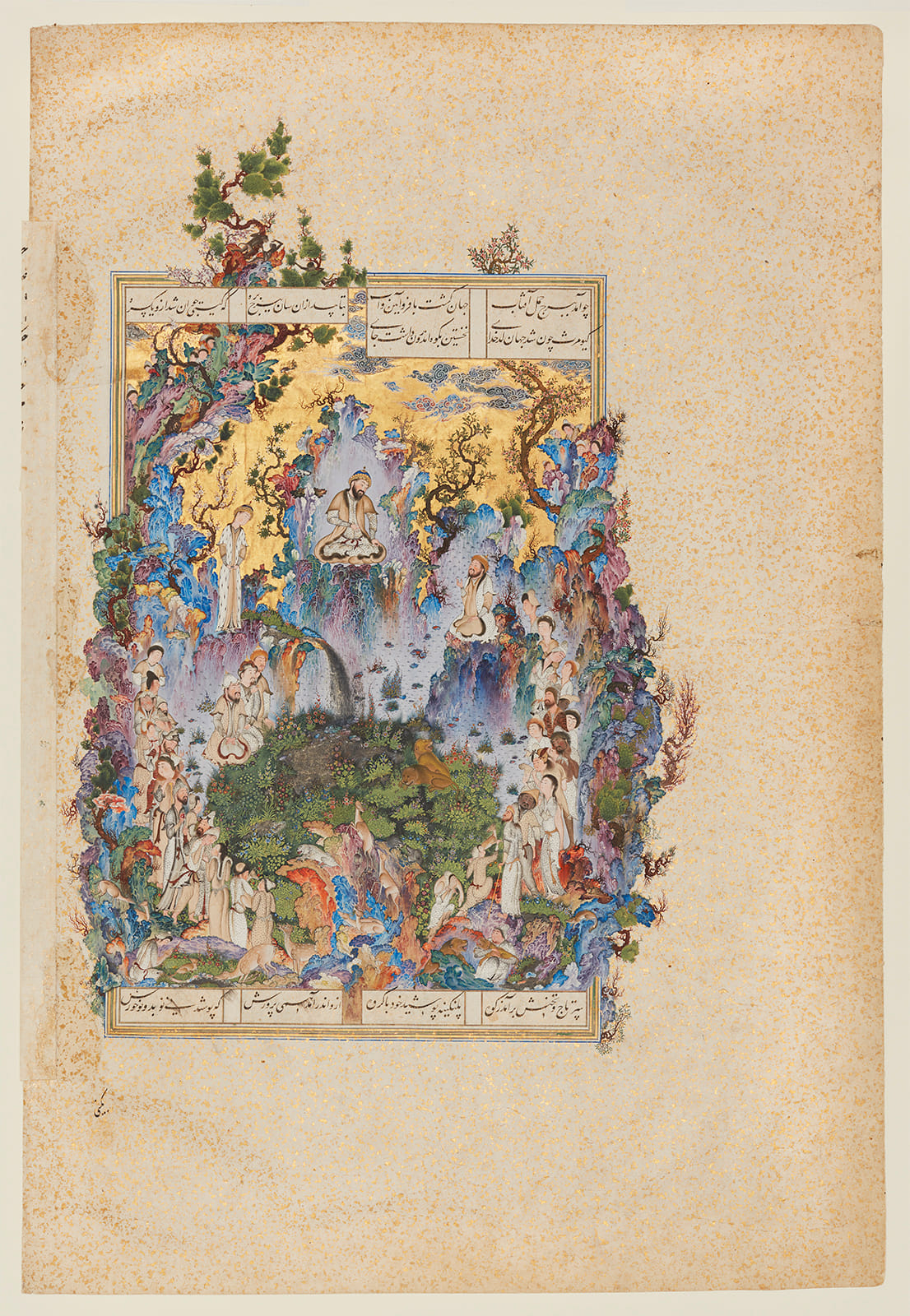
Start with what the painting refuses to show. There is no battle, no charging demon, no dead prince. King Kayumars sits above a gathering of courtiers and animals in a landscape so abundant that rocks seem to sprout faces and the sky has become gold. The violence belongs to the next part of the story. Here, the world is still intact.
But one person already knows that it will not remain so.
The Court of Kayumars, attributed to the Safavid master Sultan Muhammad and made in Tabriz around 1524–25, is a 45-by-30-centimetre folio from the Shahnameh of Shah Tahmasp. Opaque watercolour, ink, and gold transform a sheet of paper into a first world: the court of Iran's mythical first king.[1] Its beauty does not suspend tragedy. It gives tragedy something precise to destroy.
That is the painting's quiet audacity. A scene that could have been a straightforward image of rightful rule becomes an image of foreknowledge. Paradise is not pictured as timeless. It is pictured at the instant someone learns that time has entered it.
A page that exceeds its frame
The eye encounters a hierarchy before it encounters a story. Kayumars occupies the summit of a steep, flowering mass. His courtiers descend along both sides in a broad arc, while animals gather lower down. The arrangement lifts the king without isolating him. He is the highest figure, but he belongs to the same continuous mountain as everyone else.
The mountain refuses to stay politely inside the painted rectangle. Trees and rocks push beyond the ruled boundary into the gold-sprinkled margin on three sides.[1] Above and below, blocks of nasta'liq script keep the image attached to the book it came from. The painting therefore works in two directions at once. It is one episode bounded by written lines, and it is a world whose growth appears to exceed those lines.
This is not Western single-point perspective offering a window through the page. Space accumulates upward. Figures that are higher are not simply farther away; their position carries rank, narrative importance, and rhythm. A viewer reads the slope through clusters: courtier, blossom, face in stone, another courtier, then the pale-bearded king. The route is closer to climbing than looking through.
The manuscript was built to reward that slow ascent. Its fine paper, large gold-sprinkled borders, calligraphy, illumination, and paintings were the coordinated work of a royal atelier. The complete volume contained 759 folios and 258 paintings, produced in Tabriz across roughly two decades by two generations of leading artists.[2] Yet this page converts that institutional scale into an intimate demand: come closer.
The scene before the catastrophe
Ferdowsi completed the Shahnameh around 1010, drawing Iran's mythical, heroic, and historical past into a continuous epic. In earlier traditions, Gayomard or Kayumars could be understood primarily as the first man. Ferdowsi sharpened him into the first king, the figure who establishes crown, throne, mountain dwelling, food, and clothing.[5] Human society begins here not with a city wall but with an ordered gathering in nature.
The leopard skins matter. Kayumars and his people wear the material of the animal world even as kingship begins to distinguish ruler from subject. Around them, wild animals sit in improbable peace. The painting makes early civilization look less like dominion over nature than a temporary accord among people, animals, plants, and stone.
That accord has an enemy. Ahriman, envious of Kayumars, sends his son—the Black Div—to kill the king's son, Siyamak. Before the attack, the angel Surush brings a warning.[1][5] Sultan Muhammad chooses this interval rather than the fight. The most consequential event in the image is information passing between figures.
The choice changes the emotional scale of the epic. War has not yet become spectacle. It exists as knowledge borne by one person and not yet shared by the surrounding world. Monkeys still play. Paired animals still rest together. Courtiers still inhabit the mountain as if its order were permanent. The viewer sees harmony and threat simultaneously because the narrative has made us know more than most of the painted assembly.
A triangle small enough to miss
Near the peak, three figures create the painting's compressed drama. Kayumars looks toward the two younger figures and extends one finger. The three bodies complete a triangle of looks and gestures small enough to disappear inside the sumptuous landscape.[1]
The Aga Khan Museum's current catalog reads the standing figure as Surush, delivering the warning, and the other as Siyamak. Its note also records an older scholarly identification of the standing figure as Hushang, Siyamak's son. The disagreement is not a minor label to hide. It reveals how much the painting asks a viewer to infer from posture, sequence, costume, and a few lines of text. Hushang does not enter Ferdowsi's account until after Siyamak's death; reading the figure as Surush brings the image into the moment before the murder.[1]
The painting's larger argument survives the uncertainty, but its temperature changes. If the figure is Surush, the triangle is a circuit of foreknowledge: messenger, father, doomed son. If it is Hushang, three generations occupy one peak and future succession is already present beside future loss. Either way, the small gesture from Kayumars prevents the enthroned body from becoming an emblem of untroubled power.
His hand does not command the crowd. It points across an intimate distance. The king who supposedly stands at the origin of rule cannot use rule to cancel what he has learned. Authority is made visible at the same instant its limit becomes visible.
The landscape is not background
Look away from the protagonists and the mountain begins to behave strangely. Blue rock shifts toward green. Water once rendered with silver has darkened. Human and animal profiles appear embedded in the stone. Bears, deer, lions, monkeys, cattle, and birds do not form a natural-history inventory; they make the terrain feel alert.[1]
These details are easy to call decorative because they are pleasurable. They are also structural. The faces in the rocks dissolve the boundary between setting and witness. The landscape does not merely hold the court—it seems to participate in the act of looking. Kayumars rules from a rocky throne, but the throne is crowded with other forms of life and almost-life.
That density keeps hierarchy from becoming emptiness. The king rises because the mountain rises, and the mountain rises because hundreds of minute decisions—leaf tips, animal pelts, cloud curls, colored facets, attentive faces—carry the gaze upward. Power is produced collectively at the level of paint, even though the composition culminates in one ruler.
The gold sky complicates the effect further. Gold removes ordinary weather and hour; it announces an ideal register. Yet the plants retain species-like particularity, fur changes texture from figure to figure, and the stream records material aging. The page oscillates between paradise and object, myth and pigment. Its ideal world is made from substances that can tarnish.
Luxury slows the warning down
The folio's attribution is itself a history of attention. The contemporary writer Dust Muhammad singled out Sultan Muhammad's Kayumars painting in the sixteenth century, praising it through images of other painters submitting before the force of his pen. That rare early notice anchors the modern attribution, although “attributed to” still matters: a royal manuscript page emerged from a collaborative workshop of painters, calligraphers, illuminators, gilders, and other specialists rather than from the modern fiction of an untouched solitary hand.[1][3][4]
Luxury, here, is not only expensive material. It is controlled delay. The court workshop gives the eye too much to absorb quickly. Every flower and pelt postpones arrival at the pointing hand; every hidden face tempts the viewer away from the narrative center. The warning is therefore experienced as the king experiences it: inside a world one is reluctant to leave.
This is why visual abundance and grief are not opposites. The painting does not bury bad news beneath ornament. It makes ornament the measure of the news. The more harmonious the animals, the more tender the courtly gathering, the more luminous the rocks, the sharper the knowledge that Siyamak's death will break this order.
The page also addressed a living court. The Shahnameh was a “mirror for princes,” a history through which rulers could contemplate models and failures of kingship.[2] Under the early Safavids, its imagery helped assert renewed Persian royal authority, while war and divine kingship became recurring concerns across the manuscript's unusually lavish pictorial program.[6] A young Shah Tahmasp could see in Kayumars an origin story for sovereignty. He could also see that legitimate rule does not make succession painless or violence avoidable.
From royal book to solitary leaf
The manuscript's later life adds a final border to the close reading. In 1568, Shah Tahmasp sent the completed Shahnameh to the Ottoman sultan Selim II as an accession gift and diplomatic offering. It remained in the Topkapi Palace for centuries before entering the modern art market and being dispersed; the pages now reside across public and private collections.[2][6]
The Court of Kayumars is consequently both folio and fragment. The text blocks above and below insist that a story continues, but the book that once carried that continuation is no longer physically whole. A modern viewer meets the first court as a single treasured object in Toronto, separated from the sequence that would bring Siyamak's battle, death, mourning, and Hushang's revenge.
That separation can make the page seem more timeless than it is. The painting itself argues against the mistake. Its plants cross a frame. Its narrative points forward. Its silver changes color. Its meaning shifts when one standing figure is called a grandson or an angel. Everything about it exceeds the fantasy of a perfect image sealed outside history.
Kayumars remains at the summit, but the work's center is not simply his throne. It is the nearly invisible movement of knowledge across the peak. Around that gesture, paradise continues for one suspended instant: animals pair off, courtiers attend, rocks bloom, and gold refuses the coming night. The first king's world is beautiful because it is ordered. It becomes moving because the painting lets him understand, before almost anyone else, that order will not be enough.
Sources
- Aga Khan Museum, “The Court of Kayumars,” AKM165 — official object record with image, metadata, narrative, visual description, attribution history, and the Surush/Hushang identification note.
- Francesca Leoni, “The Shahnama of Shah Tahmasp,” The Metropolitan Museum of Art, Heilbrunn Timeline of Art History — manuscript scale, workshop history, stylistic synthesis, 1568 gift, and later dispersal.
- Stuart Cary Welch, A King's Book of Kings: The Shah-nameh of Shah Tahmasp, The Metropolitan Museum of Art, 1976 — free scholarly publication on the manuscript, its artists, reception, and individual paintings.
- Nancy Demerdash and Michael Chagnon, “The Court of Gayumars—part 1,” Smarthistory — close visual and manuscript-context analysis, including workshop collaboration and the relation between text and image.
- Antonio Panaino, “Gayōmard,” Encyclopaedia Iranica — the figure's development from first man to Ferdowsi's first king and the mountain-court tradition.
- Marianna Shreve Simpson, “Šāh-nāma ii. Illustrations,” Encyclopaedia Iranica — scholarly overview of illustrated Shahnameh traditions, Safavid patronage, pictorial themes, and the 1568 Ottoman gift.