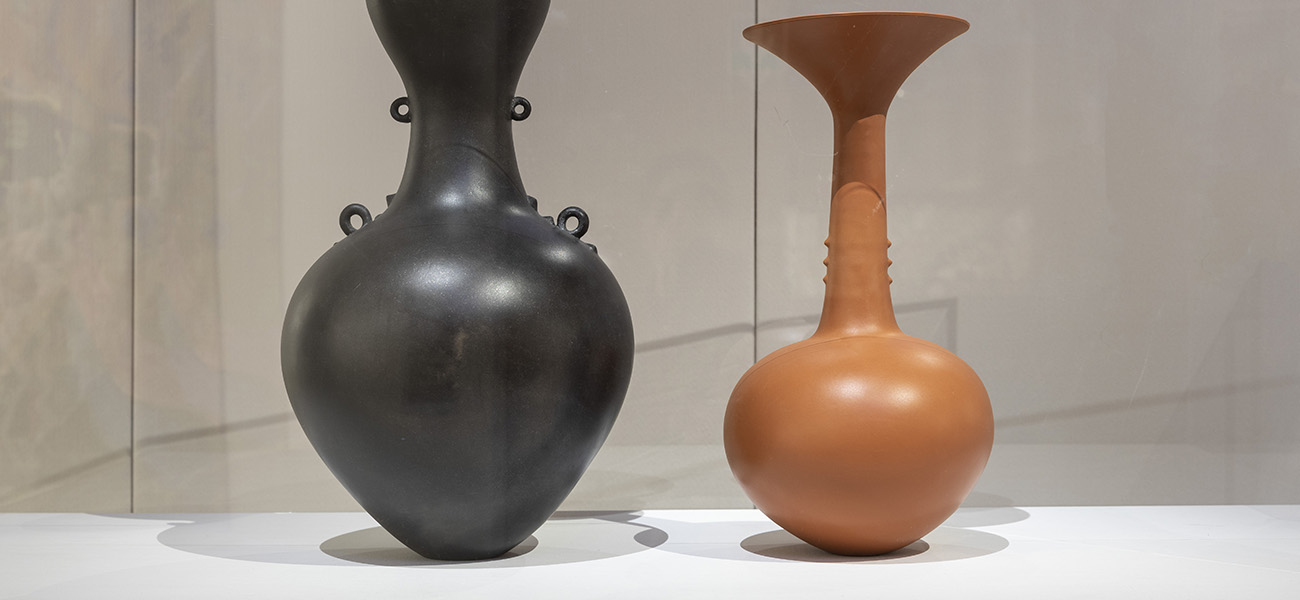
Image context: this post uses one real exhibition photograph from the 2022 Venice Biennale, not a diagram, chart, generated visual, or abstract placeholder. The black and red-orange vessels are Odundo's work, and their side-by-side display makes the article's subject—the way a pot can acquire posture, surface, and presence—immediately visible.[5][6][7]
Magdalene Odundo's vessels do not imitate bodies so much as occupy a room the way bodies do. One leans through its neck; another seems to settle its weight below a narrow waist. A lip may flare like a head held high, while small loops or nodules interrupt a shoulder with the precision of jewelry. Even before the viewer knows how the objects were made, their profiles suggest stance, gesture, and self-possession.
That presence is the result of a long, exact sequence. Odundo builds without a wheel, drawing a form upward by hand, refining its contour, polishing its surface, and allowing fire to make the last consequential decisions.[3][4][5] The finished vessel can look serene, but serenity is not its subject. The real drama is the negotiation between inside and outside, control and chance, inherited knowledge and individual invention.
A technical account built only from Odundo's elegant silhouettes would therefore miss the point. Her achievement lies in making technique carry biography. Clay records the pressure of travel, study, touch, and looking; the pot becomes less a container for something else than a concentrated history of encounters.
Technique begins with a route into clay
Odundo was born in Nairobi in 1950 and first trained in graphic art. She moved to Britain in 1971, continued her studies in Cambridge, and then pursued ceramics at the West Surrey College of Art and Design in Farnham before completing a master's degree at the Royal College of Art.[1][4][6] The chronology matters because it blocks an easy but misleading story: she did not simply carry an unchanged Kenyan pottery tradition into a British studio. Her language in clay emerged through movement between places, institutions, objects, and makers.
In 1974, Odundo worked at the Abuja Pottery in Nigeria, where she encountered Ladi Kwali and a community in which women sustained sophisticated hand-building practices.[2][4][5][6] She also returned to Kenya to study pottery there. Those experiences did not give her a ready-made style. They changed the terms of her education by placing embodied making alongside the museum, the art school, and the history book.
The Hepworth Wakefield records the colonial hierarchy Odundo had confronted in school, where African art was presented to her as inferior, and connects her later practice to postcolonial inquiry.[2] That context makes her subsequent range of references especially important. Museum accounts locate sources in Nigerian and Kenyan ceremonial vessels, British studio pottery, ancient Mediterranean and Japanese ceramics, pre-Columbian forms, modernist sculpture, Congolese carving, and even Elizabethan dress.[1][4] The work does not ask those traditions to dissolve into a vague idea of the “global.” It asks what an artist can learn from the different ways cultures have made a vessel meaningful.
The first body in the work is the maker's
Odundo's forms begin in a process that is slower and less mechanically regular than wheel throwing. The British Museum notes that every piece is hand-built and avoids the rotational symmetry a wheel naturally encourages.[4] The Venice Biennale describes her hollowing and drawing up a mass of clay, then scraping the surface with a gourd.[5] At The Met, the method is described through coiling: the clay rises while the interior is opened into the body of the vessel.[3]
These descriptions are not competing recipes so much as views of the same physical intelligence. The form is established from both sides. Pressure on the exterior changes the volume within; the growing cavity limits what the wall can bear. A vessel is therefore not a solid sculpture wearing the appearance of emptiness. Its interior is an active fact, present in every curve even when the viewer cannot see it.
The method also restores time to objects that can look effortless in photographs. A neck does not arrive as a single outline. It is coaxed upward while the clay remains workable. A shoulder must carry the transition from swelling volume to constriction. A lip has to open without making the whole form lose its poise. The body we perceive in the finished work is inseparable from the maker's repeated circling, lifting, scraping, and judging.
That is why the vessels' asymmetry matters. They are not irregular as a gesture of casual spontaneity. Their slight departures from perfect rotation allow a profile to behave like a profile: one side can advance, another can withdraw, and a neck can seem to turn. Odundo makes the pot legible through bodily difference rather than geometric flawlessness.[3][4]
Burnishing turns surface into skin
After shaping comes a second transformation. Odundo does not rely on glaze to supply a separate glassy coat. She applies a fine terra sigillata slip and burnishes the clay with stones and polishing tools, compressing the surface until it holds a deep sheen.[4][5] The labor does not decorate the form after the fact. It makes the contour more perceptible. Light travels across the polished vessel slowly enough for the eye to register every swelling and narrowing.
“Skin” is a tempting word here, but it should be used carefully. The surfaces do not pretend to be flesh. Rather, they perform one of skin's visual functions: they reveal the structure beneath through tension, highlight, and change. On a red-orange vessel, reflected light warms the volume and makes a long neck feel taut. On a carbon-darkened vessel, the same sheen can make the object seem both dense and strangely luminous.
Fire keeps that surface from becoming a demonstration of total mastery. The Met's 1997 Untitled vessel was partially deprived of oxygen during firing, producing gray-black tones whose exact distribution could not be completely controlled.[3] The Biennale account similarly emphasizes repeated firings behind Odundo's red-orange and black surfaces, while art historian Marla C. Berns traces the shift from oxidized orange to the less predictable markings of oxygen-poor firings.[5][6] Chance is not an accident added to an otherwise finished design. It is one of the collaborators that completes the work.
This balance explains why Odundo's vessels feel composed without feeling sealed. The silhouette shows years of practiced control; the fired color preserves the memory of conditions that could be guided but not commanded. A finished piece is neither a raw document of process nor a perfect escape from process. It holds both.
A water carrier points toward the later figures
An early work makes the development visible. Esinasulo (Water Carrier), made in 1974–76 after Odundo's Abuja residency, has a rounded, inscribed, comparatively rough body. The Hepworth Wakefield acquired it in 1976, the first purchase of her work by a British institution.[2] Against the polished vessels for which she later became famous, Esinasulo can look like a beginning left behind. It is more revealing to see it as a question she kept refining.
The title ties the vessel to carrying, use, and a human task. Its fullness already gives volume a bodily charge, while its marked surface keeps the history of making close to view. Later works often surrender explicit titles and practical function, but they do not abandon carrying. They carry space inside them. They carry references without becoming illustrations of those references. Most of all, they carry attention from one contour to the next.
The shift from the early pot to the later burnished vessel is therefore not a simple rise from craft to sculpture. Such a story would repeat the hierarchy Odundo's education had forced her to question. What changes is the concentration of her language. Rough inscription gives way to a surface where light does the describing. The useful object's relation to a body gives way to an object that establishes a bodily relation with the viewer.
The vessel as an encounter
The 2022 Biennale photograph brings two of Odundo's vessels into a particularly clear conversation.[5][6][7] The black vessel spreads its weight low and wide, with a rounded upper form and small loops that sharpen its silhouette. Beside it, a red-orange vessel rises through an improbably long neck into a flared mouth. They share a family of hand-built volume and polished surface, yet they do not read as variations churned from a template. One feels gathered inward; the other projects upward and out.
Their pairing also clarifies what Odundo gains by keeping the vessel recognizable. The ancient form arrives with expectations: containment, pouring, storage, domestic work, ritual, exchange. Her objects activate those associations and then suspend ordinary use. A mouth remains a real opening, but no drink is waiting. A belly encloses space, but storage is not the point. Function survives as memory, making the sculpture feel socially inhabited rather than formally isolated.
Odundo has described the body itself as a vessel with an inside and an outside.[5] Her art reverses that thought as well: the vessel becomes a body because its interior has shaped every visible decision. This does not turn the pots into coded portraits or generalized symbols of womanhood. Their bodily force is more specific and less illustrative. It lies in posture, vulnerability, balance, and the fact that a polished boundary both separates an interior from the world and makes that separation beautiful.
Seen across her route from Nairobi to British art schools, Abuja, Kenya, museum collections, and international exhibitions, Odundo's practice resists being pinned to one geography or one category.[1][2][4] She is not choosing between vessel and sculpture, African knowledge and European institutions, tradition and modernity. She makes those oppositions feel too blunt for the object in front of us.
The result is a pot that does not wait quietly to be classified. It stands. Its outline meets the viewer before its references do; its surface makes touch imaginable while the museum keeps touch away. Coiling gives it posture, burnishing gives it a responsive skin, and fire gives it a history the artist can guide but never fully script. Odundo makes clay hold an interior—and then makes that hidden space feel unmistakably alive.
Sources
- The Hepworth Wakefield, “Magdalene Odundo” — artist profile covering her education, travels, diasporic perspective, and the wide historical range of her formal references.
- The Hepworth Wakefield, “Magdalene Odundo” — collection highlight on Esinasulo (Water Carrier), her Abuja residency, encounter with Ladi Kwali, and the work's 1976 acquisition.
- The Metropolitan Museum of Art, “Magdalene Odundo, Untitled, 1997” — object record detailing coiling, bodily profile, firing, color, dimensions, and medium.
- The British Museum, “Magdalene Odundo” — collection biography documenting her training, travel, hand-building without a wheel, burnishing, and cross-cultural study.
- La Biennale di Venezia, “Magdalene Odundo,” Biennale Arte 2022 — exhibition profile describing hand-building, gourd scraping, terra sigillata, burnishing, multiple firings, bodily form, and the artist's understanding of inside and outside.
- Marla C. Berns, “The Shifting Resonances of Magdalene Odundo's Vessels on the Global Stage,” MoMA post (October 4, 2023) — scholarly account of Odundo's sources, hand-building, burnishing, firing, bodily vocabulary, and 2022 Biennale installation.
- La Biennale di Venezia hosted JPEG — real exhibition photograph of two Odundo vessels at the 2022 Venice Biennale, used as the article image.