Johannes Vermeer's View of Delft is one of those paintings that people often approach already half persuaded. The reputation arrives first. Mauritshuis calls it the most celebrated cityscape in seventeenth-century Dutch art, and the museum's later single-work exhibition leaned into the fact that Marcel Proust considered it "the most beautiful painting in the world."[1][2] But the painting keeps its power for a more exact reason. It does not merely show a city. It shows a city after selection, after quieting, after structure and atmosphere have been tuned until the whole place seems to hover between observation and arrangement.[1][3]
That is why the work feels so still without feeling inert. Vermeer has not emptied Delft of life. He has brought its movement below the threshold of noise. Boats wait in the water with their sails lowered. Towers rise, but not theatrically. The skyline is present as a fact, yet it also feels like something that has been pressed gently flat so light can move across it more cleanly.[1][4]
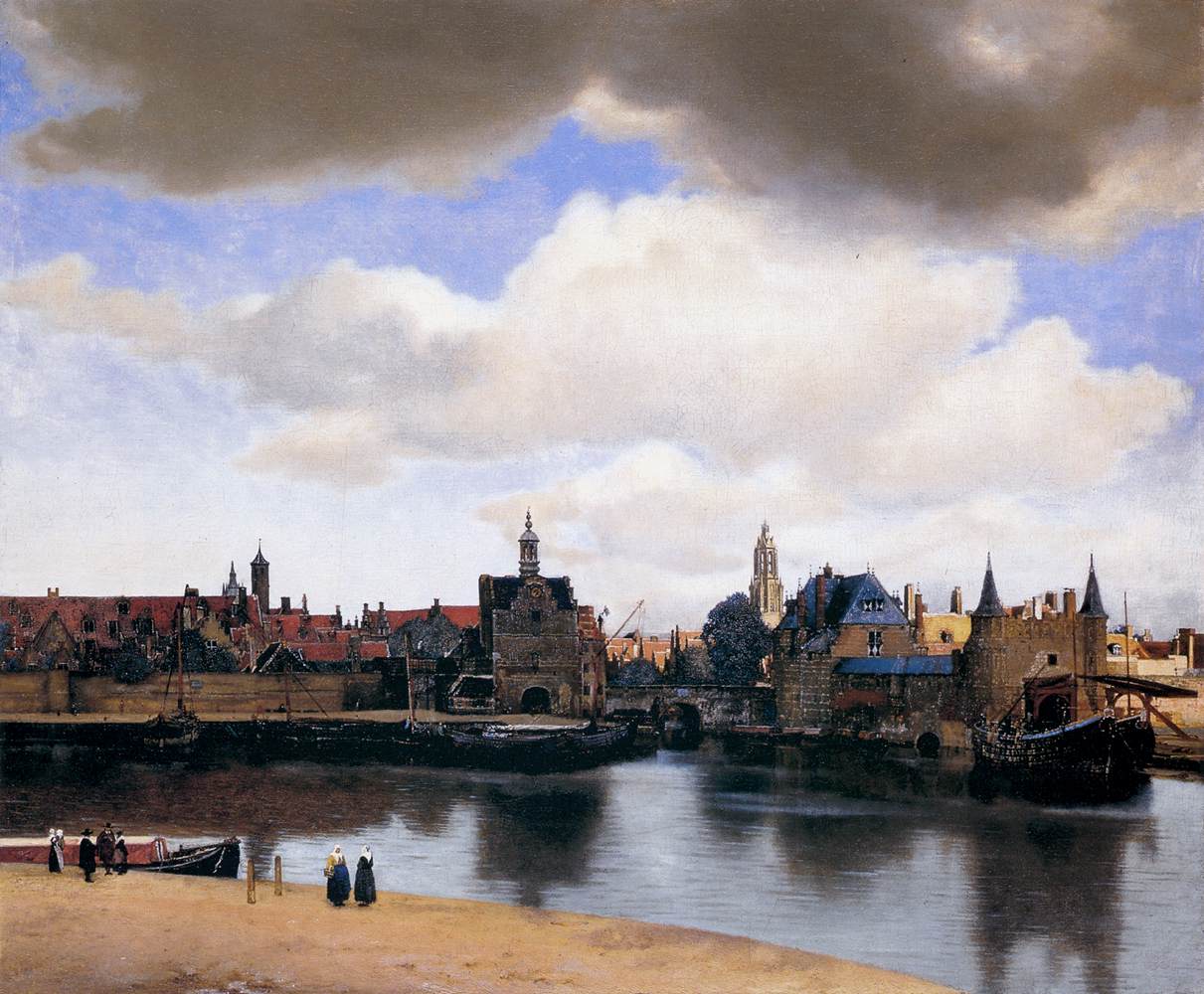
Image context: this article uses the painting itself because the argument depends on direct looking. The force of View of Delft lies in the exact balance Vermeer creates between water, architecture, and sky, where calm is not found but composed.[1]
The tranquility is built, not simply observed
Mauritshuis provides the cleanest starting point: Vermeer organizes the scene into three horizontal strips, water, city, and sky.[1] That sounds simple, but it is the essential decision behind the picture's strange steadiness. Horizontal bands slow the eye down. Instead of forcing a dramatic entry into the city, they keep us moving laterally across reflections, masonry, and cloud. The work does not thrust us into Delft; it lets Delft settle outward in measured layers.[1][4]
The museum's description insists on how little appears to be moving. The boats are moored, the sails are lowered, and "all is serenity."[1] This serenity matters because Dutch city views could easily become inventories of civic pride, busy trade, or architectural display. Vermeer chooses another register. He gives us the harbor at a pause point. The city is not absent from work, commerce, and weather, but everything has been brought to a temporary standstill so that atmosphere becomes legible.[1][3]
That decision also explains why the painting feels almost larger than its actual dimensions. The calm is spacious because it is structured. Vermeer does not rely on empty sky alone; he creates equilibrium by distributing weights carefully across the canvas. Dark boats and shadowed masonry keep the lower half grounded, while the illuminated roofs and cloud breaks keep the upper half alive. The stillness is the product of balance, not of vacancy.[1][4]
Delft is edited into order
The Mauritshuis catalogue text makes a crucial point that changes the way one reads the picture: the city was not really this neat.[1] In reality, the buildings were more untidy, the skyline more jagged, and gaps between structures opened views farther into the town.[1] Vermeer regularized that disorder. He straightened and lengthened the bridge between the gates, lowered parts of the Rotterdam Gate complex, and screened the one opening that might have let the eye escape into the distance by placing trees there.[1]
Essential Vermeer pushes the point further. The site's detailed commentary notes that while the view is fundamentally accurate, Vermeer declines the normal topographical urge to emphasize every landmark. He alters contours and proportions, and he lets even major monuments behave with unusual restraint.[3] The painting therefore sits in a productive tension: it is recognizably Delft, but it is Delft made answerable to pictorial calm before civic description.
This is where the work becomes more than a beautiful postcard avant la lettre. Vermeer is not falsifying the city so much as finding its most stable visual grammar. He reduces interruption. He turns jaggedness into cadence. He allows the city to appear inevitable, as though harbor, wall, gate, and church tower had always been waiting for one another in exactly these proportions.[1][3]
Light chooses the city we are allowed to see
If structure slows the picture down, light tells us where to stay. Mauritshuis emphasizes the "play of sunlight and shadow," the cloudy sky that seems to radiate light, and the subtle reflections on the water.[1] Vermeer does not spread illumination democratically. He selects. The tower of the Nieuwe Kerk catches full sun; the bright roof at the right edge flashes out against the more muted mass around it; water below receives these changes in softened reflection.[1]
The same catalogue text becomes unusually concrete about paint handling. In the yellow roof on the right, Vermeer suggested roughness through coarse grains of white lead in the underpainting. On the sunlit tower he used a thick, smooth layer of lead-tin yellow on the brightest sections, almost as though he were modelling with paint rather than merely coloring forms.[1] These details matter because they explain why the painting never collapses into generalized atmosphere. It feels airy, yet its most luminous passages remain tactile and specific.
The Mauritshuis exhibition Alone with Vermeer helps explain why viewers continue to submit to this concentration. Few works, the museum notes, can sustain an exhibition on their own, but this one could because silence and attention are already built into the picture's terms.[2] The painting teaches viewers to linger on selected patches of light until the city stops functioning as location and starts functioning as duration.[1][2]
Distance is held close without being cancelled
One of Vermeer's subtlest achievements is that the city feels intimate while still remaining across the water. We look from the southeast over the Kolk, the triangular harbor at the city's southern edge.[1] That vantage places us outside Delft, not in its streets. We are kept at a measured remove. Yet the remove does not become coldness, because Vermeer controls what distance does. He keeps the shoreline crisp enough to anchor us, then lets atmosphere soften the farther buildings into an inhabited hush.[1][3]
Essential Vermeer notes that the Old Church, one of the city's major monuments, is barely allowed to assert itself; it is almost concealed instead of triumphantly displayed.[3] That withholding is decisive. A more declarative city view would stack recognizable monuments for the viewer's benefit. Vermeer lets recognition arrive slowly. The city is legible, but never loud. We stay in relation to it as to something known from across a canal on a morning when wind has not yet picked up.
This is why View of Delft still feels modern in its own quiet way. It understands that a city can be made powerful not by multiplying incident but by disciplining it. Vermeer composes stillness without deadening the place, edits topography without destroying truth, and uses light to turn distance into a form of nearness. The result is a cityscape that seems to suspend time rather than simply record it.[1][3][5]
Sources
- Mauritshuis, "Johannes Vermeer - View of Delft" - collection page with catalogue text on composition, viewpoint, altered topography, and paint handling.
- Mauritshuis, "Alone with Vermeer - 'The most beautiful painting in the world'" - exhibition page on the painting's singular viewing effect and Proust reception.
- Essential Vermeer, "View of Delft by Johannes Vermeer" - detailed commentary on the painting's viewpoint, artistic license, and relation to the city as seen today.
- Mauritshuis, "Johannes Vermeer (1632-1675)" - artist page on Vermeer's light, calm atmosphere, and treatment of detail.
- The Metropolitan Museum of Art, Vermeer and the Delft School - publication page for broader historical context on Delft painting and city culture.