Lee Krasner is still too often introduced through someone else's biography. The usual shorthand places her beside Jackson Pollock, then asks how much of her career was overshadowed, delayed, or misread. That history matters, but it can also flatten the harder fact of the work itself. Krasner's real distinction lies in how often she changed the terms of her own painting without losing force. She kept starting again: from academic drawing to cubist structure, from tightly packed allover surfaces to torn-paper collage, from the bedroom studio to the barn, from compressed scale to paintings wide enough to require a different reach of the arm.[1][3][4]
That recurrent self-revision is what makes her feel current. A great many twentieth-century painters are legible through a signature look. Krasner is more demanding. Her signature is the willingness to discard one solved language before it hardens into manner. The room changes, the conditions change, the body changes, and the work changes with them.[1][3][5]
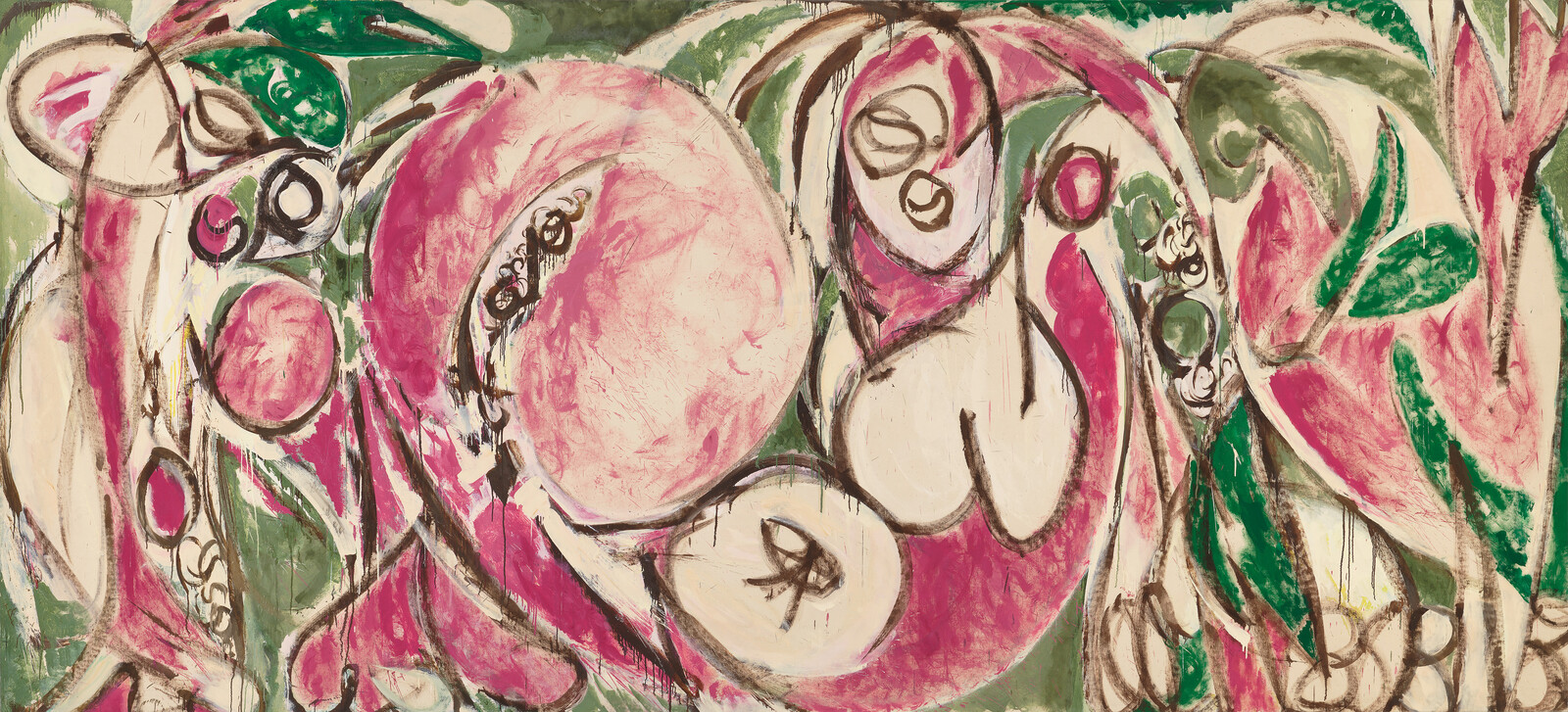
Image context: this article uses The Seasons because the argument turns on a physical threshold. Krasner's large late-1950s canvases matter less as monuments than as evidence that scale, after years of compression, became one of her ways of reopening paint.[1][2]
Training gave her structure; dissatisfaction kept it from becoming a cage
The Pollock-Krasner House biography and the Whitney's artist page agree on the basic outline of her formation: Brooklyn-born, trained at Cooper Union, the Art Students League, and the National Academy of Design, then sharpened by Hans Hofmann in the late 1930s.[1][4] That sequence gave Krasner a serious technical base, but it also left her restless. By the time she returned to study with Hofmann, she was already trying to break the hold of academic finish and move toward a sharper modern language.[4]
This early phase matters because Krasner never stopped carrying structure with her, even when the paintings look spontaneous. The Pollock-Krasner House notes that she radically revised her visual language in Hofmann's orbit, shifting away from naturalistic habits toward a schematic cubist idiom.[4] Later work would become looser, larger, and more bodily, but underneath that freedom there is nearly always an armature of judgment. Her paintings breathe because they are built, not because they are casual.
The Little Images turned constraint into density
The Whitney's artist page gives one of the most useful keys to Krasner's 1940s work: the small scale of the so-called Little Images was partly a consequence of studio space.[1] She made many of them upstairs in the bedroom of the Long Island house she shared with Pollock.[1] That fact does not shrink the work. It clarifies why these paintings feel so compact, so pressurized, and so internally alert.
The surfaces are crowded with marks that Krasner herself described as hieroglyphic.[1] They do not spread like murals. They accumulate. Her admiration for Mondrian, noted by the Pollock-Krasner House, helps explain why even the densest allover fields still feel held together by a hidden logic of interval and containment.[4] Constraint became a productive pressure. Rather than reading the bedroom years as a prelude to something fuller, it is better to see them as a period in which Krasner learned how much energy could be packed into a restricted field.[1][4]
Collage made revision visible
The Barbican's 2019 retrospective description moves cleanly across Krasner's phases: early self-portraits, the Little Images, collages made from torn-up earlier work, and large-scale abstractions.[3] That sequence is more than exhibition design. It reveals a habit of mind. Krasner did not treat earlier canvases as sacred relics from a settled style. When a language stopped moving, she was willing to cut into it and make it material for another one.[3]
This is one reason her career resists simple linear storytelling. The collages are not an interlude between more "important" paintings. They are a declaration that revision can be physical. Krasner's art often advances by refusing to preserve the previous version intact. In her hands, editing is not a secondary act performed after invention; editing is itself one of the engines of invention.[3]
After the barn studio, scale became a way of thinking
The most famous spatial shift in Krasner's life came after Pollock's death in 1956. The Whitney notes that once she began working in the barn studio on the property, she could attempt a size that had been impossible in the upstairs room.[1] The Pollock-Krasner House makes the transition tangible: she moved from the bedroom studio into the barn and worked there for the rest of her life, tacking canvases to the walls rather than working at domestic scale.[5]
The Seasons is the first decisive answer to that new room. The Whitney identifies it as the largest work she had attempted up to that point, nearly seventeen feet wide and more than seven feet high, with sweeping black brushstrokes moving through pink, off-white, and green forms associated with growth and cyclical life.[1][2] The painting does not read like a simple eruption of grief, even though the biographical pressure is there. It reads like a painter discovering that larger scale can carry both bodily release and compositional intelligence at once.[1][2]
MoMA's record for Gaea shows that the ambition did not recede: in 1966 she was still making canvases over ten feet wide.[6] The Pollock-Krasner House studio page names Gaea among the works whose lively gestures and brilliant color still mark the barn walls.[5] This is the larger point. Space did not merely allow Krasner to enlarge what she was already doing. It changed the thinking of the work. Gesture became longer, color could arrive in heavier weather systems, and the painting could feel less like a field to be filled than like an environment to be entered.[5][6]
Recognition came late because the work refused an easy label
The Barbican framed its retrospective as a corrective to the long eclipse caused by Krasner's marriage to Pollock.[3] The Smithsonian oral-history summary from 1972 shows that Krasner herself was sharply aware of how female artists were under-recognized inside the story of Abstract Expressionism.[7] Yet the delay in recognition also has something to do with the work's own refusal to settle into one instantly marketable image. Krasner is harder to package than artists whose careers can be compressed into a single repeatable formula.
That difficulty is part of her value now. She offers a model of artistic seriousness grounded in recommencement rather than branding. Each phase keeps contact with what came before, but no phase is allowed to become a permanent alibi. The result is a career that feels less like a smooth ascent than a sequence of deliberate resets, each one widening the field in which painting can still remain alive.[1][3][4][7]
Sources
- Whitney Museum of American Art, "Lee Krasner" - artist page covering the Little Images, the bedroom studio, and the shift to large works after 1956.
- Whitney Museum of American Art, "Lee Krasner, The Seasons" - collection page with date, medium, dimensions, and collection audio text.
- Barbican, "Lee Krasner: Living Colour" - retrospective page describing the arc from self-portraits to Little Images, torn-paper collages, and major large-scale abstractions.
- Pollock-Krasner House and Study Center, "Lee Krasner" - biography covering her New York training, Hofmann years, modernist revision, and relation to Mondrian and Matisse.
- Pollock-Krasner House and Study Center, "The Studio" - site history noting Krasner's move from the bedroom studio to the barn after 1956 and naming later works associated with that space.
- The Museum of Modern Art, "Lee Krasner. Gaea. 1966" - collection page with scale, medium, and department record for a major later canvas.
- Archives of American Art, Smithsonian Institution, "Oral history interview with Lee Krasner, 1972" - summary noting her remarks on recognition, women artists, and Abstract Expressionist networks.