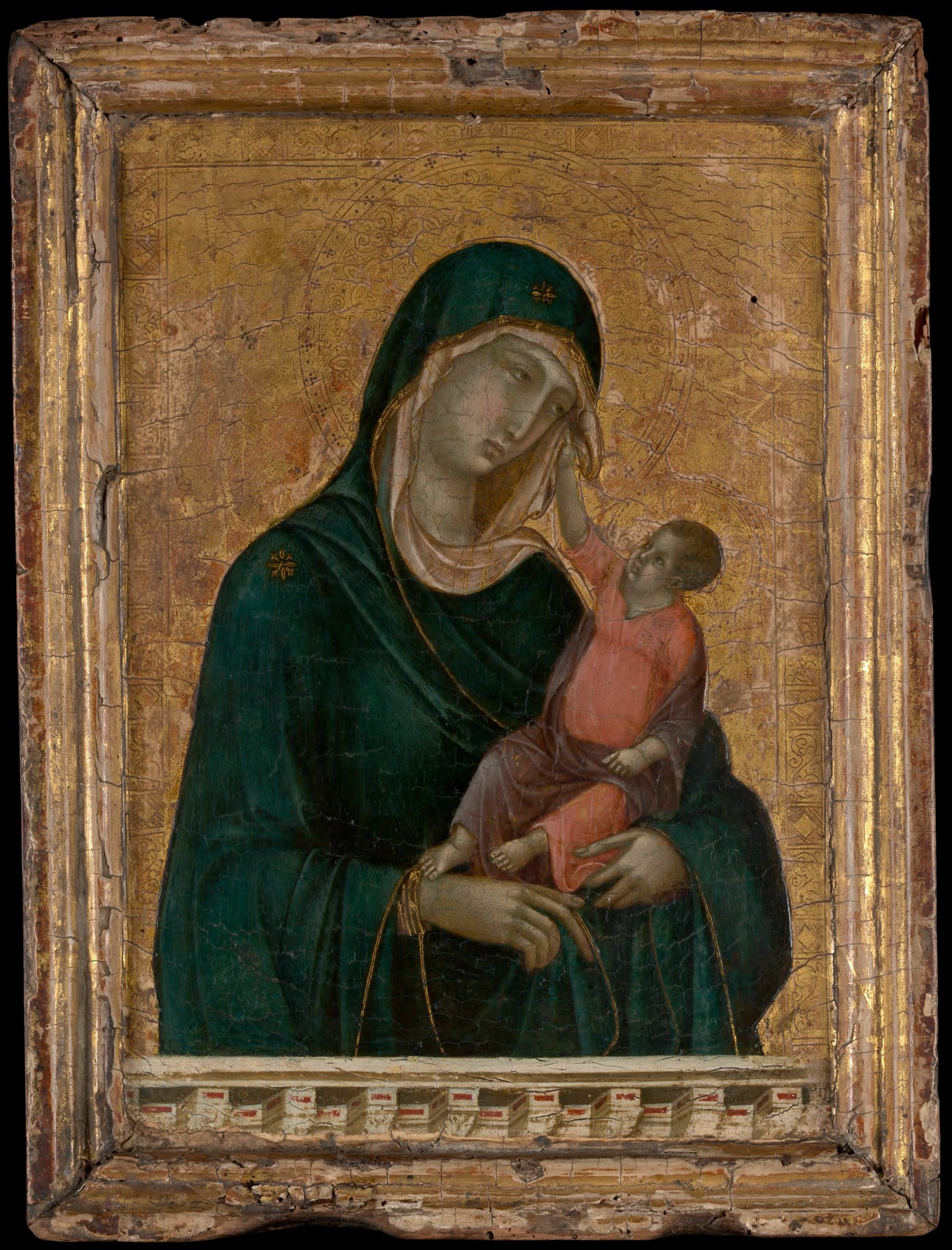
Duccio's Madonna and Child is easy to admire from a safe distance. It is small, luminous, and perfectly balanced; the gold field looks precious, the faces look tender, and the whole object seems to belong to the history of reverence as much as to the history of painting. But the Met's own object text points to a sharper way of reading it. This is not simply an early Italian Madonna made beautiful by gold. It is a devotional picture organized around contact. The Christ Child pushes away his mother's veil, Mary's face carries foreknowledge of the Crucifixion, and the parapet at the bottom reaches outward to connect the sacred picture to the beholder's world.[1]
That last point matters more than it first appears to. Many medieval and early Renaissance paintings are described as if they are chiefly windows into another realm. Duccio's panel does something more exacting. It brings the holy pair close, but not by dissolving them into ordinary domestic realism. Instead it sets up a threshold. The gold ground refuses ordinary room space, while the parapet and the child's touch create a zone of approach. Intimacy and distance arrive together.[1]
Image context: this article uses the painting itself because the argument rests on three visible structures in the object: the low parapet, the pulled veil, and the worked gold field. A studio portrait of Duccio or a generic medieval-gallery view would miss the panel's real evidence.[1]
The parapet is the picture's pressure point
The Met describes the parapet as the element that connects the fictive sacred world to the temporal world of the viewer.[1] That is the sentence to build from. In a painting this small, the parapet is not a minor piece of staging. It is the panel's pressure point. It creates a low barrier that feels both separating and near enough to touch. The Virgin and Child do not float in inaccessible splendor. They appear just beyond a ledge, as if the picture were testing how close devotion can come without becoming ordinary encounter.
This is why the panel still feels modern in its control of space. The sacred is not pushed far away into depth. It is held forward. The bodies are pressed toward the front surface, and the parapet stabilizes that compression. Duccio does not ask the viewer to travel imaginatively into a distant setting. He asks the viewer to confront a holy presence staged almost at arm's length.[1][2]
That staging also helps explain why Sienese painting mattered so much in the decades around 1300. The Met's Siena: The Rise of Painting, 1300-1350 exhibition frames Siena as a site of intense innovation in both large public works and intimate objects made for private devotion.[2][4] Duccio's small panel belongs to that second category. It proves that scale reduction did not mean emotional reduction. On the contrary, portability made pictorial decisions more concentrated. A picture meant to be held, carried, or placed near prayer had to engineer closeness with unusual precision.[1][4]
The veil turns tenderness into foreknowledge
The most moving action in the panel is also the smallest: Christ tugs at Mary's veil.[1] Without that gesture, the picture might remain serenely iconic. With it, the image acquires time. The veil becomes cloth with a future. The Met's interpretation reads the motion as a premonition of the burial shroud, and that reading is persuasive because Mary's expression already refuses uncomplicated sweetness.[1] She holds the child, but she also seems to know what holding him means.
That is where Duccio's emotional intelligence exceeds mere prettiness. He does not stage maternal affection as a closed private scene. He turns it into a devotional paradox. The child is affectionate and restless; the mother is physically close yet inwardly burdened. The panel keeps beginning and ending in the same frame. Nativity tenderness and Passion sorrow occupy one compact image.[1]
Seen against the broader Sienese context, this density is not accidental. The Met's exhibition and press material both emphasize Duccio's influence on a new generation of painters and the rise of narrative altarpieces in Siena.[2][4] Even in a small single-panel work, narrative pressure is already present. The picture does not narrate an event in sequence, yet it condenses a whole future into one touch. That ability to fold story into stillness became one of the great strengths of early Sienese painting.[2][4]
Gold is not background here; it is a field of nearness
The gold field in Duccio is often treated as a medieval leftover, something beautiful but superseded by later spatial realism. That is the wrong hierarchy. In Siena around 1300, gold was not a failed atmosphere. It was an active pictorial decision. The Met's exhibition objects page makes this easy to see by placing paintings alongside textiles, ivories, metalwork, and other portable luxuries.[3] The press release goes further, noting that Sienese artists encountered luxury fabrics threaded with gold and worked their shimmering motifs into painting.[4]
That context changes what the panel's surface is doing. Gold does not send the figures backward. It keeps them close while removing them from ordinary weather. The National Gallery's Duccio panel of the Virgin and Child with Saints Dominic and Aurea is useful here because it preserves the same devotional logic in a somewhat later form: a sacred grouping held before a richly worked gold field, with halos sharpened by tooling into the soft leaf.[5] In both works, gold behaves less like scenery than like a charged skin. It makes the holy figures legible as present and set apart at once.[5]
So the painting's space is built from an unusual combination. The parapet reaches toward the viewer. The bodies remain frontal and near. The gold does not recede. The result is not illusionistic depth but devotional frontality under tension. Duccio gives the beholder neither full entry nor full distance. He creates a threshold relation and holds it there.[1][5]
The candle burns keep the object honest
The most revealing detail on the Met page may be the simplest one: the original frame is marked by candle burns.[1] That fact rescues the painting from over-aestheticized looking. However refined the panel is now, it was also an object that stood near flame, prayer, and repeated use. It belonged to ritual proximity before it belonged to the museum.
Those marks matter because they confirm the article's whole argument. The panel was not made to be admired as untouched design. It was made to operate. Candlelight would have shifted across the gold, animated the tooled surface, and intensified the picture's sense of presence. At the same time, the burns literalize duration. The object has been approached again and again. Devotion left evidence at the edge of the frame.[1]
This is where Duccio's Madonna and Child still feels stronger than many larger, more famous images. It does not rely on grandeur. It relies on exactness. The parapet places the scene at the threshold of the viewer's world. The tugged veil folds future sorrow into present tenderness. The gold field holds the figures close without domesticating them. The candle burns remind us that the panel was once used in living practice. Taken together, those elements make the picture less a remote icon of medieval piety than a machine for staging encounter.[1][2][4][5]
Sources
- The Metropolitan Museum of Art, "Madonna and Child" - object page for Duccio's ca. 1290-1300 panel, including the parapet interpretation, the veil gesture, and the note on candle burns.
- The Metropolitan Museum of Art, "Siena: The Rise of Painting, 1300-1350" - exhibition overview on Siena's innovations, Duccio's influence, and the role of intimate devotional objects.
- The Metropolitan Museum of Art, "Siena: The Rise of Painting, 1300-1350 - Exhibition Objects" - checklist page showing Sienese paintings alongside textiles, ivories, and other luxury objects in the exhibition.
- The Metropolitan Museum of Art, "The Metropolitan Museum of Art to Present First Major Exhibition in America on Early Sienese Art" - press release on Siena's position in trade networks, narrative altarpieces, and portable works for private devotion.
- The National Gallery, London, "Duccio | The Virgin and Child with Saints Dominic and Aurea | NG566" - collection page for a related Duccio panel with worked gold ground and tooled halos.