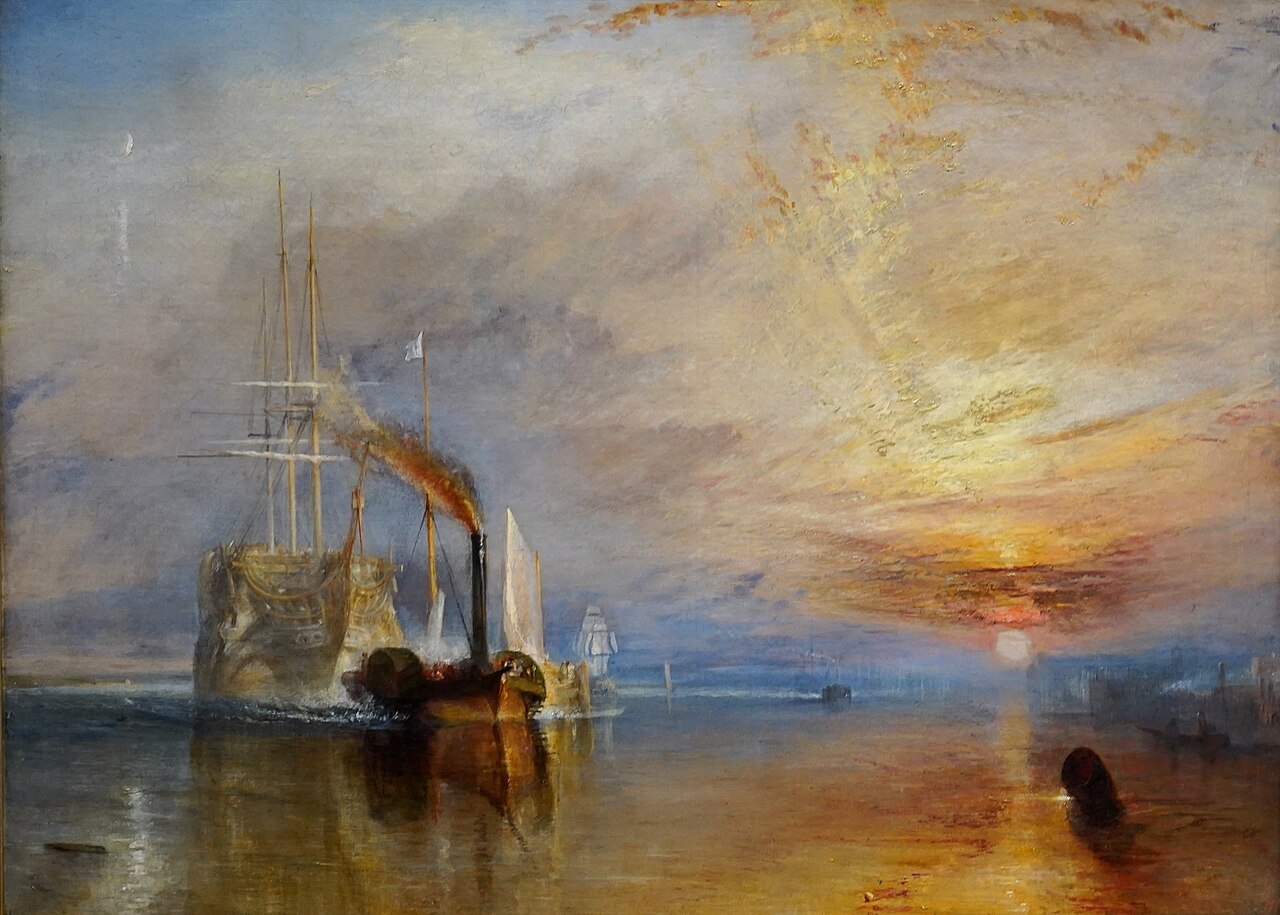
Turner's The Fighting Temeraire is often introduced as a national elegy: one heroic warship, one glorious sunset, one farewell to the age of sail. That reading is not wrong, but it is incomplete. The painting does mourn. It also arranges a handover. Turner takes the final tow of HMS Temeraire and turns it into a scene in which authority, motion, and visibility are all reassigned.[1][2] The old ship is larger, nobler, and more beautiful than the tug that pulls it. Yet nearly every important sign in the picture tells us that power has already shifted.
The National Gallery's account supplies the historical skeleton. The veteran ship had fought at Trafalgar in 1805, spent its later years reduced to secondary use, was sold by the Admiralty in 1838, and was then towed up the Thames to be broken apart at Rotherhithe.[1] Turner did not record that journey like a reporter. He rebuilt it. He restored masts that had already been removed, simplified the number of tugs, changed the tug's construction, and turned a stripped naval hulk into a pale, almost ceremonial survivor.[1][2] The result is why the painting still feels emotionally exact. It is factual enough to carry history and fictional enough to concentrate meaning.
Image context: the cover image is a recent gallery photograph of the painting rather than a cropped reproduction detail. That choice matters because this close reading depends on the whole field: the white ship on the left, the dark tug in the center, the round sun to the right, the rising moon above, and the buoy in the foreground all cooperate to stage a transfer rather than a simple farewell.[7]
The ship is painted as memory, not as machinery
The first thing Turner does is deny the viewer a neutral record. The National Gallery notes that the real Temeraire had already been stripped of reusable parts before the tow, but Turner gives her three lower masts and partial rigging back so she can retain dignity.[1][2] That is a formal decision before it is a patriotic one. He wants the ship to appear not as wreckage but as memory still holding its shape.
He then pushes that memory further by changing the ship's color. Instead of the practical dark scheme the vessel had carried in service, Turner renders it in pale white and gold, so that it seems less built than summoned.[1] The ship glides rather than labors. The National Gallery catalogue describes this as a ghostly presence, and that is exactly how the picture works.[2] The old battleship is not where force resides anymore. It has already crossed into the register of apparition.
Even the missing Union flag matters. Turner included no naval flag on the ship because it had ceased to be naval property.[1] That absence does more than clarify ownership. It removes the ship's public voice. Temeraire is still the emotional center of the painting, but it no longer speaks in the language of command. The thing that once embodied state power now moves under someone else's direction.
The tug is ugly on purpose
If the warship is memory, the tug is present tense. Turner paints it squat, dark, and almost abrasive, but he also gives it the one kind of agency that matters here: propulsion. The catalogue entry points out that he deliberately altered the tug's design, placing the black funnel before the mast so smoke can stream backward through the old ship's rigging.[2] A literal engineer would call that wrong. A painter of historical transition calls it exact.
This is one reason the tug feels larger than its physical size. It occupies less canvas than the warship, yet it controls the painting's direction, rhythm, and temperature. Its commercial flag flies clearly where the great ship's battle flag is absent.[1] Its furnace smoke rhymes with the copper blaze of the sunset.[1][2] Its engine turns steam into drawing power, but Turner also turns it into visual grammar. The tug drags the future through the skeleton of the past.
That is why the painting avoids simple anti-industrial nostalgia. Smarthistory is useful on this point: the picture can be read as an image of Britain's entry into industrial modernity, but Turner's attitude remains ambiguous rather than merely condemnatory.[6] He gives the tug no beauty of form, yet he grants it undeniable efficacy. The painting does not pretend sail can win this contest. It stages the loss in a way that preserves grandeur without denying displacement.
The sunset and buoy keep the scene from floating into myth
Turner could have let the picture dissolve into pure atmosphere, but he does something stricter. The National Gallery emphasizes the simultaneous sunset and rising crescent moon, a pairing Turner had long explored and that here sharpens the sense of transition.[1] The scene therefore contains two clocks at once. One light sinks in copper fire while another begins in cooler silver. The old order is not simply ending; a new one has already entered the sky.
The buoy in the lower right is just as important. It is easy to miss because the sky and ship claim so much attention, but the buoy acts like a hard stop against sentimentality. The catalogue notes its role in creating scale and leading the viewer into the picture.[1] I would put it more strongly: the buoy is the painting's blunt material fact. It is dark, dense, local, and unheroic. Against the vaporous ship and theatrical sky, it anchors the scene in navigable water, property lines, and working river space.
That small object changes the emotional logic of the whole canvas. Without it, the picture might drift too easily into allegory. With it, Turner insists that even national memory has to pass through channels, markers, and managed traffic. The buoy says that this is not only about death or glory. It is about routing.
Paint handling splits permanence from weather
The close reading becomes sharper when the painting is treated as a surface, not only as an image. The National Gallery's technique pages explain that Turner used relatively stable oil materials here, then built the sunset through thin glazes overlaid with scumbled passages of thick opaque yellow and orange.[4] In the water near the tug, quick finishing marks and rounded dabs of impasto break reflections into restless fragments.[5] The sky is therefore not just represented as instability. It is physically made unstable by the handling of paint.
That matters because the ship is treated differently. Smarthistory notes the contrast between the more naturalistically described vessel and the heavier, more turbulent accumulations in the sky.[6] Turner divides the picture into zones of retention and zones of dissolution. The warship carries detail like a remembered structure. The sunset carries matter like weather that cannot be held still. Between them sits the tug, converting smoke into motion and motion into historical verdict.
This is why the painting remains modern. It is not only about what industrial change means. It is about how a painting can distribute certainty unevenly. Turner lets the old ship keep its contour while the world around it thickens, blurs, and burns.
Why the picture still holds
The Fighting Temeraire lasts because it gives the viewer two satisfactions at once and does not let either settle. It offers the beauty of a memorial and the clarity of a demotion.[1][2][6] The ship is loved, but it is finished. The tug is graceless, but it is sovereign. The sky is magnificent, but it belongs to an economy of smoke and heat that the old vessel cannot master.
That is the real force of the picture. Turner does not merely ask us to feel bad that one noble machine replaced another. He asks us to watch how power changes costume. The old warship keeps the aura. The new engine takes the work. Between them lies one of the clearest paintings ever made about historical succession: not a clean revolution, not a sentimental goodbye, but a transfer in which beauty lingers on the loser while agency passes elsewhere.
Sources
- The National Gallery, "Joseph Mallord William Turner, The Fighting Temeraire" - official collection page with historical overview, artistic liberties, and compositional notes.
- The National Gallery, The Fighting Temeraire in National Gallery Catalogues: The British Paintings - catalogue entry on the ship's history, Turner's alterations, and the symbolic role of the tug and smoke.
- The National Gallery, "Heroine of Trafalgar: The Fighting Temeraire" - in-depth feature on the painting's memorial logic, ghostly ship, and end-of-an-era framing.
- The National Gallery, "Heroine of Trafalgar: The Fighting Temeraire - Technique" - notes on Turner's oil paint mix and scumbling method in the sky.
- The National Gallery, "Heroine of Trafalgar: The Fighting Temeraire - Special effects" - notes on quick finishing marks, impasto, and water reflections beneath the tug.
- Smarthistory, "J. M. W. Turner, The Fighting Temeraire" - independent art-historical reading of industrial transition, compositional contrast, and Turner's late self-positioning.
- Wikimedia Commons, "File:JMW Turner - The Fighting Temeraire - 1839.jpg" - source page for the real gallery photograph used as the article image.