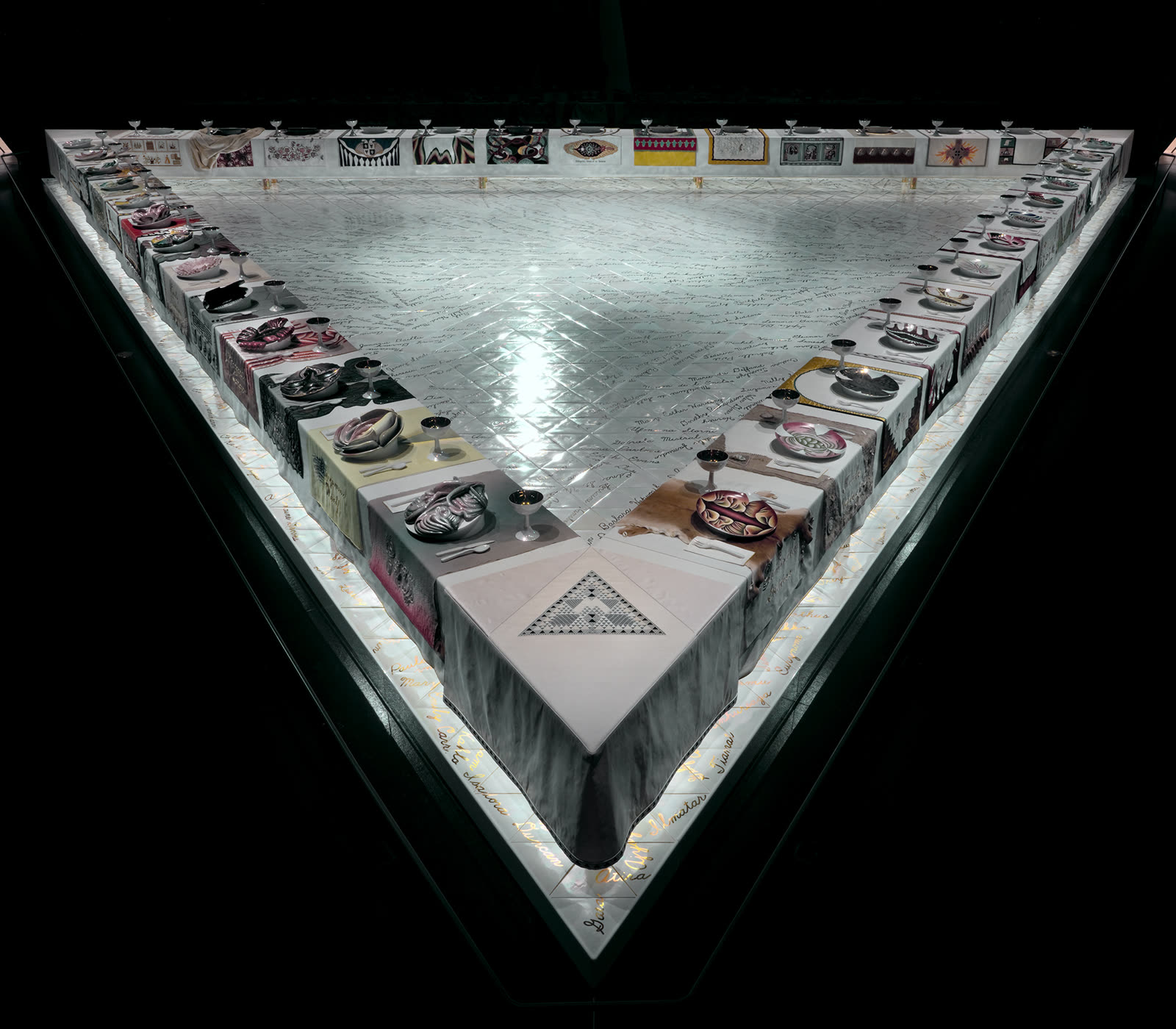
People often flatten The Dinner Party into one easy phrase: Judy Chicago gave women a seat at the table.[1][3] That is true as far as it goes, and it does explain why the work became a shorthand for feminist revision. But it also makes the installation sound tidier than it is. The real ambition of the piece is larger, stranger, and more spatial. Chicago did not simply invite thirty-nine women into symbolic attendance. She built an environment in which omission has to be walked around, read underfoot, and felt as a problem of scale.[1][2]
That difference matters because the work is not only a banquet tableau. The Brooklyn Museum describes a forty-eight-foot triangle with thirty-nine place settings and another 999 names inscribed on the white Heritage Floor below.[1] Its curatorial overview makes the aim explicit: The Dinner Party was part of a 1970s feminist reclamation project that tried to write women back into historical memory while also challenging the hierarchy that had long pushed ceramics, embroidery, and other forms of "women's work" downward in cultural value.[2] Smarthistory likewise stresses that Chicago turned the structure of the Last Supper into something else entirely, using the ceremonial table to produce a feminist history lesson at monumental scale.[3] Once those facts are held together, the installation starts to look less like a symbolic dinner and more like memory made infrastructural.
That is the argument worth keeping in view. The famous plates are only one layer of the work. The runners, the floor, the room, the collaborative labor, and the requirement that viewers circulate around the triangle do just as much of the meaning-making.[1][2][4][5] The Dinner Party endures because it does not merely represent forgotten women. It reorganizes the viewer's body around the fact of historical exclusion.
Image context: the cover uses Donald Woodman's installation photograph because this essay depends on seeing the triangular table and the Heritage Floor in one glance. A single plate detail would miss the work's spatial argument about scale, circulation, and the names gathered below the table.[1][4]
1) The triangle turns commemoration into a navigable room
The first important thing about The Dinner Party is that it has no head of the table.[1][2] Chicago chose an open equilateral triangle, and the Brooklyn Museum's curatorial overview notes that she understood the form both as an image of equality and as an early feminine symbol.[2] That formal choice sounds almost too neat when reduced to iconography. In the room, however, it changes everything. The viewer cannot stand in one privileged frontal position and receive the work as a fixed tableau. You move. You circle. You take one wing and then another. Each turn reorganizes chronology, attention, and bodily proximity.
This is where the work exceeds the slogan of "having a seat." A normal banquet establishes rank through placement. The Dinner Party does something more unsettling: it distributes honor without allowing one master vantage point.[1][3] There is no throne at the apex, no dominant chair to stabilize the whole. The open center and the long sides create a structure of approach rather than a climax. The installation's relation to The Last Supper therefore matters less as parody than as reversal. Instead of one sacred center ordering the room, Chicago offers an expanding historical field in which viewers must keep moving to understand the sequence.[2][3]
The current Brooklyn Museum installation deepens that feeling. The museum notes that the room was built for the work and designed to let it remain on view with minimal wear, using low light and mirrored walls to hold and extend the environment.[1] That detail is easy to treat as practical exhibition design, but it has thematic force as well. The work now lives inside a space designed around its own terms. A feminist historical argument that once toured through provisional venues has been given architectural permanence.[1][4][5]
2) The plates rise, but the craft labor keeps the work from turning into mere emblem
Chicago's place settings are famous because they are easy to remember: embroidered runners, gold chalices and utensils, and porcelain plates whose raised central forms grow more elaborately dimensional as the chronology advances.[1][3] Yet the installation would lose much of its force if it were only a sequence of provocative plates. The runners and textile surfaces matter just as much. Each place setting is rendered in a historically inflected style, and the work's materials were chosen with full awareness that embroidery, china painting, and other domestic crafts had been culturally downgraded for generations.[1][2]
The Brooklyn Museum's curatorial essay states this plainly. One of the work's strongest feminist strategies was to reclaim "women's work" from the bottom of aesthetic hierarchy and make it bear monumental historical meaning.[2] That is why the plates do not float free as isolated symbols. They sit on labor. Needlework, pattern, and handwork steady the installation and keep it tied to domestic production even while the scale pushes it into the register of public monument.[1][2] The work does not ask craft to become painting in order to be taken seriously. It makes craft itself carry the monument.
That decision also explains why The Dinner Party still feels physically persuasive. The plates swell upward with a kind of staged visibility, but the stitched runners hold them down in time and touch. You register not only celebration but making: hours of sewing, design, firing, glazing, research, and coordination.[2][4][5] Chicago's own project documentation emphasizes that the installation consisted of multiple parts, from banners and place settings to Heritage Panels and acknowledgment panels, and that hundreds of volunteers participated in its production.[4][5] The piece therefore argues at two levels at once. It honors women from the past, and it embodies a collective feminist labor process in the present tense of its making.
3) The Heritage Floor is where the installation becomes a theory of public memory
If the table gives the work its iconic image, the floor gives it its hardest thought.[1][2] Another 999 names appear in gold on the white Heritage Floor below the table.[1] This is the part of The Dinner Party that keeps the installation from collapsing into a closed pantheon of stars. The thirty-nine settings are memorable partly because they are selective and staged. The floor interrupts that closure. It says that commemoration cannot end with a curated list of heroines. History extends outward into a field of partially recovered, newly researched, and once-omitted names.[1][2][4]
The Brooklyn Museum's curatorial overview is especially useful here because it places the installation inside a moment when feminist scholars were still doing first-generation excavation work across mythology, archaeology, art history, and social history.[2] Chicago and her collaborators were often assembling these histories in a landscape where monographs were scarce, museum visibility was thin, and women's names had simply not been given the same institutional persistence as men's.[2] The Heritage Floor carries that condition into the room. It is not only a supplement beneath the spectacle above. It is the visual evidence that recovery work is broader than any one table can contain.
This is why the work feels public rather than private. A dinner is intimate by default; a floor of names is civic. It changes how bodies behave in the gallery. Viewers read downward. They pace the perimeter. They encounter the honored women not only as guests seated above but as a widening archive beneath their own feet.[1][2] In that sense, The Dinner Party does not merely restore women to history as an abstract proposition. It stages restoration as a relation between monument and database, ceremony and index, image and ground.
4) The controversy tells you how many hierarchies the work crossed at once
The work's critics understood one part of its challenge and missed the larger one. The Brooklyn Museum notes that the installation was once dismissed by a U.S. congressman as "3-D ceramic pornography," while its curatorial overview recalls attacks describing it as kitsch, bad art, or an offensive display of vaginal imagery.[1][2] Those reactions were never only about the plates. They were reactions to a much denser crossing of boundaries: between high art and craft, scholarship and spectacle, singular authorship and collaborative labor, museum monument and activist pedagogy.[2][3][5]
That crossing helps explain the work's durability. Chicago's biography and project materials both emphasize that The Dinner Party traveled through sixteen venues in six countries and reached enormous audiences before finally receiving a permanent home.[4][5] The installation was controversial because it was legible far beyond a narrow art-world circle. It was didactic without apology, tactile without embarrassment, and popular in a way that made elite dismissal look defensive.[2][5]
Seen now, that durability comes from the work's double structure. The Dinner Party offers immediate visual recognition, but it does not stop at recognition. The triangle makes viewers move. The craft insists on labor. The floor expands the canon into a wider field of names. The room itself becomes part of the thesis.[1][2] What survives is not the old slogan about a place at the table alone. What survives is Chicago's harder claim that public memory has to be built across surfaces, institutions, and bodies if omission is going to become visible at all.
Sources
- Brooklyn Museum, "The Dinner Party object page," on the installation's dimensions, thirty-nine place settings, 999 Heritage Floor names, and current permanent display environment.
- Brooklyn Museum, "Curatorial Overview" for The Dinner Party components, on the triangle form, feminist reclamation, women's work, criticism, touring history, and permanent home.
- Smarthistory, "Judy Chicago, The Dinner Party," on the work's relation to The Last Supper, central-core imagery, monumentality, and feminist historical revision.
- Judy Chicago, "Process" page for The Dinner Party, on the installation's multiple components, grassroots touring history, and project documentation from the artist's own site.
- Judy Chicago, "Biography," on the work's 1974-79 production, hundreds of volunteers, touring history, and permanent installation at the Brooklyn Museum.