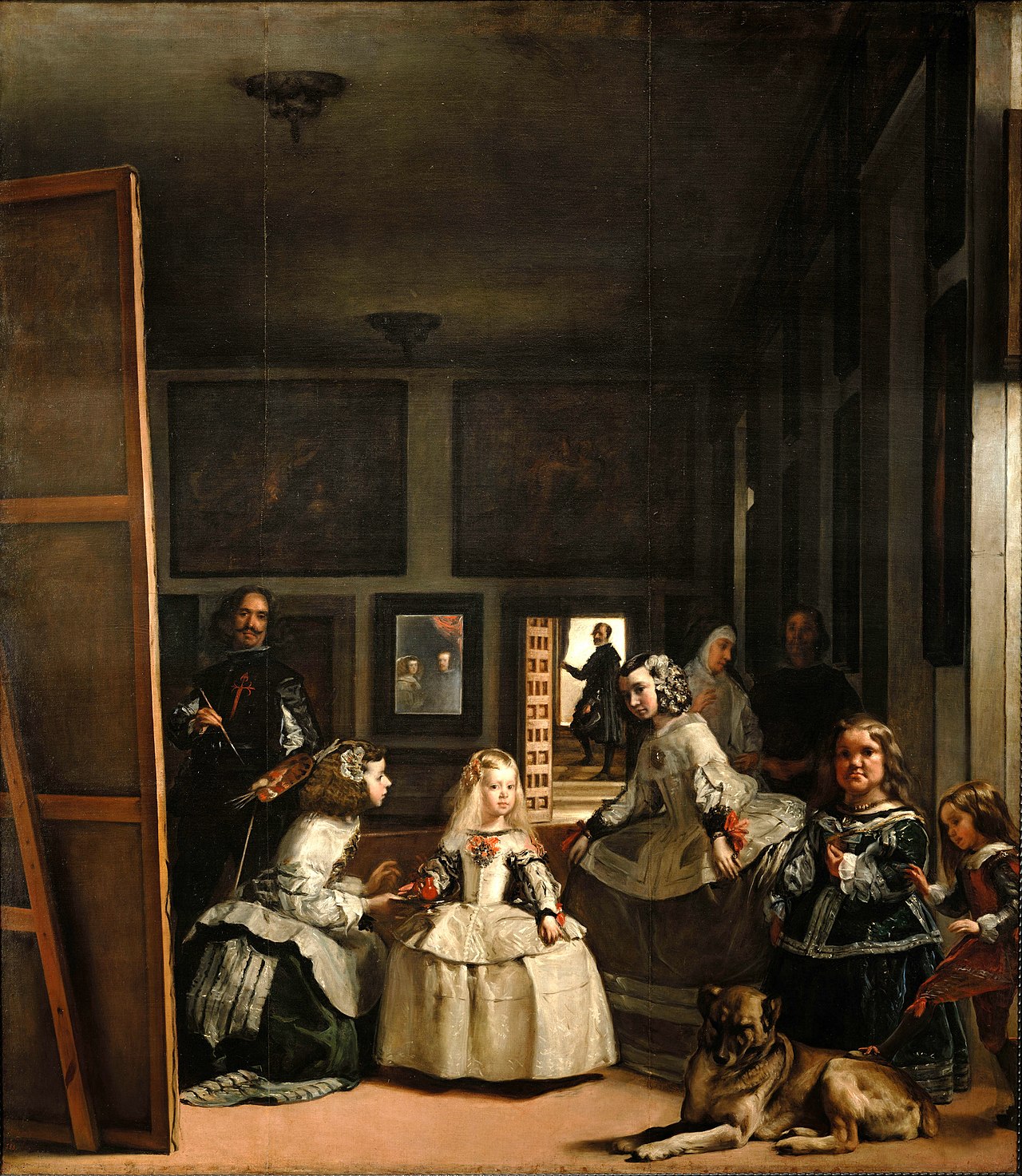
Las Meninas is so famous that it often arrives already wrapped in theory. The mirror becomes a puzzle, the painter's self-portrait becomes a manifesto, and the viewer is invited to enjoy the picture as a brilliant trap about representation.[1][4] All of that is real, but it can leave the room strangely empty. Velázquez's great move was not simply to make us wonder where we stand. It was to make monarchy felt through the people who must constantly stand around it.
The Prado's collection page stresses the painting's density of meanings and its unusual ability to combine a convincing lived space with a complex web of representation.[1] The museum's accessible guide adds the basic social map: the scene takes place in the Room of the Prince in the Alcázar of Madrid; the Infanta Margarita has entered; María Agustina Sarmiento offers her water; Isabel de Velasco stands ready; Mari Bárbola and Nicolasito Pertusato occupy the right side; Marcela de Ulloa and a guardadamas hover behind; José Nieto appears in the doorway; and Velázquez paints at the left while the monarchs are reflected in the mirror.[2] Taken together, those facts point toward a simpler and stronger argument than the usual mirror riddle. The picture makes service into the visible structure of power.
That is why the absent king and queen feel heavier than many directly painted rulers. Philip IV and Mariana of Austria occupy only a reflection, yet every gesture in the room bends toward them.[1][2] The painting does not place sovereignty in the center as a solid body. It lets sovereignty radiate outward through posture, waiting, interruption, and readiness. Las Meninas is less a family portrait than a theater of access.
Image context: the cover uses the painting itself because this argument depends on the distribution of bodies across the canvas. A cropped detail would lose the social geometry that makes the picture work.[1]
1) The room is organized by attendance
The clearest fact about Las Meninas is also the easiest to underread: almost everybody in it is attending to someone else.[1][2] The Infanta stands at the center, but even she is not self-contained. One maid kneels with the búcaro, another waits upright for the next motion, the dwarfs and dog thicken the courtly scene, the chaperoning figures keep decorum in the background, and the chamberlain marks the far threshold.[2] This is not incidental staffing. Velázquez paints hierarchy as a chain of specialized presences.
Seen that way, the canvas feels less like a snapshot than a system under tension. No one appears relaxed into private life. Even the stillness has tasks inside it. The attendants do not merely decorate royalty; they convert royalty into a field of observable relations. If the king and queen had been shown as large frontal bodies, the painting would read more conventionally as dynastic portraiture. By leaving them out of the main field and allowing the labor around them to carry the scene, Velázquez makes court order itself the subject.
Khan Academy's discussion describes the foreground as a frieze of figures whose attention seems to turn toward us, while the reflected monarchs are imagined just beyond the picture plane.[4] That observation matters because it clarifies the painting's pressure point. We do not only look at service. We inherit the position that summons it. The servants' glances, pauses, and half-movements make the viewer occupy a station of command without ever letting that station become comfortable.
2) Velázquez turns the painter into an intellectual court worker
The left side of the painting sharpens the argument. Velázquez does not place himself outside the machinery of service. He places himself inside it, but at a newly elevated level.[1][2] The Prado's accessible guide makes the point unusually well when it notes that he is shown looking and thinking rather than simply applying brushstrokes, and that the work expresses his idea of art as intelligence, not manual skill alone.[2] In other words, the picture does not reject service; it renegotiates the status of one kind of service.
That matters in a court culture where painters still had to argue for the dignity of their profession. The Prado's collection page says Las Meninas stretches portraiture toward history painting, the most prestigious genre of the period.[1] Velázquez's self-placement does the same thing socially. He remains a court functionary with a job to do, yet he makes that job look inseparable from thought, composition, and the management of appearances. The huge canvas at left blocks our view of what he is painting, but the concealment is strategic. He withholds the product in order to make the act of pictorial intelligence visible.
This is one reason the painting has generated so much later writing. Jonathan Brown remarked in a Yale interview that scholarship on Las Meninas spent decades under the shadow of Foucault and that newer work has tried to recover the painting's first audience and the actual material object before us.[5] That shift is useful here. The self-portrait is not only a philosophical wink at modern viewers. It is also a courtly claim made in 1656: the artist belongs among the people who organize access to the sovereign because he helps produce sovereignty's image.
3) Mirror and doorway make royal power feel distant and immediate at once
The small mirror at the back and the open doorway behind José Nieto are often treated as separate mysteries, but together they do something more specific.[1][2][4] They turn the room into a corridor of controlled approach. The mirror gives us the monarchs only as a shimmering confirmation. The doorway gives us a figure who governs passage. Between those two points, the painted room becomes a social instrument for regulating who may enter, who may pause, who may serve, and who may look.
That is why Las Meninas never settles into a single stable answer to the question of viewpoint. The Prado's collection text notes that the mirror helps the viewer reflect on the laws of representation and on his or her own role within the painting.[1] True, but the viewer's role is not abstract. It is procedural. We stand where rank has effects. We seem to occupy the place of the king and queen, yet we also feel how much mediation surrounds that place. The room acknowledges us through layers of etiquette before it ever grants us certainty.
This also explains the painting's peculiar emotional temperature. The scene is luminous and calm, but it is not intimate. Nearness does not dissolve hierarchy; it sharpens it. The Infanta's visibility depends on attendants, and the monarchs' invisibility depends on everyone else's orientation toward them. Royal absence is therefore not a lack in the picture. It is the principle that organizes the picture.
4) The restored surface reminds us that visibility is material
The 1984 restoration history adds one more dimension to this argument.[3] The Prado's account explains that conservators removed a thick yellowed varnish that had flattened the painting into an amber tone and obscured Velázquez's range of nuance.[3] That is not just a conservation anecdote. It tells us something essential about how Las Meninas works. The painting depends on delicate tonal intervals, on the difference between lit fabric and receding air, on the measured spacing between bodies, and on the soft but exact transitions that keep the room alive without making it rigid.
Once that surface is understood materially, the painting's social intelligence becomes easier to see. Velázquez does not stage court life through hard outlines and emblematic symbols alone. He stages it through atmosphere. Rank travels in light, in distance, in the difference between the bright Infanta and the darker staff behind her, in the recession toward the doorway, and in the quiet authority of the painter's black silhouette beside the great canvas.[1][3] Service becomes visible not as anecdote but as a modulation of pictorial attention.
That is why the painting continues to feel inexhaustible without needing to become mystical. Its brilliance lies in how many things it lets happen at once: portrait, self-portrait, spatial illusion, court record, meditation on painting, and social diagram.[1][4][5] Yet the deepest coherence comes from one governing fact. Velázquez made a picture in which monarchy is strongest where it is least physically present, because the real subject is the labor that receives it, frames it, and waits upon it.
Sources
- Museo Nacional del Prado, "Las Meninas" collection entry, on the 1656 date, the Cuarto del Príncipe setting, identified figures, mirror, and the painting's complex representational aims.
- Museo Nacional del Prado, "Las Meninas. Diego Velázquez" accessible guide, on the room, attendants, mirror, and the painting's argument about art as thought as well as skill.
- Museo Nacional del Prado, "El brillo de Las meninas. 40 años de su restauración" on the 1984 cleaning, yellowed varnish removal, and tonal recovery.
- Khan Academy, "Diego Velázquez, Las Meninas (video)" on the foreground frieze of figures, the reflected monarchs, and the painting as a work about painting and viewpoint.
- Yale University Press, "A Scholar's Life: An Interview with Jonathan Brown by David Ebony," including Brown's comments on Foucault, first-audience questions, and the need to return attention to the painting itself.